
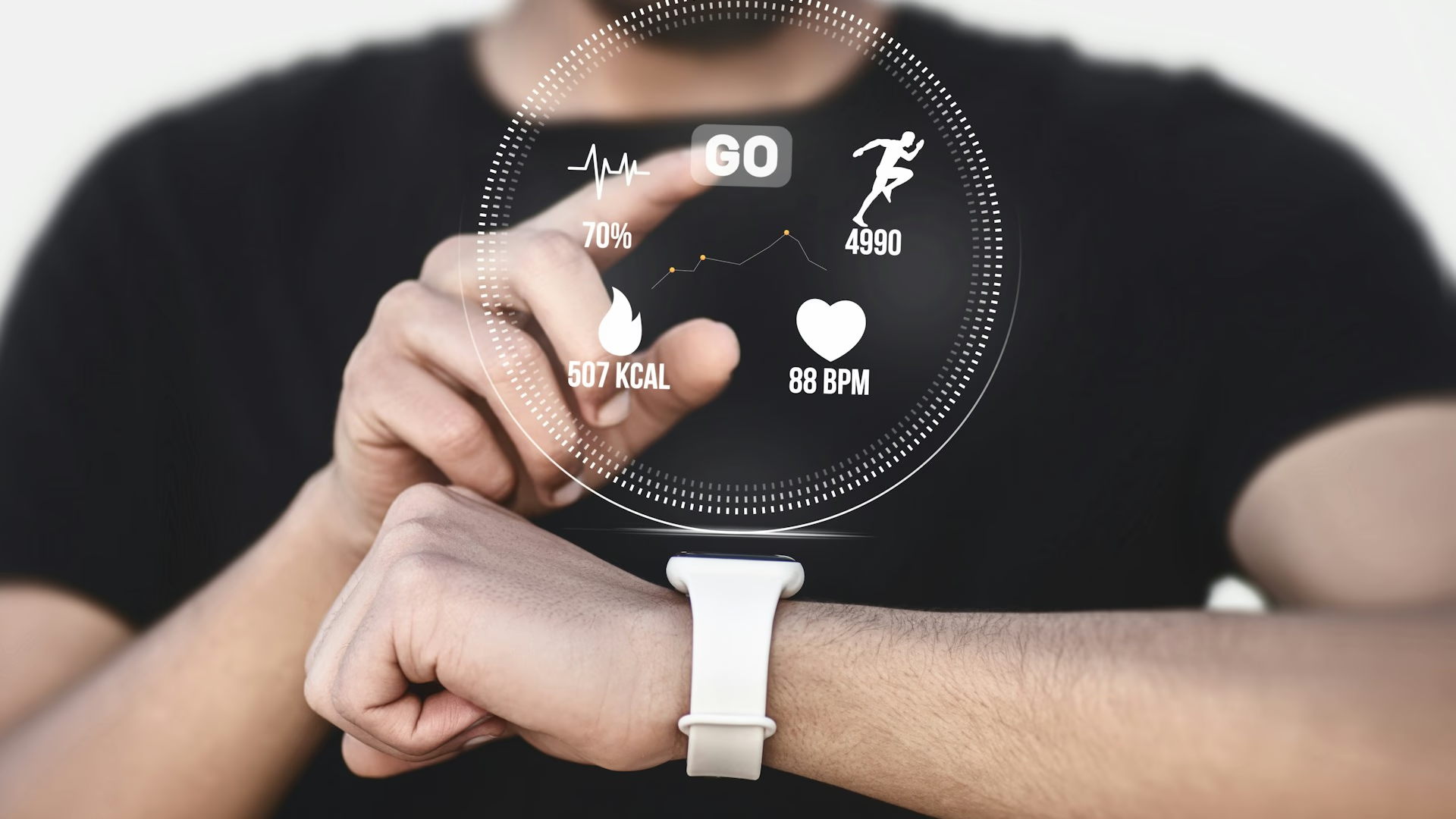
Your watch buzzes before you’re fully awake: recovery score 62 percent, sleep debt detected. A minute ago you felt fine. Now you’re second guessing the coffee, the workout, the whole day, because a small screen handed you a number that looks precise. That number feels like a verdict. It’s closer to an educated guess.
A Morning With Your Tracker
That readiness score isn’t read off your body like a temperature.
 Photo by
 It’s assembled overnight from a handful of signals, then run through a formula the company keeps private. Nobody in a lab checked your result. The software just compared last night to your recent nights and produced a percentage.
The trouble is how easily that percentage swings. One restless night, a warm room, a late meal, and the score can drop hard while your actual health hasn’t changed at all. A single rough evening shouldn’t read like a diagnosis.
For most people, the morning score works best as a mood ring built on patterns. It’s useful for a nudge, not for deciding whether something is wrong with you.
What Sensors Actually Measure
Open the case and the ambition shrinks, in a good way.
 Photo by
 The green light on the underside of a wrist device is an optical heart rate sensor, a light that shines into your skin and reads how blood flow changes the reflection. It never touches your heartbeat directly. It infers rate from flickers of light, which is why skin tone, motion, cold hands, and tattoos can throw it off.
Sleep tracking asks even more of that thin data. A clinical sleep study wires your scalp to read brain waves directly. Your watch has no window into your brain. It estimates sleep stages from movement and heart rate, then labels the guess deep, light, or REM (rapid eye movement, the sleep stage linked to dreaming).
Doctors tend to trust the simple readings and stay wary of the fancy ones. “Most consumer devices measure resting heart rate with sufficient precision for general wellness but struggle with more complex metrics like sleep stages and stress estimation,” according to a review of wearable accuracy from a doctor’s perspective [Ubiehealth].
The sensor captures a narrow physical signal. Everything poetic on the screen after that is software filling in the blanks.
Where the Data Holds Up
None of this makes the device a toy.
 Photo by
 Wearables are genuinely dependable at the boring, repeated stuff, and boring is exactly where health lives.
Step counting is among the most reliable metrics, and resting heart rate is measured tightly enough for everyday use. Independent reviews put the typical error ranges like this [Ubiehealth]:
-
Resting heart rate: about 2 to 5 beats per minute off
-
Step count: within 3 to 10 percent
-
Sleep duration: within 10 to 20 minutes
-
Blood oxygen: about 2 to 4 percent off
Cuffless blood pressure is the outlier still not ready for the clinic. A cardiology review calls it technically promising but not recommended for routine clinical use [European].
The real strength shows up across weeks, not days. A resting heart rate that drifts up over a month can hint at rising stress or fading fitness in a way no single Tuesday reading ever could. Read the line, not the dot: the slope over weeks tells the story, one morning doesn’t.
Using Wearables Wisely
The smartest approach is to treat the device as something that starts a conversation with your body, not one that ends it.
 Photo by
 The makers seem to agree. Under 2026 FDA guidance, many of these noninvasive estimates are treated as general wellness features rather than medical tools, not devices cleared for diagnosis [Duke Pratt].
Even a validation summary that trusts the trend data is blunt about the limit. “Wearable devices can be trusted to track heart rate trends and flag potential irregularities under the right conditions, but they are not diagnostic tools,” one review notes [Sensio-ai].
So when an alert startles you, it can help to treat it as a prompt to check in rather than proof of a problem. And when something feels consistently off, the useful thing to bring to a doctor’s office isn’t one scary screenshot. It’s the month of pattern behind it.
The trend line is the best gift you can hand a clinician. The panic button on the app is the least reliable part of the whole system.
Next time the watch buzzes at dawn with its 62 percent verdict, it’s worth checking the weekly view instead of just the daily one. That single morning number is a statistical guess dressed up as a result. The line climbing or falling across the past month is the part worth trusting, and the part worth mentioning to someone who can actually examine you.
Sources
- Sensio-ai on trusting wearables for heart-rate trends versus diagnosis
- Ubiehealth on doctor perspectives and approximate accuracy ranges for common wearable metrics
- European Society of Cardiology review on cuffless blood pressure not ready for clinical use
- Duke Pratt School of Engineering on 2026 FDA guidance treating noninvasive wearable estimates as general wellness products


