Chain Reaction
Distant Dots Ignite Breakthroughs
Whether your best ideas come from inside your field or outside it is a habit you can track and strengthen, not a fixed talent you are stuck with.
Think about the last time a solution came from somewhere completely unexpected, a cooking technique that fixed your code, a sports metaphor that unlocked a business problem. That wasn't an accident, and three converging studies show why the same pattern shows up in creativity, careers, and innovation output.
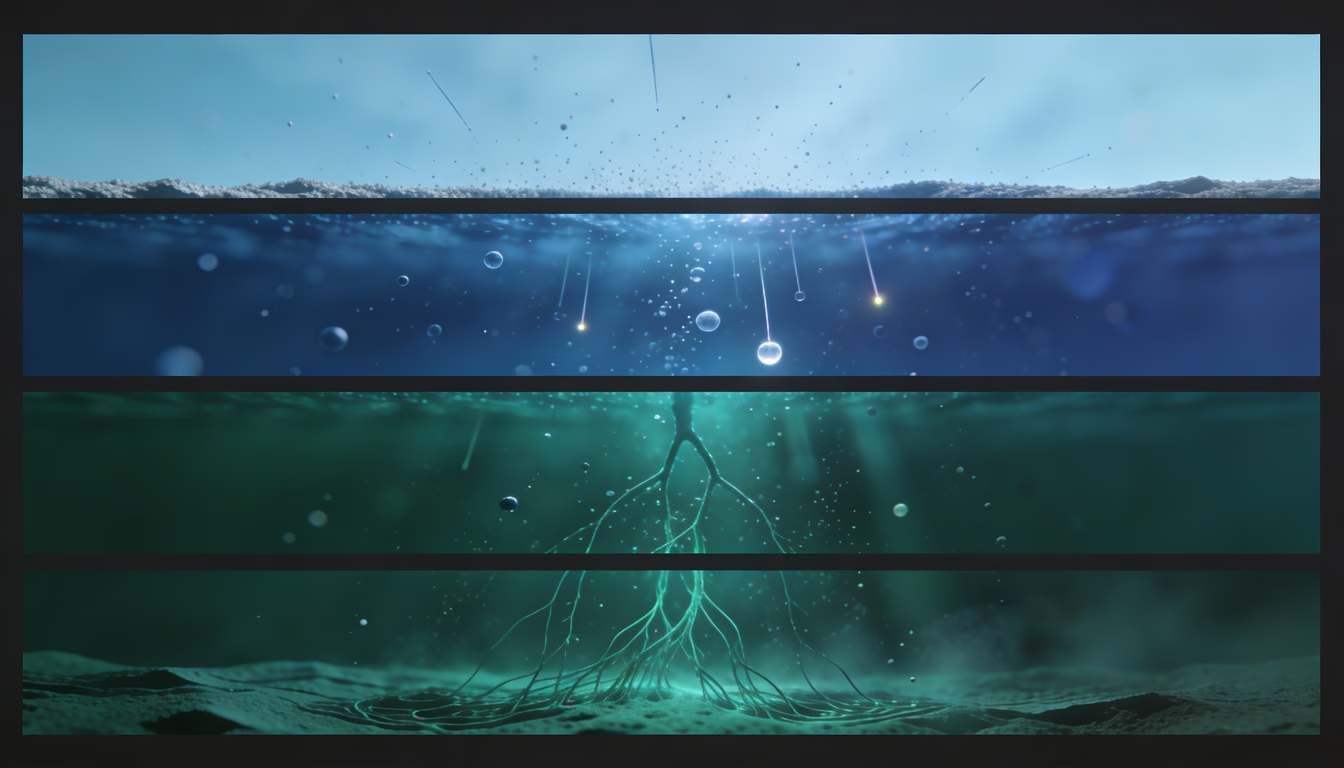
Trigger
Two semantically distant concepts collide in a single mind
Conceptual distance and creativity ratings move together at about 0.81 out of 1.0, far above the roughly 0.3 typical in psychology.
Step 1
Scientists asked 175 people to come up with creative ideas and measured how 'far apart' the concepts were. The farther the leap, the higher the creativity score, and the link was strikingly strong.
your brain's best moves aren't refinements of what you already know, they're jumps to territory you barely recognize.
Across 175 adults, the modeled link between idea distance and creativity reaches about 0.81 out of 1.0, among the strongest in creativity research.
Step 2
The same far-apart principle that drives creative thinking turns up in networks. LinkedIn tested which connections actually helped people get new jobs, and the surprising winners were distant acquaintances, not close friends.
Scale of the LinkedIn job-mobility experiment: 20 million people and 2 billion connections, enough to isolate small effects.
Step 3
That habit of reaching far has a name, and it does measurable work. One practice alone, connecting ideas from different fields, accounts for a fifth of the gap between high and low innovators. Stack it with resilience and confidence and you can predict more than half of who actually behaves innovatively, in a real organisation, with real stakes.
associating across domains isn't a fixed trait, it's a documented, trainable behaviour, and once you add the resilience to carry ideas through rejection, the pair predicts more than half of who innovates.
Cross-field associating provides the ignition; psychological capital provides the fuel. Together they predict more than half of who actually innovates at work.
Outcome
Combining cross-field association with mental resilience explains more than half of who actually behaves innovatively, which makes that pairing one of the strongest measurable predictors of breakthrough output we have
Cross-field association plus resilience together account for more than half of who behaves innovatively, among the strongest predictors we have.
Takeaway
Next time you solve a problem, notice which field the solution actually came from. If it is always your own, that is your ceiling, and the move is to go borrow from somewhere further out.