Chain Reaction
The Scarcity Spiral
How depleted soil triggers a feedback loop that starves both fields and minds
You probably didn't choose your lunch today with full cognitive bandwidth. Neither did the farmer who grew it, the economist who priced it, or the policymaker who funded it. Scarcity doesn't just empty shelves, it quietly hollows out the thinking needed to refill them.
Industrial farming strips soil of nitrogen, phosphorus, and sulfur faster than natural cycles can restore them
100–1,000× destruction rate vs. replenishment
Think of soil nutrients like a bank account. Industrial farming withdraws far more than it deposits, and once the account is overdrawn, plants can't grow as well, no matter how much fertilizer you add on top.
What this means: every harvest without replenishment is a loan taken from a future farmer who doesn't know the debt exists yet.
Across most of the world's farmland, the soil is running a nutrient deficit every single year. That's like a factory losing raw materials faster than it can restock, output starts falling, and the machinery slowly grinds down.
Just as depleted soil makes crops more vulnerable to a single dry season, stressed financial systems make economies more vulnerable to a single shock. The damage compounds through the same loop: less resource → less buffer → bigger collapse from the next hit.
What this means: the mechanism that bankrupts farms and the mechanism that crashes credit markets are structurally identical, both convert mild shortfalls into self-sustaining collapses.
When people feel they don't have enough, money, food, options, their brains shift into survival mode and lose the ability to think far ahead. That's not weakness; it's biology. But it means the people most responsible for fixing depletion are the least cognitively equipped to plan solutions.
Without urgent systemic intervention, degraded cognition, depleted capital, and exhausted land reinforce each other in a self-sustaining collapse, projected to render most of the world's agricultural soils critically degraded
Takeaway
Pick one consumable resource in your daily life, a food, a material, a service, and spend ten minutes tracing backward: what soil, credit, or cognitive labor does it depend on, and what happens to your life if that input drops 30%? Most people have never stress-tested a single dependency. Do it once, and you'll never look at scarcity the same way.
More Insights
All Insights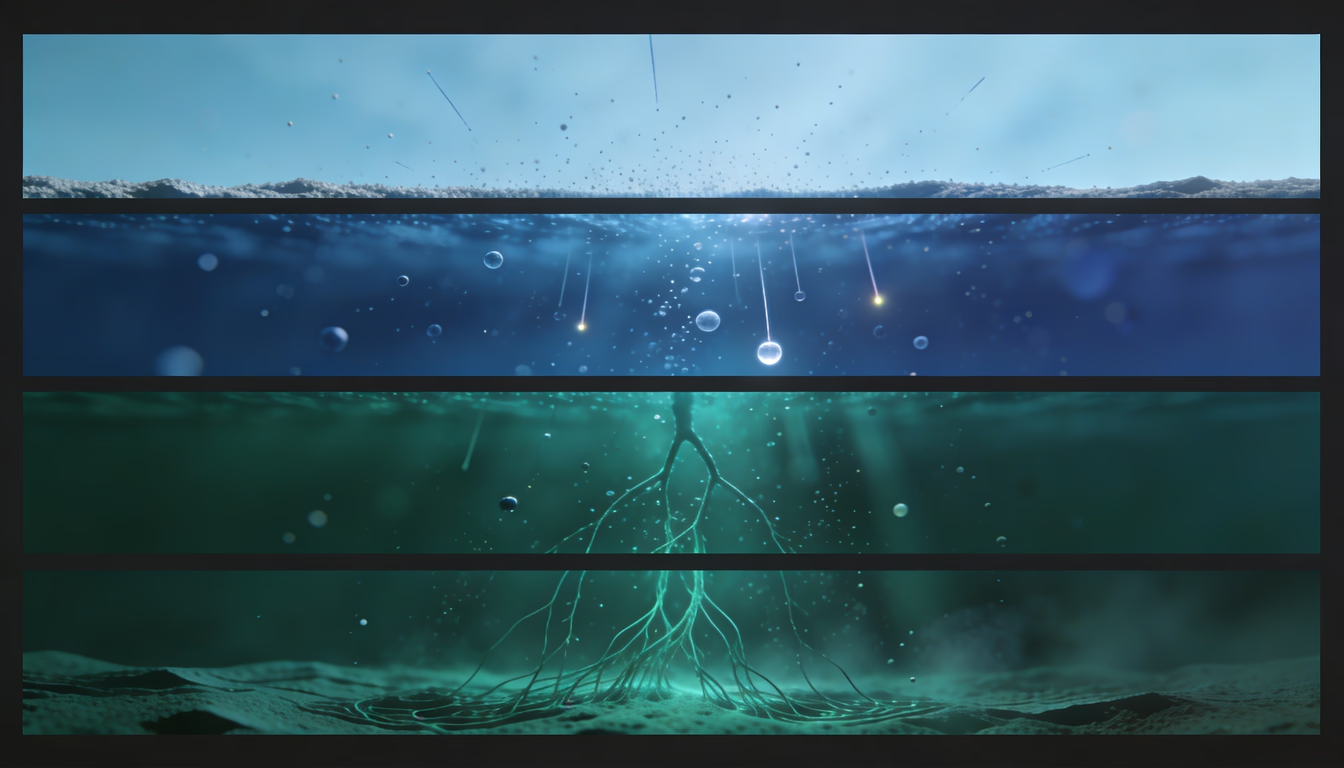
Distant Dots Ignite Breakthroughs
How connecting two unrelated ideas cascades into 52% of all innovative behaviour

Obituary Sparks
How one stranger's life story cascades into your next breakthrough idea

The Grammar of Collapse
How optimizing away redundancy cascades into catastrophic single-point failure
Enjoyed this?
Get insights like this every week — interactive visual stories that reveal hidden patterns.