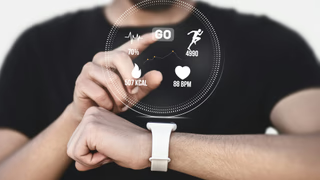
Your watch says you burned 600 calories, slept great, and hit your target heart rate. But your body feels exhausted, sluggish, and overtrained. What’s going on?
If you’ve ever stared at your wrist in confusion, wondering why your fitness tracker insists you’re thriving while you feel like you’re falling apart, you’re not alone. Millions of us rely on these sleek devices as personal health oracles, trusting their colorful graphs and encouraging notifications to guide our wellness decisions.
But here’s the thing: while fitness trackers provide valuable insights, they also have significant accuracy limitations and miss critical health context that can mislead your wellness journey. Understanding these gaps isn’t about ditching your device. It’s about using it more wisely.
The Accuracy Gap: When Numbers Lie
That heart rate reading flashing on your wrist during your morning run?

It might be telling you a different story than what’s actually happening inside your chest.
Consumer fitness watches rely on optical sensors that shine light through your skin to detect blood flow changes. While this technology has improved dramatically, it still struggles in certain conditions. Heart rate monitors can be off by 5-20% during high-intensity exercise or activities involving significant arm movement. Studies show these optical sensors face particular challenges with darker skin tones and during rapid heart rate changes, moments when accurate data matters most.
Calorie calculations compound these errors further. Your watch uses generic formulas based on factors like age, weight, and estimated heart rate to guess how many calories you’ve burned. But these calculations can’t account for your unique metabolism, current fitness level, or body composition. Two people doing identical workouts can have 30-40% different actual calorie burns, yet their watches might display nearly identical numbers.
Sleep tracking faces similar challenges. Consumer devices achieve accuracy rates around 78-80% when detecting whether you’re asleep or awake [Allseniors]. While that sounds reasonable, sleep stage detection, distinguishing between light sleep, deep sleep, and REM, relies primarily on movement and heart rate patterns. These metrics miss the brain activity that truly defines sleep quality. As sleep researchers note, “Sleep trackers can provide meaningful data, but they aren’t perfectly accurate. Technology in sleep trackers has come a long way, but even sleep experts can’t say exactly how well they measure sleep” [NIH].
The bottom line? Your watch provides estimates, not medical-grade measurements. Expect 10-30% variance from reality on any given metric.
What Gets Lost in Translation
Beyond accuracy concerns lies an even bigger blind spot: context.
 Photo by
 Your wearable captures quantitative metrics like steps taken, minutes exercised, and hours slept. But it can’t measure the qualitative factors that often determine your actual health status and recovery needs. Stress levels, mental fatigue, and emotional state dramatically affect your performance and wellbeing, yet they don’t show up in your step count.
Some devices attempt to bridge this gap using heart rate variability sensors, which can detect physiological stress responses. However, these sensors can’t distinguish between work stress, relationship anxiety, physical overtraining, or simply drinking too much coffee. Device performance is also highly susceptible to motion, sensor positioning, body posture, and other environmental factors [ACU Research].
True recovery involves more than just logging hours in bed. It requires assessing muscle soreness, energy levels, motivation, and injury risk, factors no sensor can quantify. Interestingly, research has found that athletes using subjective wellness questionnaires alongside device data often make better training decisions than those relying solely on their wearables. Your body sends signals that technology simply can’t capture: that nagging tightness in your hip, the mental fog that won’t lift, the subtle warning signs that you’re pushing too hard.
Numbers can’t replace listening to your body’s signals about readiness, pain, and energy. They can only supplement that internal wisdom.
Using Your Watch Wisely
None of this means you should toss your fitness tracker in a drawer.
 Photo by
 These devices work best when you understand their proper role: trend indicators and motivation tools, not definitive health diagnostics or rigid training guides.
First, consider focusing on week-to-week patterns rather than daily fluctuations. That random Tuesday when your watch claimed you only got four hours of deep sleep? Probably not worth worrying about. But if your sleep quality scores have been declining steadily over two weeks, that’s meaningful information worth investigating. Trending data over 7-14 days smooths out sensor errors and daily variability, revealing patterns that actually matter.
Second, it helps to cross-reference watch metrics with how you actually feel. When your device says you’re fully recovered but your legs feel like concrete, trust your legs. When your sleep score looks terrible but you wake up energized, trust your energy. Research suggests that combining objective device data with subjective self-assessment improves training outcomes by 15-25% compared to relying on either alone.
Finally, recognize when to seek professional guidance. For medical concerns like potential arrhythmias, sleep apnea, or other health conditions, consulting healthcare providers who have access to clinical-grade diagnostic equipment can be valuable. Some advanced medical devices can achieve over 90% accuracy in detecting certain cardiac conditions [UAB], and sleep studies using polysomnography can reach 92% accuracy [Professional], standards that consumer watches simply aren’t designed to meet.
Treat your watch as one data source among many, not the single source of truth about your health.
Finding Balance with Technology
The relationship between you and your fitness tracker doesn’t have to be all-or-nothing.
 Photo by
 Many people find a middle ground that works beautifully: using their devices for motivation and general awareness while staying attuned to their body’s own signals.
Consider keeping a simple journal alongside your watch data. Note how you feel each morning: energy level, mood, any aches or pains. Over time, you’ll start to see where your subjective experience aligns with your device metrics and where they diverge. These patterns become your personal user manual, helping you interpret what your watch is really telling you.
Some days, your watch will be spot-on. Other days, it will miss the mark entirely. Both scenarios are normal, and neither means the technology is useless. It simply means you’re using a tool with inherent limitations, just like any other tool in your wellness toolkit.
Fitness watches offer valuable insights into your health patterns, but they come with accuracy gaps and miss crucial context that only you can provide. The numbers on your wrist are estimates, not absolutes, useful for spotting trends but not for making medical decisions.
This week, try an experiment: compare your watch data with how you actually feel. Notice where they align and where they diverge. The best health data comes from combining technology with self-awareness, not replacing one with the other. Your body has been tracking your health since long before smartwatches existed, and it still has wisdom worth listening to.
🌿 Supplement Information: This content shares general guidance for a healthy lifestyle. Reactions to supplements can vary depending on your body and medications, so please consult a healthcare professional before use. This is for informational purposes only. Choose what feels right for you.
Sources
- Allseniors - Actigraphy algorithm accuracy study showing 78-80% accuracy rates
- Professional Heart Association - Polysomnography comparison showing 92% accuracy
- NIH - Sleep tracker accuracy limitations research
- ACU Research Bank - Device performance susceptibility to motion and positioning
- UAB Human Rights - AI healthcare accuracy in cardiac detection