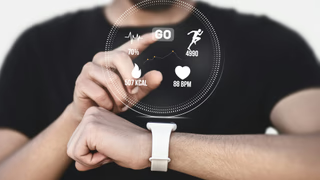
Saturday morning. Coffee still warm. A small number on your wrist has already been working for eight hours. It’s not a finish time or a pace. It’s a readiness score, and most mornings, it turns out to be right.
Saturday Morning Before the Run
Before you take a single step, the watch has already logged three overnight signals.
 Photo by
 The first is your resting heart rate, the slow pulse your body settles into when nothing is asked of it. When that number sits five to seven beats above your normal baseline, yesterday’s effort hasn’t cleared yet.
The second is heart rate variability (HRV), the tiny gaps between heartbeats that widen when your nervous system is relaxed. Think of HRV as a stress meter built into your pulse: higher variation means more recovery, lower means less. After two hard days in a row, variability drops, often before any soreness shows up in your legs.
Athletes who average under seven hours of sleep run slower time trials even when the effort feels completely normal to them. For a weekend runner, three quiet overnight numbers sketch a readiness picture before you open the front door.
What the Numbers Actually Mean
A low readiness score isn’t a command to stop.
 Photo by
 It’s a note that today’s ceiling sits lower than you planned. Runners who ease off on low-HRV days tend to hold the same weekly fitness while dealing with fewer injuries.
The device also separates two kinds of tiredness that feel identical from the inside. Cardiovascular fatigue and muscular fatigue can wear the same disguise. Heart rate that creeps upward during a steady run often signals a tired cardiovascular system, even when your legs feel fresh.
The gap between how hard a run feels and what the data says is where the useful information lives. The watch adds precision to a conversation your body is already trying to have with you.
Data Patterns Worth Trusting
One morning reading rarely tells the full story.
 Photo by
 A trend across ten to fourteen days does. The machine learning behind modern sports wearables works by reading long stretches of data, not isolated mornings [Nature].
Watch for these slower patterns:
-
A resting heart rate that climbs week over week, hinting at fatigue one rest day won’t fix
- A HRV trend that sags across two weeks is the clearest early warning of overreaching, pushing your body harder than it can recover from.
-
Sleep scores that stay low through a training block while performance flattens regardless of mileage
Research reviews document how wearables monitor workload and recovery in both elite and recreational athletes [Market Data]. For a weekend athlete, trust the two-week story over any single Saturday.
Adjusting the Plan Mid-Weekend
Real-time numbers let you bend a plan without breaking it.
 Photo by
 When effort climbs while pace holds steady, the body is working harder than the schedule assumed. Easing off ten to fifteen seconds per mile keeps the run aerobic and leaves you fresher the next day.
Cadence offers a second checkpoint. When steps per minute fall in the last third of a run, form is starting to unravel. Wearable sensors that track movement patterns and load in real time can flag this drift as it happens.
After you stop, how fast your heart rate drops in the first minute reveals how hard the day truly was. Mid-run data turns a rigid plan into a flexible one that protects the weekend instead of ruining it.
The Athlete Sees Differently Now
Use these signals for a few months and something quiet shifts. You stop chasing effort for its own sake and start treating recovery as part of the work. The same tools that help clinicians decide when an injured athlete is ready to return to sport are, in a smaller way, teaching you to read yourself [Frontiers].
The biggest change is comparison: you stop measuring yourself against generic charts and start measuring against your own best weeks. A resting heart rate of 58 means one thing for a 42-year-old cyclist and another for a 28-year-old runner. The device learns the person, not the category.
For a weekend athlete, that means fewer surprise injuries and a season that behaves more predictably than it used to. Next Saturday, the number on your wrist will look the same as always. What changes is how you read it.
Sources
- Nature collection on AI in sport science, on optimizing training load and refining injury risk prediction
- Market Data Forecast, Europe fitness trackers market, on wearables in elite and recreational athletic ecosystems
- Market Data Forecast, Europe sports medicine market, on sensors tracking movement and load in real time
- Frontiers in Sports and Active Living, on wearable sensor models predicting return-to-sport and re-injury risk