Riiven Threads
Barometric Pressure Sensor
Atmosphere, Carved in Silicon
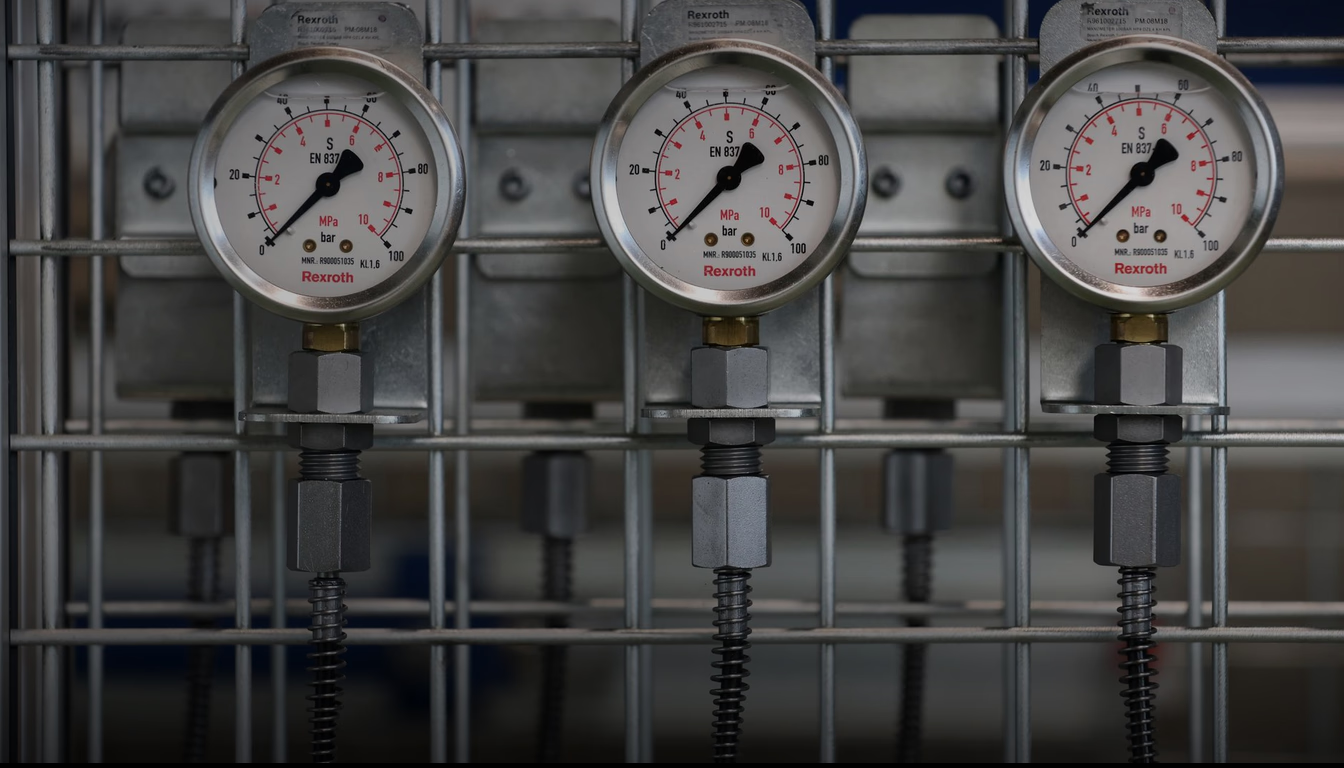
Step out of an elevator and your phone already knows you climbed three floors. It did not ask. Your phone knew you took the elevator, not the stairs, without you telling it anything, because a sensor smaller than a grain of rice counted the air. Air thins as you rise, and a single floor shifts pressure by roughly 12 pascals out of about 101,000. Reading a change that small means carving a silicon membrane thin enough to flex under the weight of the sky, then trusting the number it gives. The question is how four separate trades, none of which set out to track footsteps, ended up doing it together.
- 50x
- Doped silicon reads strain about 50 times more strongly than a metal gauge.
- 5x
- Naive membrane scaling raises central deflection fivefold, breaking the linear range.
- 0.019% F.S.
- Accuracy a self-compensating barometer holds from minus 20 to plus 60 degrees C.
How each idea was handed down
Barometric Pressure Sensor inherited its parts in sequence. Each field handed its result to the next.
The inheritance, in order
- 1954 Piezoresistive Effect in Semiconductorshanded down ↓
- 1995 Deep Reactive Ion Etching Microfabricationhanded down ↓
- 1999 Thin Diaphragm Mechanics and Plate Theoryhanded down ↓
- Thermodynamics of Gas Laws and Temperature Compensation
Follow the inheritance, link by link.
Each link hands its result to the one after it. The chart above places them by date.
Keystone
The silicon trick that made stress speak
Squeeze a doped silicon bar and its resistance jumps far more than the squeeze alone explains. C. S. Smith measured that in 1954.
A bathroom scale turns your weight into a number by stretching a metal strip until it resists current a little more. Silicon does the same job, but wildly better. The piezoresistive effect, the way a material's electrical resistance changes when you bend it, runs about 50 times stronger in doped silicon than in metal. Without semiconductor piezoresistance, a barometric sensor would be about 50 times less sensitive, dropping its output from roughly 10 mV/V to around 0.2 mV/V for the same strain. That gap decides everything downstream. A weak signal needs a huge membrane and hungry electronics to be readable; a strong one fits inside a phone running on a coin cell. Four resistors wired into a Wheatstone bridge, a simple balance that flags tiny imbalances, turn membrane stress into a clean voltage.
Without this link
Without the piezoresistive effect in doped silicon, MEMS barometric sensors could not translate diaphragm stress into a sizeable resistance change, leaving outputs near metal-gauge levels and forcing much larger diaphragms and higher excitation power to reach usable resolution.
Without semiconductor piezoresistance, barometric sensors are about 50 times less sensitive than doped silicon designs, dropping output from 10 to 0.2 mV/V.
How we know
Smith's 1954 measurements, formalized for microsystems in Barlian's 2009 review, showed silicon's gauge factor reaching the low hundreds versus roughly 2 for metal foil, the headroom that makes compact piezoresistive bridges practical.
Source: Review: Semiconductor Piezoresistance for Microsystems (2009) · tier1
A strong signal still needs something to flex. Next came a way to carve the silicon membrane thin enough to bend.
Etching walls straight down into silicon
Wet acid eats silicon sideways as fast as it eats down, rounding every wall. In 1995 the Bosch process etched straight trenches instead.
Older chemical etching dissolves silicon in all directions at once, so it cannot cut a narrow deep slot without widening the top. Deep reactive ion etching, a method that alternates a cutting gas with a protective coating, carves nearly vertical walls one thin layer at a time. Without DRIE holding the sidewalls straight, sensor cavities cannot shrink, forcing larger membrane openings and sharply weaker response to small pressure changes. That control is what lets a diaphragm be both small and thin at once.
Without this link
Without deep reactive ion etching, silicon diaphragms could not be thinned and structured with high aspect ratio cavities, leaving membranes too thick and stiff. Wet etching alone yields limited aspect ratios, larger openings, and poorer vertical-wall control, reducing full-scale output and accuracy.
How we know
Source: Advances in high-performance MEMS pressure sensors: design, fabrication, and packaging (2023) · tier1
A thin membrane you can carve is only useful if you know how thin to make it before it bursts.
Knowing how far a membrane can bend
A drum skin pulled too tight tears; pushed too gently it barely moves. A sensor membrane lives in the same narrow band.
Push on a thin plate and it bows in the middle. Push too hard and pressure and stress stop tracking in a straight line, which wrecks accuracy. Thin plate theory, the math Kirchhoff and Love worked out for how flat sheets bend, predicts deflection and peak stress from radius and thickness. Size the membrane by naive scaling instead, and central deflection jumps 5 times for the same pressure, pushing it past the linear range toward burst failure. The theory tells engineers exactly how thin is too thin.
Without this link
Without thin diaphragm mechanics, engineers could not hold membrane deflection inside the small-deflection regime needed for linear stress-pressure behavior, causing unpredictable sensitivity and nonlinearity, nor could they predict deflection and peak stress from geometry to avoid burst or touch-mode failure.
Without Kirchhoff-Love plate theory sizing the membrane, naive scaling raises central deflection 5 times, pushing the sensor out of its linear range.
How we know
The 1999 TechConnect analytical solution tied central deflection directly to geometry, and naive scaling pushes the membrane's sensitivity to about a nanometre of deflection per pascal, outside the small-deflection regime where stress stays proportional to pressure.
Source: TechConnect Briefs 1999 diaphragm deflection (1999) · tier2
A perfectly sized membrane still lies if heat alone makes it swell. The last fix separated temperature from true pressure.
Telling real pressure from a warm day
Leave a sealed sensor in a hot car and the trapped air expands, faking a pressure drop. Heat and altitude look identical.
Air pressure and air temperature are bound together by the same gas law, so a warming sensor reports altitude change that never happened. Self-temperature compensation models that thermal expansion and subtracts it before the number leaves the chip. Uncompensated, the quartz resonator in a 2024 design slid 1.65 hertz for every degree Celsius, and the barometer reads that slide as altitude. Han's team folded the correction into the sensor itself and held accuracy to 0.019 percent of full scale from minus 20 to plus 60 degrees C, which is what the elevator trick needs.
Without this link
Without thermodynamic gas law modeling and temperature compensation, sensors interpret thermal expansion of the element and surrounding air as real pressure change. Across the ambient range this drives full-scale errors from below 0.1% up to several percent, corrupting altitude, weather, and gas readings by tens of pascals.
Without gas-law temperature compensation, the resonator's zero point slides 1.65 hertz per degree C, which the barometer reports as altitude.
How we know
Source: A Self-Temperature Compensation Barometer Based on All-Quartz Resonant Pressure Sensor (2024) · tier1
Watch
A visual companion to the fields above.
Takeaway
None of these four trades was chasing your footsteps. Smith was probing how strain moves electrons in silicon in 1954. The Bosch process in 1995 wanted vertical trenches for entirely different chips. Plate theory predates the transistor by decades. Temperature compensation is still being tightened, with the quartz design cited here published in 2024. Forced together inside a cavity smaller than a grain of rice, they produced a sensor that resolves the 12 pascals between one floor and the next. The piezoresistive effect supplies a signal worth reading. DRIE carves a membrane thin enough to flex. Plate theory keeps that flex honest and linear. Gas-law compensation strips out the heat that would otherwise masquerade as height. Pull any one link and the chain drops below the resolution a phone needs to tell stairs from an elevator. The atmosphere has not changed in millions of years; what changed is that we learned to carve something small enough to feel it shift by a single floor.
References
- Review: Semiconductor Piezoresistance for Microsystems (2009) tier1
Barlian AA, Park WT, Mallon JR, Rastegar AJ, Pruitt BL, Proceedings of the IEEE 97(3), 2009. Reviews silicon piezoresistance and the gauge factors that make compact bridges practical.
- Advances in high-performance MEMS pressure sensors: design, fabrication, and packaging (2023) tier1
Han X et al, Microsystems and Nanoengineering 9, 2023. Reviews the fabrication routes for MEMS pressure sensors, including the DRIE step that replaced isotropic wet etching from 1993 on.
- TechConnect Briefs 1999 diaphragm deflection (1999) tier2
TechConnect: A New Analytical Solution for Diaphragm Deflection and its Application to a Surface Micromachined Pressure Sensor, 1999
- A Self-Temperature Compensation Barometer Based on All-Quartz Resonant Pressure Sensor (2024) tier1
Han D, Yuan S, Feng C, Yang T, Sensors (Basel) 24, 2024. Reports 1.65 Hz per degree C thermal zero shift before compensation and 0.019% full-scale accuracy after it, across 200 to 1200 hPa and minus 20 to plus 60 degrees C.