Riiven Threads
LED Lighting
Daylight Was Engineered
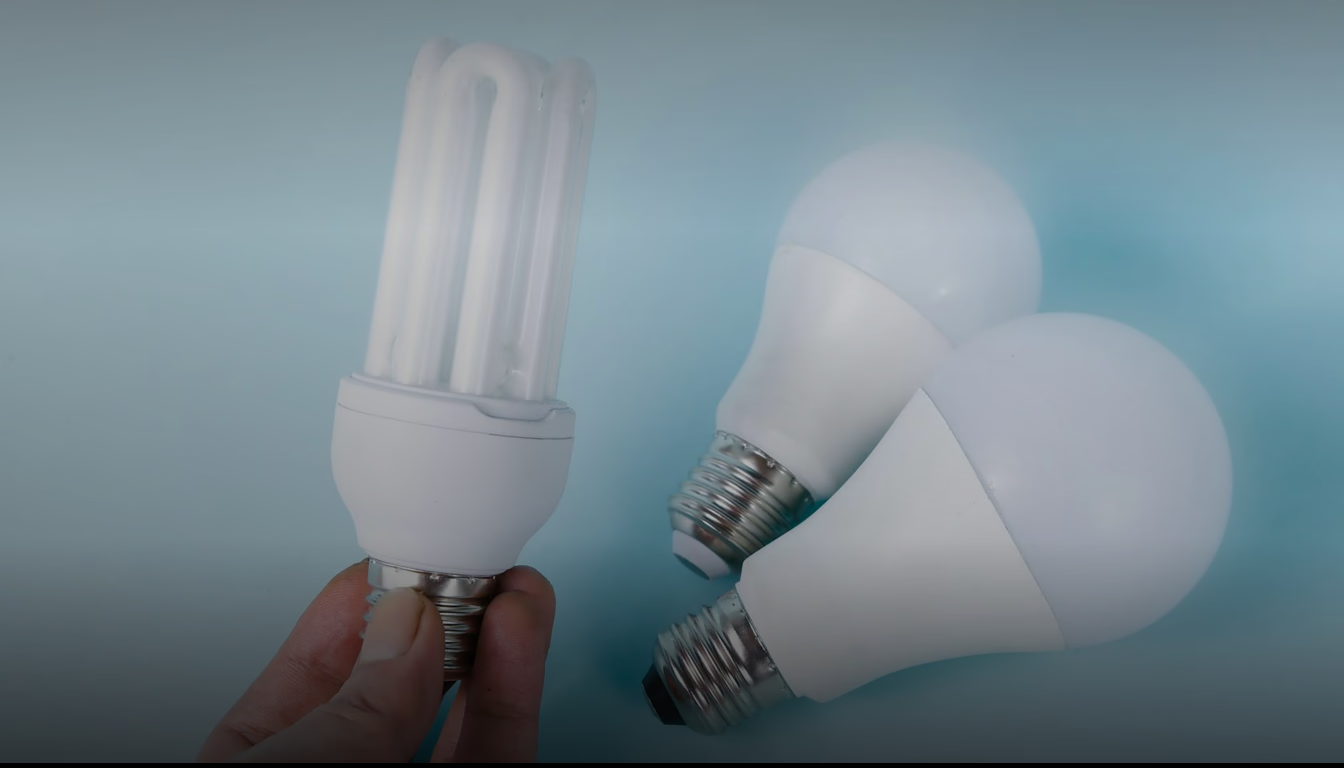
You flipped a light switch this morning and thought nothing of it. The photons that hit your retina were the result of six fields of science that matured independently and only lined up about fifteen years ago. A crystal grower in Nagoya. A phosphor chemist tuning yellow powder onto a blue chip. A metrologist arguing about what a lumen even means. A thermal engineer obsessed with 65 degrees. A biologist measuring the hormone in your blood at midnight. A standards committee in Geneva. The bulb above your desk is not a product. It is a negotiated treaty between disciplines that spent decades ignoring each other, finally signed in 2014 when Stockholm handed out a physics Nobel for the color blue.
- 1order of magnitude
- Efficiency falls roughly tenfold when the crystal grows with too many dislocations.
- 100%
- Brightness stops holding up once the chip's junction hits 120 degrees Celsius.
- 28.57%
- LED road luminaires that fail luminance requirements without traceable photometric standards.
When the fields matured
Each field had to produce a specific result before LED Lighting could exist as you know it. The timeline below shows when each one arrived.
Pull any thread, and the same story unravels.
In the order the story needs them, not the order they happened. Each card carries the year its field matured.
Keystone
Growing the crystal atom by atom
The light comes from a layer thinner than a virus. Growing it without defects took thirty years.
Inside the chip sits a stack of InGaN quantum wells just nanometers thick, grown atom by atom onto a substrate. Every misaligned atom becomes a defect that absorbs light instead of emitting it. Isamu Akasaki and Hiroshi Amano cracked the crystal quality problem at Nagoya, and Shuji Nakamura carried it to production, so that by 1994 the first practical blue LEDs were on the bench.
Without this field
Without epitaxial growth, quantum well heterostructures cannot be formed cleanly. Nonradiative recombination dominates, efficiency collapses, and high brightness LEDs at consumer prices become impossible.
Without epitaxial crystal growth on nanopatterned or optimized substrates, UV C and InGaN LEDs retain threading dislocation densities above about 10^9 cm^-2, leading to roughly an order of magnitude reduction in external quantum efficiency compared with low dislocation epitaxial structures reported using engineered substrates and heterostructures
How we know
On conventional substrates, threading dislocation densities stay above 10^9 cm^-2, which costs roughly an order of magnitude in external quantum efficiency. Engineered nanopatterned substrates and direct epitaxial micro LED structures have hit 28% internal quantum efficiency at 300 K and luminance above 10^7 cd/m^2.
Source: A Direct Epitaxial Approach To Achieving Ultrasmall and Ultrabright InGaN Micro LEDs (2020) · tier2
A defect-free crystal emits the right color only if the material is tuned to the right energy.
Choosing the gap that picks the color
Color is an energy. To make blue light, you must build a crystal with exactly the right gap.
Every photon an LED emits corresponds to a specific energy jump inside a semiconductor. To get blue, green, or warm white, you need a material whose band gap matches that energy. Nakamura, Akasaki and Amano cracked the blue problem by 1993 by tuning gallium nitride alloys, work that took the 2014 Nobel in physics. Without that tuning, you cannot span the visible spectrum from one chip family.
Without this field
Without band gap theory, no engineer could match a material to a target color. Blue, green, and warm white would be guesswork instead of design, and high efficiency visible LEDs would not exist as a systematic product family.
Blue light at 460 nm requires a 2.7 eV band gap. Without alloys tunable to that energy, no chip family spans the visible spectrum and white LEDs have no blue source to start from.
How we know
Indium gallium nitride is one alloy family whose band gap slides from about 0.7 eV at pure InN to 3.4 eV at pure GaN, which brackets the entire visible spectrum. The relationship E = hc/lambda means a 2.7 eV gap gives you 460 nm blue. Quantum confinement in thin InGaN wells shifts the gap further by squeezing the electron wavefunction, so the emitted color is set by well thickness as much as by alloy fraction.
Source: Efficient blue light-emitting diodes (Nobel Prize in Physics 2014, scientific background) (2014) · tier1
Blue photons alone cannot produce white light; a second chemistry has to borrow and re-emit them.
Yellow powder that completes white light
A blue LED alone cannot make white light. The trick is a yellow powder that eats some of the blue.
The white LED above your head is actually a blue chip coated in a thin yellow phosphor. The phosphor absorbs part of the blue and re-emits broader yellow and red, and your eye blends the result into white. Nakamura's 1996 work on cerium doped yttrium aluminum garnet made this commercially viable. Without it, LEDs stay monochromatic and useless for general lighting.
Without this field
Without phosphor luminescence, LEDs would emit only the narrow color of the chip. No practical white lamp could be balanced to CIE coordinates or to the correlated color temperatures that lighting codes require.
How we know
Hitting target CIE 1931 white coordinates and a CRI above 80 requires layering a second red emitting nitride phosphor on top, because YAG alone leaves a deficit in the 620 nm band.
Source: Light Converting Inorganic Phosphors for White Light-Emitting Diodes (2010) · tier1
Even perfect white light is commercially worthless if the chip overheats within the first year.
Keeping 65 degrees between success and failure
An LED that runs hot dies young. The hidden enemy of solid state lighting is its own waste heat.
Roughly half the power into an LED still leaves as heat, not light. That heat has to escape the package, through a thermal interface, into a heat sink, or the junction temperature climbs and the chip starts losing brightness for good. Yong Zhang and E. F. Schubert formalized chip scale thermal management in 2003 and made long life luminaires possible.
Without this field
Without thermal engineering, enclosed luminaires drive junction temperatures far above spec. Lumen depreciation and early failures wipe out the supposed lifespan advantage over fluorescent and incandescent.
Without effective thermal management that holds LED junction temperature near 65 degrees Celsius, LED packages operated at 120 degrees Celsius lose essentially all lumen maintenance margin compared with operation at 25 to 65 degrees Celsius so practical luminaires would suffer rapid lumen depreciation instead of maintaining over 70 percent output for tens of thousands of hours
How we know
Holding the junction near 65 degrees Celsius preserves over 70% lumen maintenance for tens of thousands of hours. Push the same package to 120 degrees Celsius and essentially all that margin disappears. The thermal path is governed by Fourier conduction through solder, copper, and aluminum, where every degree per watt of resistance counts.
Source: Zhang 2003 chip scale thermal management (2003) · tier2
A cool, long-lived chip still cannot be sold without a number on the box that regulators can verify.
Agreeing on what a lumen actually means
Every lumen on a box has to mean the same thing in Tokyo, Berlin, and Detroit. That agreement is not free.
When a manufacturer prints 800 lumens on a package, an accredited lab has to be able to confirm it against SI traceable units. Y. Ohno and colleagues built the photometric framework that made this possible for LEDs. Without it, utility rebates, road safety codes, and label claims would collapse into marketing.
Without this field
Without standards, no regulator could compare luminaires, no utility could enforce a rebate threshold, and no road authority could verify safety compliance. LED claims would become unverifiable.
Without standardized photometric testing and calibrated simulations based on reference data, up to 28.57% of LED road luminaires would miss minimum luminance requirements on higher class roads, leaving installations non compliant with lighting standards
How we know
The LM-79 procedure measures total luminous flux in an integrating sphere, while LM-80 tracks lumen maintenance over 6,000 hours minimum. Without calibrated reference spectra, simulation tools cannot predict road luminance accurately, and 28.57% of LED road luminaires would fail minimum luminance on higher class roads.
Source: Recent advances and perspectives in photometry in the era of LED lighting (2023) · tier1
Measured and labeled correctly, the bulb still needed to answer for what its spectrum does to the body at midnight.
What 480 nm does to you after dark
Your eye has a third kind of photoreceptor. It does not see images, it tells your brain whether it is day.
Melanopsin in retinal ganglion cells responds to blue wavelengths around 480 nm and suppresses melatonin when activated. George Brainard and Mariana Figueiro mapped this response around 2002, which forced lighting designers to care about spectrum and timing, not just brightness. The cool white LED that wakes you up at 8am is the same one that wrecks your sleep at 11pm.
Without this field
Without circadian photobiology, LEDs would be optimized only for visual brightness and color rendering. The market would default to blue rich high CCT spectra around the clock, suppressing melatonin at night and weakening sleep in shift work and windowless environments.
Without circadian informed control of LED lighting based on human activity and daylight, an office lighting system in one study would consume 36.42% more energy per month for the same space
How we know
Circadian informed LED control, matching CCT and intensity to time of day, cuts office lighting energy by 36.42% per month compared with static high CCT systems. The melanopic response peaks near 480 nm, distinct from the photopic V(lambda) curve that peaks at 555 nm and that every lumen measurement is built on.
Source: Investigation on entraining and enhancing human circadian rhythm in closed environments using daylight-like LED mixed lighting (2020) · tier2
Watch
A visual companion to the fields above.
Takeaway
The incandescent bulb was a single trick: heat a wire until it glows. One physicist, one filament, one century of incremental tweaks. The LED above you is not that. It is a blue photon born inside a gallium nitride crystal, partly absorbed by a rare earth powder, measured against an SI traceable standard, cooled by a designed heat path, timed to your melatonin, and sold to you under a label a regulator can actually enforce. None of these six fields would have produced a usable lamp alone. Crystal growers had no phosphors. Phosphor chemists had no blue source. Biologists had no tunable spectrum to test. The lesson of LED lighting is that the boring objects are often the hardest ones, because daylight, the thing you assumed was free, had to be reassembled from six separate laboratories that finally agreed on what white means.
References
- A Direct Epitaxial Approach To Achieving Ultrasmall and Ultrabright InGaN Micro LEDs (2020) tier2
Bai J, Cai Y, Feng P, Fletcher P, Zhao X, Zhu C, Wang T, ACS Photonics 7, 2020. Ultrasmall InGaN micro LEDs grown by direct epitaxy, reported at over 10^7 cd/m^2 luminance and 28% internal quantum efficiency at 300 K.
- Efficient blue light-emitting diodes (Nobel Prize in Physics 2014, scientific background) (2014) tier1
Royal Swedish Academy of Sciences, 2014. The committee's technical account of how Akasaki, Amano and Nakamura solved p-type doping and InGaN band gap engineering to produce a practical blue LED.
- Light Converting Inorganic Phosphors for White Light-Emitting Diodes (2010) tier1
Chen L, Lin CC, Yeh CW, Liu RS, Materials (Basel) 3, 2010. Survey of the phosphor chemistries used to convert blue LED emission into white light.
- Zhang 2003 chip scale thermal management (2003) tier2
Y Zhang, E F Schubert, Chip scale thermal management of high brightness LED packages, Proc SPIE 2003
- Recent advances and perspectives in photometry in the era of LED lighting (2023) tier1
Ikonen E, Measurement Science and Technology 35, 2023. Reviews how photometric units and their SI traceability were reworked for LED sources.
- Investigation on entraining and enhancing human circadian rhythm in closed environments using daylight-like LED mixed lighting (2020) tier2
Nie, Zhou, Chen et al., Science of The Total Environment, 2020