Riiven Threads
Ultrasonic Fingerprint Scanner
The Skin That Echoes
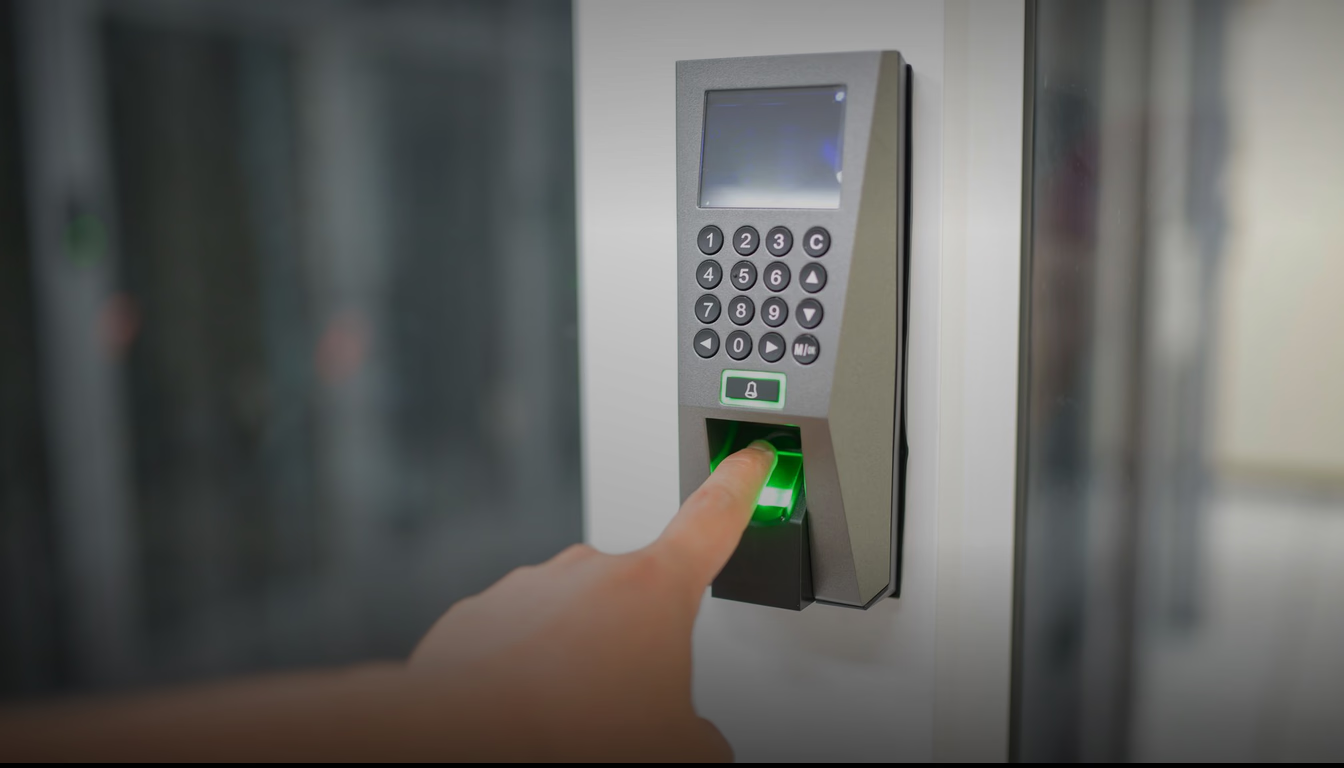
The ridges you press to glass are mostly dead skin, flakes of keratin too dry to conduct much of anything. An optical sensor photographs that surface. A capacitive one feels its faint electrical charge. Both can be fooled by a clean print lifted onto tape. Sound is harder to trick. You press your thumb to your phone screen without looking, in the dark, and it unlocks. That took 70 years to make possible, because four fields had to agree on a problem none of them shared: how to bounce a megahertz pulse off the living tissue under the skin, map the echo, and prove the map belongs to one person. So why did sonar, not a camera, win the inside of your phone?
- 15kPa
- Acoustic pressure the transducer array puts out, enough to image ridges through glass.
- 75µm
- Lateral blur after array focusing, fine enough to keep ridges separable.
- 0.001FAR
- NIST cap on false acceptance: at most one wrong match in a thousand.
- 14MHz
- Ultrasound frequency that penetrates glass and maps the skin beneath the surface.
When the fields matured
Each field had to produce a specific result before Ultrasonic Fingerprint Scanner could exist as you know it. The timeline below shows when each one arrived.
Pull any thread, and the same story unravels.
In the order the story needs them, not the order they happened. Each card carries the year its field matured.
Keystone
The crystal that turns voltage into sound
A quartz crystal flexes when you feed it voltage and rings out a tone. Push it millions of times a second and it makes ultrasound.
The same effect that keeps a quartz watch ticking runs in reverse here. A piezoelectric material, one that turns a squeeze into voltage and voltage back into a squeeze, sits under your screen. Feed it a sharp electrical pulse and it slams the glass with a sound wave at 14 megahertz, far above hearing. That wave travels into your fingertip, bounces off the boundary between ridge and air, and returns to push the same film, which now generates the readout voltage. In 2017 Xiaoyue Jiang, David Horsley and their coauthors built the transducer array straight onto the readout chip and got 15 kilopascals of acoustic output, enough to image ridges through the display stack.
Without this field
Without piezoelectric transducer physics there is no way to convert drive-voltage pulses into megahertz acoustic waves that penetrate glass, and no way to turn the returning echoes back into electrical signals, making subsurface fingerprint imaging through a display physically impossible.
Without a piezoelectric film, there is no 15 kilopascal pressure pulse to send through the glass and no echo to read a ridge from.
How we know
The device was monolithic, building the transmit and receive transducers directly onto the readout electronics rather than bonding them on, which is what made an under-display stack thin enough to fit a phone (Jiang et al., Microsystems & Nanoengineering, 2017).
Source: Monolithic ultrasound fingerprint sensor (Microsystems and Nanoengineering 2017) (2017) · tier1
Pressure alone makes noise, not a picture. Steering that noise into a sharp image had already been solved by sonar engineers who never touched a phone.
How sonar learns to focus without lenses
A submarine has no lens for sound, yet it can aim a beam at one ship. The whole trick is timing.
Sound cannot be focused with glass the way light can. So you fire many tiny emitters with staggered delays, and their waves add up sharply at one chosen point and cancel everywhere else, a method called beamforming. Medical ultrasound engineers at Acuson, Samuel Maslak and Christopher Cole among them, patented the receive side of it through the 1990s, steering and focusing a beam electronically with no moving parts. In a fingerprint sensor that focus pulls the lateral blur down to about 75 micrometers, fine enough to keep ridges 500 micrometers apart from smearing into one gray band.
Without this field
Without electronic beam steering and synthetic aperture focusing, the sensor is stuck with a single unfocused element, so ridge and valley echoes blur together and minutiae extraction and spoof detection both collapse.
Array focusing holds lateral blur to about 75 micrometers, so ridges 500 micrometers apart stay separable instead of smearing.
How we know
Synthetic aperture imaging extends this by combining echoes from many element positions into one reconstructed view, recovering near-field resolution far better than a single unfocused element's native point spread function (Jiang et al., Microsystems & Nanoengineering, 2017).
Source: Monolithic ultrasound fingerprint sensor (2017) · tier1
A sharp image still needs a reason to trust the pattern inside it. That reason came from biology, decades of it.
Why ridges count as identity at all
Ridges form in the womb and never change. That is the entire reason a smudge can stand for a person.
Fingerprints are not just lines, they are a three dimensional landscape of ridges and valleys laid down before birth and stable for life. In 2015 Nature noted that reading that relief in 3D, rather than as a flat photo, is what gives ultrasound its security edge: depth carries detail a printed copy on the surface cannot reproduce.
Without this field
Without dermatoglyphics there is no scientific premise that ridge patterns are persistent and individualized. The scanner could still image skin, but identity matching would lack any biological basis for treating that image as a stable identifier.
How we know
Source: Ultrasound fingerprint scanners amplify security (2015) · tier2
A trustworthy image and a permanent trait still are not enough for a bank. Someone had to define what 'accurate enough' actually means.
The number a bank needs before it trusts you
A bank will not accept 'pretty accurate.' It needs a number every vendor measures exactly the same way.
Before a sensor can guard a bank login or a border gate, regulators need proof it rarely lets the wrong person in. In 2004 Patrick Grother's NIST evaluation set common benchmarks, capping the false acceptance rate near 0.001, meaning at most one wrong match in a thousand. Standards like ISO/IEC 19794-2 then fixed how the ridge details are stored, so a template captured on one system reads on another. Without that shared yardstick, every vendor's accuracy claim would be uncomparable, and ultrasound would stay a lab demo.
Without this field
Without standardization, sensors could not be certified against shared error benchmarks, vendors would report incomparable accuracy figures, and regulators could not rely on interoperable minutiae formats, blocking use in any regulated authentication.
Standards cap fingerprint false acceptance near 0.001; without them sensors could run ten times higher and fail banking rules.
How we know
The NIST Fingerprint Vendor Technology Evaluation 2003 (NISTIR 7123, 2004) ranked commercial matchers on identical large-scale data, the first time false accept and false reject rates were directly comparable across vendors.
Source: NIST FpVTE 2003 fingerprint evaluation (2004) · tier1
Watch
A visual companion to the fields above.
Takeaway
What shipped in 2017 as Qualcomm's Sense ID was not a better camera. It was a piezoelectric film borrowing a quartz watch's trick, fired through a focusing scheme borrowed from submarine sonar, aimed at a tissue pattern biology had spent a century proving was permanent, then certified against an error rate a government lab had pinned down for banks. None of those four groups was building a phone. The physicist wanted pressure per volt. The sonar engineer wanted a sharp focus in the near field. The biologist wanted to know why ridges persist for life. The standards office wanted one wrong match in a thousand. The phone needed all four at once, under glass, with a wet thumb in the dark. That is why sound won the inside of your phone and a camera did not: only an echo can read the living ridge beneath dead skin and still survive water sitting on top of it.
References
- Monolithic ultrasound fingerprint sensor (Microsystems and Nanoengineering 2017) (2017) tier1
Jiang X, Lu Y, Tang HY, Tsai JM, Ng EJ, Daneman MJ, Boser BE, Horsley DA, Microsystems and Nanoengineering 3, 2017. Reports 15 kPa pressure output and 75 micrometer lateral resolution from transducers built directly on the readout ASIC.
- Monolithic ultrasound fingerprint sensor (2017) tier1
Jiang X et al, Microsystems and Nanoengineering 3, 2017. Monolithic ultrasound fingerprint sensor measured at 75 micrometer lateral resolution and 150 micrometer axial resolution.
- Ultrasound fingerprint scanners amplify security (2015) tier2
Boer Deng, Nature news, 2 July 2015. Reports why reading the ridge relief in three dimensions gives ultrasound sensors an edge over a flat optical image.
- NIST FpVTE 2003 fingerprint evaluation (2004) tier1
Grother PJ et al, NIST Fingerprint Vendor Technology Evaluation 2003, NISTIR 7123, 2004