Riiven Threads
Autofocus Camera Lens
The Eye That Learned
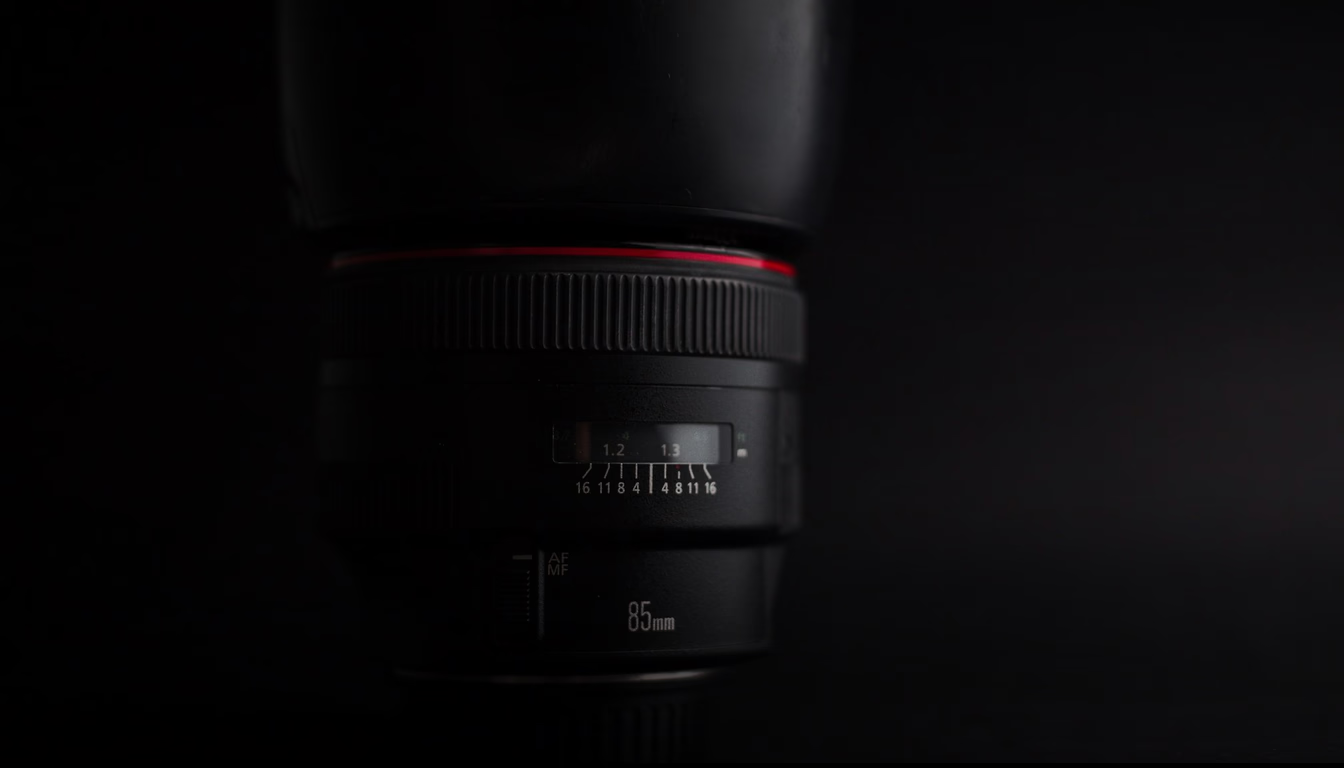
In 1985 Minolta put autofocus inside a camera body and sold it as the Maxxum, and within two years the patents behind it were tangled in court. You tap a face on your phone screen and the image snaps sharp in under a second. That tap triggers more negotiated history than most treaties. The hard part of seeing was never the lens. Glass that sharp had existed for decades. What did not exist, all at once, was a chip that could read focus direction off an image, a motor that could stop without hunting, a physics linking blur to a number, and a court willing to price what one firm owed another for the idea. So why did a camera learn to see in 1987 and not in 1965?
- 127.5million USD
- What Minolta paid Honeywell for shipping phase detection without a license.
- 10x
- How much slower a focus search runs without phase-detection algorithms.
- 5%/µm
- Image contrast lost per micron of defocus in high-magnification imaging.
When the fields matured
Each field had to produce a specific result before Autofocus Camera Lens could exist as you know it. The timeline below shows when each one arrived.
Pull any thread, and the same story unravels.
In the order the story needs them, not the order they happened. Each card carries the year its field matured.
Keystone
The chip that reads which way to move
An out-of-focus photo carries a hidden direction: nearer or farther. A focus chip reads that direction before moving the lens at all.
Point an old manual lens at a blurry wall and it cannot tell you which way to turn the ring. Phase detection solves that by splitting incoming light into two views, then measuring how far apart they land, the way your two eyes judge distance from a small offset. The gap reports both direction and amount, so the lens can jump straight toward sharpness instead of guessing. Contrast sensing is the backup: it nudges the lens, watches a sharpness score climb, and stops at the peak. By 1987 these algorithms were reliable enough to ship. Without them, a focus search runs 5 to 10 times slower, hunting frame by frame.
Without this field
Without phase detection and contrast sensing, an autofocus system cannot compute focus direction from image data, so it cannot tell whether the lens must move nearer or farther. It also loses the ability to search for the focus peak by maximizing a contrast score, leaving it unable to converge reliably from an out-of-focus frame.
Without these focus algorithms, the lens hunts frame by frame and focuses 5 to 10 times slower than a guided search.
How we know
Phase-detection sensors place microlenses over paired photosites, sampling left and right light bundles. Their phase disparity maps directly to defocus distance, letting the lens move toward near-focus in one step before a fine contrast search settles the last fraction.
Source: arXiv / Intelligent Autofocus (2020) · tier1
The chip could read direction only because physics had already turned blur into a predictable curve, a problem solved on its own bench.
Why blur is a number, not a mood
Blur is not just softness. Every defocused point of light spreads into a precise shape that physics can write down.
Squint at a streetlight at night and it swells into a fuzzy disc. Wave optics describes that disc exactly through the point spread function, the fingerprint a single point of light leaves when it falls out of focus. Joseph Goodman and Albert Macovski formalized the math that links defocus to lost contrast. That link is what lets a chip read sharpness as a number rather than a hunch. In high-magnification imaging, every micron of defocus costs roughly 5% of contrast, a slope steep enough to detect.
Without this field
Without wave optics and diffraction theory, autofocus lenses could not use point spread function and wavefront models to quantify defocus and predict the correct lens movement. Phase and contrast algorithms would lack the optical transfer function links between focus error and image contrast, so sensing would fail in low light, at high numerical aperture, and with aspheric elements.
In high-NA imaging, each micron of defocus costs about 5% of image contrast, the signal contrast-based focus detection reads.
How we know
The optical transfer function describes how an imaging system passes spatial detail at each frequency. Defocus, high numerical aperture, and diffractive or aspheric elements all reshape it, which is why focus sensing degrades in low light and at the edges of fast lenses.
Source: Wavefront-sensing-based autofocusing in microscopy (2017) · tier2
Knowing where focus lies is useless if the motor overshoots it, a separate problem being tuned in control labs.
The motor that stops without bouncing
A lens that races to focus and sails past it is worse than slow. The fix is knowing exactly when to brake.
Push a swing too hard and it swings back past where you wanted it. An autofocus motor does the same: drive it fast and it overshoots focus, then oscillates around it, hunting. Closed loop control, the engineering of feeding the error back to throttle the motor, tells the lens to ease off as it nears the target. The teams behind the Canon EOS 650 and the Konica Hexar AF tuned this for consumer shutter speeds, where a slow settle ruins the frame. Tuned feedback is the whole difference between a lens that settles on the subject and one that keeps sailing past it.
Without this field
Without servomechanism design and closed loop control, autofocus actuators overshoot the focus position, then oscillate around it, increasing time to lock. Modules lacking tuned feedback show larger focus error and longer settling times before the lens stops hunting, which would make real-time photography and video impractical at consumer shutter speeds.
How we know
Source: Implementation and Optimization of a Dual-confocal Autofocusing System (2020) · tier1
All three pieces worked. Whether any one firm could legally combine them was a fight settled in courtrooms, not labs.
The company that owned focus, and collected
The firm that patented phase detection never sold a camera. It sold the right to see, and it took thirteen years to collect.
Honeywell was not a camera company. It built sensors, and in 1980 its engineer Norman Stauffer patented the module that reads focus direction off an image. Japanese makers shipped the technique anyway, and Minolta put it in the Maxxum. Honeywell sued, and in February 1992 a jury told Minolta to pay 96 million dollars, settled weeks later at 127.5 million with interest. Other manufacturers watched that verdict and signed licenses rather than argue. The technology did not spread because rivals agreed to share. It spread because one of them lost in court and the rest did the arithmetic.
Without this field
Without enforceable patent rights and the licensing that followed them, the firm that solved focus detection had no way to be paid by the firms that sold it. Sensor research of this kind is funded on the expectation that the result can be licensed, so removing the enforcement removes the reason to fund the work at all.
How we know
Source: US Patent 4,185,191: Range determination system (1980) · tier1
Watch
A visual companion to the fields above.
Takeaway
What shipped in the Maxxum was not a breakthrough in any single field. The glass was old. The blur math was Goodman and Macovski's. The control loops came from servo engineering that predated cameras. The focus algorithms were the newest piece, and even they leaned on optics worked out elsewhere. What made 1987 the year was that all four reached usable form at once, and the courts then settled who owed whom for the privilege. The result was a quiet inversion: the camera stopped asking the photographer to confirm focus and started telling the photographer it was sure. A motor that brakes itself, a chip reading direction from a tiny offset, a physics of blur, and a patent someone had to be sued over, none built for each other, now decide sharpness faster than your thumb can lift off the shutter. The unresolved part is who owns that decision. Every phone that locks onto a face is still running on licenses someone had to be sued into signing.
References
- arXiv / Intelligent Autofocus (2020) tier1
Huh et al., Intelligent Autofocus, 2020
- Wavefront-sensing-based autofocusing in microscopy (2017) tier2
Xu J, Tian X, Meng X, Kong Y, Gao S et al, Journal of Biomedical Optics 22(8), 2017. Derives autofocus from the wavefront itself rather than from image contrast.
- Implementation and Optimization of a Dual-confocal Autofocusing System (2020) tier1
Jan CM, Liu CS, Yang JY, Sensors (Basel) 20, 2020. Works through the closed loop design of an autofocusing system and what the feedback geometry does to settling behavior.
- US Patent 4,185,191: Range determination system (1980) tier1
Norman L. Stauffer, Honeywell Inc., filed 1978, issued January 1980. The through-the-lens phase-detection range-finding patent at the center of Honeywell v. Minolta, which a jury valued at 96 million dollars in 1992.