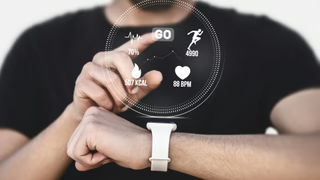
Titanium bands the width of a wedding ring are now logging heart rate, skin temperature, and sleep quality through the night without a single buzz or notification. No screen. No prompt. The ring sits on your finger, reads the body underneath, and waits until morning to report what it found.
That quiet quality is the whole point. Smart rings represent a shift from active health tracking, where you start a workout or check a number, toward ambient health data: continuous, passive monitoring that runs in the background and surfaces patterns over weeks rather than alerts in the moment.
What Smart Rings Actually Do
A smart ring is a dedicated biosensor worn on the finger.
 Photo by
 Inside the band are optical sensors and a thermometer that measure heart rate variability (HRV, the tiny timing gaps between heartbeats that serve as a rough proxy for stress and recovery), resting heart rate, blood oxygen, skin temperature, and movement.
The finger turns out to be a good place to listen. Blood vessels there sit closer to the skin surface than at the wrist, so the optical sensor gets a cleaner signal. In plain terms, the ring hears the body more clearly than a watch pressed against a bony wrist.
What the ring leaves out matters as much as what it includes. No screen, no notification loop nudging you to move. Data syncs quietly to a paired phone, and battery life stretches to several days because the device never lights up a display. The output is a trend line: readiness scores, sleep stage breakdowns, and recovery baselines built up over time.
Who Makes Them, and How Big the Market Is
A small group of companies defines this category.
 Photo by
 Oura has been the reference point since its early rings, selling hardware paired with a monthly membership, a structure most competitors have since copied. Newer challengers like the Ultrahuman Ring position themselves directly against Oura and Whoop, offering sleep, recovery, and HRV tracking through a paired smartphone [Barchart].
The broader wearable technology market is projected to reach roughly 130 billion dollars in 2025 and climb toward 238 billion in 2026 [Business]. Smart rings are a slice of that, but a fast-growing one. The entry of large consumer electronics brands has pulled the category out of the niche.
How Ambient Collection Actually Works
Ambient data collection means the device measures continuously without you starting anything.
 Photo by
 The ring samples physiological signals around the clock, including through the night, which is exactly the stretch most wrist devices struggle to capture cleanly.
That overnight window is where the useful signals tend to live. Sleep staging algorithms lean on HRV, movement, and temperature read together, and the finger’s sensitivity to small temperature shifts feeds the picture. Modern rings combine sleep, stress, recovery, and temperature into a single readiness read, what one source describes as “a quiet body layer for ambient AI”.
The data doesn’t arrive as raw numbers. It’s processed into derived metrics: a readiness score or a strain level. What you see in the morning is an interpretation, not a sensor dump. The behavior this encourages is different from logging a run. You do nothing, and a summary appears.
What the Data Can and Cannot Tell You
Smart rings now offer clinically adjacent accuracy on core metrics, yet they remain unregulated consumer products.
 Photo by
 That gap means the data can look more precise than it’s validated to be [Mattioli 1885].
The signals are not equally trustworthy:
-
Temperature trends and resting heart rate tend to be the most reliable, useful for spotting the slow drift that precedes illness or marks a menstrual cycle phase.
-
HRV correlates reasonably well with clinical measures when read as a trend rather than a single reading.
-
Sleep staging is genuinely useful for noticing patterns, but it’s an estimate, not the equivalent of a clinical sleep study.
Researchers have started combining ring data such as heart rate, sleep, and activity to estimate aspects of metabolic health rather than reporting one hard clinical value. Read your morning score as a weather forecast for your body: broadly right about the direction, not a lab result to act on alone.
Who Owns the Data You Generate
Continuous biometric collection raises a question most people skip at checkout: who controls all of this?
Most platforms store both raw and derived data on company servers, which means you’re effectively licensing access to readings taken from your own body. The subscription model adds a second layer, because richer insights can sit behind a paywall if you stop paying.
There’s also the matter of deletion. A workout you typed into an app is easy to erase. Ambient biometric data is generated nonstop and folded into long-term models, and the trained insights built from it are harder to claw back even where deletion rights exist. It’s worth reading the data terms with the same attention you give the sensor specs.
Where the Form Factor Is Heading
The most anticipated next capability is non-invasive glucose estimation through optical sensors, with several companies actively working toward it. The day a ring earns regulatory clearance for a medical claim will mark a real threshold: the move from wellness gadget to medical device, with all the scrutiny that brings.
Employers and insurers are also circling, exploring how ring data might feed wellness programs. That opens harder questions about incentives and consent. And the ring is likely an early template rather than the final shape. The same ambient model is spreading to patches, earbuds, and fabrics. The finger is just where it fit first.
Oura alone has gathered billions of nights of sleep data, a resource that didn’t exist a decade ago. A smart ring isn’t a faster smartwatch competing for your attention. It’s a quiet recorder whose value lives in the line that forms over weeks, not the digit that appears today. When your readiness score drops, treat it the way you’d treat a friend saying you look tired: worth noticing, worth pairing with how you actually feel, and not worth mistaking for a diagnosis.