

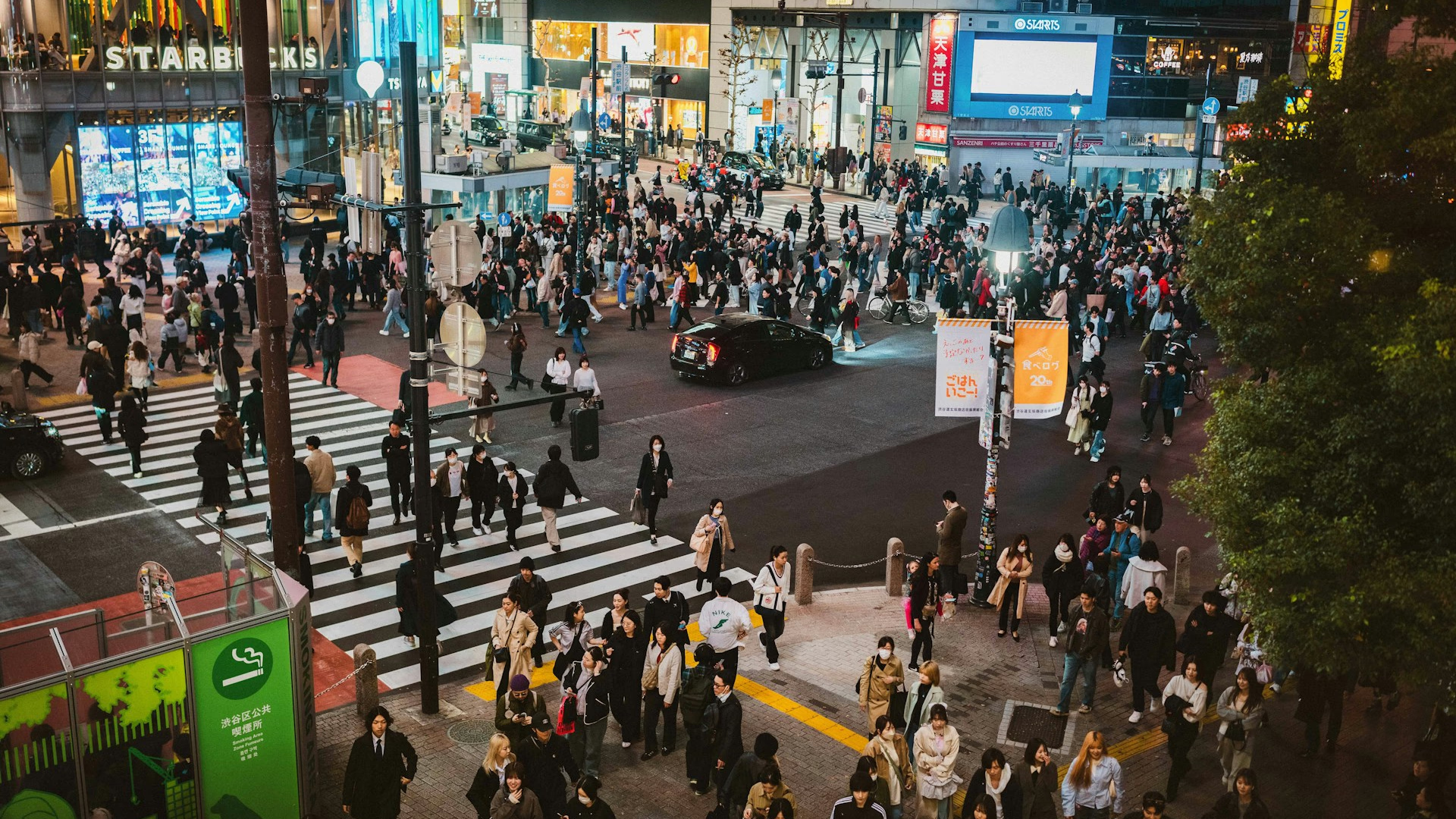
Over a billion people live in cities where average street noise sits above 70 decibels, roughly the level of a vacuum cleaner held a few feet away. Most of them stopped noticing it years ago. That is exactly the catch. As more of the world urbanizes and noise maps of major cities grow sharper, researchers are getting a clearer picture of something the human ear hides from us: the brain keeps reacting to sound long after the mind has tuned it out. The result is not just momentary irritation. It is a slow recalibration of the emotional baseline we return to when nothing in particular is happening.
The City Hum We Stop Hearing
Auditory habituation feels like proof that noise stops mattering.
 Photo by
 Move into an apartment near a busy intersection, and within weeks the traffic fades into the background. That happens in the auditory cortex, which learns to filter predictable sound out of conscious awareness. The amygdala, the brain’s threat-monitoring center, does not get the same memo. It keeps logging each siren and each braking truck as a small alarm.
That gap between what you notice and what your body registers is where the damage accumulates. Busy streets routinely run 70 to 85 decibels, well past the roughly 55-decibel mark the World Health Organization links to measurable stress hormone elevation. Even when you feel calm, your cortisol can stay elevated.
There is a cognitive cost too. Suppressing awareness of constant sound consumes attentional resources, the same pool you draw on for regulating mood and savoring good moments. Noise you no longer consciously hear keeps drawing down those resources.
Two Lives, Same Brain
Picture two residents of the same metro area.
 Photo by
 One lives on a quiet courtyard facing a garden. The other lives forty meters from an arterial road. They share income, job type, and sleep schedule. On paper, nothing separates them.
Watch them over a decade and the divergence shows up in the body before it shows up in self-report. The courtyard resident’s nervous system spends more of the day in a parasympathetic, low-arousal state. The road-facing resident’s stress axis, the hypothalamic-pituitary-adrenal axis (the hormonal chain that governs the body’s fight-or-flight response), gets nudged toward activation more often. Over time, the threshold for entering a stress state drops. What once required a genuine problem now triggers on ambiguity.
This is what an emotional default actually is: the resting affective tone you drift back to once an event fades. Affective neuroscience treats it as a hedonic baseline, meaning the emotional set-point the brain returns to at rest. That baseline is more plastic than most people assume, and sustained low-grade input reshapes it. The road-facing resident is not weaker or more anxious by temperament. Their baseline has simply been worn down by repetition.
Where the Two Lives Converge
The two residents share one thing they rarely connect to noise: their nights.
 Photo by
 Sound above about 40 decibels fragments sleep even when it does not fully wake you, and the fragmentation lands hardest on REM sleep, the phase that processes emotional memory. Lose enough of it and the next day’s emotional range narrows. Less joy lands, calm arrives slower, and irritability becomes the path of least resistance.
Daytime and nighttime effects compound rather than cancel. Large population studies have repeatedly linked chronic traffic noise to higher rates of depression and anxiety after controlling for income and occupation [Frontiers]. That suggests the sound itself is doing work that lifestyle factors cannot explain.
The convergence point is attentional depletion, the gradual exhaustion of the mental resources needed to filter out background noise. Positive experiences need cognitive room to register and consolidate. When that room is taken up suppressing noise, good moments leave shallower traces. The mechanism is quiet and cumulative, which is precisely why it escapes notice.
What Quiet Reveals
Genuinely quiet places work like a contrast agent, making the recalibration visible.
 Photo by
 Many urban residents report feeling restless, even faintly anxious, when dropped into a silent forest or empty valley. That discomfort is diagnostic. A nervous system tuned to constant stimulation reads the absence of it as something missing.
Give it time and the system resets quickly. Studies of natural quiet document measurable parasympathetic recovery once people settle in, with drops in cortisol and self-reported rumination that can persist for hours after returning to the city. The speed of the rebound is the encouraging part: the baseline drifts, but it is not stuck.
The restlessness in silence tells you how thoroughly noise has become the reference point rather than the exception. Reading that signal correctly is the first useful move.
Adaptation Is Not Immunity
The comforting story is that city dwellers simply adapt and pay no lasting price. The evidence splits this claim cleanly. Subjective annoyance does fall over the years, but objective stress markers remain elevated. That divergence is the dangerous part, because it lets people feel fine while cardiovascular and psychological risk quietly climbs.
Children make the cost hardest to dismiss. Research near major airports found that kids in flight-path schools carried persistently elevated blood pressure and scored lower on reading comprehension than peers in quieter settings. They had adapted only in the sense that they no longer complained, even as their blood pressure and reading scores stayed measurably worse.
Self-report surveys tend to understate all of this, because people normalize their own diminished baseline and compare themselves to neighbors living in the same noise. Adaptation here means tolerating the input, not escaping its effects.
Reclaiming Your Baseline
The recovery research points in a hopeful direction. Because the baseline is plastic, small and consistent reductions in noise exposure compound over time. A few practical levers show up across studies:
-
Scheduled quiet periods: even 15 to 20 minutes of low-stimulation time daily can shift resting stress and mood within a couple of weeks.
-
Acoustic micro-environments: noise-canceling headphones, rearranging a bedroom away from a street-facing wall, or choosing a quieter commute route lowers your cumulative daily dose.
-
Conscious transitions: paying attention to the shift from noisy to quiet, rather than letting it pass automatically, helps the nervous system recalibrate faster.
The aim is not silence as a luxury good. It is quiet treated as routine maintenance for an emotional system that, left alone in a loud city, slowly drifts toward vigilance.
City noise resets the emotional default through three overlapping channels: stress sensitization that lowers the bar for entering an alarm state, attentional depletion that flattens positive experience, and fragmented sleep that narrows next-day emotional range. Conscious adaptation hides all of it, which is why the drift feels like personality rather than environment. The reset is reachable without leaving the city. Audit your week, find one recurring high-noise stretch, and replace it with fifteen minutes of deliberate quiet. For the billion-plus people living above 70 decibels, that is a small change against a cost most have never measured.