Most people assume scrolling through a phone counts as rest. Their nervous systems disagree. This gap between perceived relaxation and actual recovery is at the center of a growing conversation around neurowellness: tools and practices designed to directly regulate the nervous system. Research from [Frontiers] confirms that people with baseline heart rate variability (HRV) abnormalities had 19.4 to 53.4% lower probability of favorable cognitive and functional performance at one-year follow-up. The nervous system isn’t background biology anymore. It’s becoming the primary target for people seeking genuine calm, and the tools to work with it are more accessible than ever.
Why Your Nervous System Is Overloaded Now
Before “nervous system regulation” entered mainstream wellness, most people described their state simply: stressed, tired, burned out.
 Photo by
 The biological reality is more specific. The sympathetic nervous system, the body’s accelerator, stays engaged when the brain perceives ongoing threat. Modern life delivers those signals constantly: notification pings, financial uncertainty, social comparison, isolation.
The scale of this overload is measurable. During the COVID-19 pandemic, PTSD symptom prevalence reached approximately 21 to 22% among over 90,000 healthcare workers [NIH]. That’s not a niche finding. It reflects how sustained stress rewires the nervous system toward chronic vigilance. Many people report a version of this pattern in their own lives: not full PTSD, but a persistent hum of activation that never fully quiets.
Loneliness compounds the load. Neuroscience research shows that social disconnection activates the same neural threat pathways as physical danger. The nervous system doesn’t distinguish between a predator and prolonged isolation. It responds to both with the same alarm. This isn’t a personal failing. It’s biology doing exactly what it was designed to do, in an environment it was never designed for.
Myths Blocking Real Relief
A few misconceptions keep people stuck in surface-level fixes.
 Photo by
 -
“Watching TV is recovery.” Passive screen consumption maintains cortisol elevation. The brain stays in a low-grade alert state processing novelty and narrative tension. Many people feel more drained after a binge-watching session, not less.
-
“I just need to think more positively.” Neuroscience suggests why this often falls short. Dr. Stephen Porges’ Polyvagal Theory describes regulation as a bottom-up process. The body sends safety signals to the brain, not the other way around. Cognitive reframing has value, but it can’t override a nervous system locked in survival mode.
-
“One yoga class should fix it.” A single session can feel wonderful. Nervous system resilience builds through consistent, repeated practice over weeks.
Clearing these myths matters because they shape which tools people reach for, and whether those tools actually reach the biology.
What Neurowellness Tools Actually Do
Tools that genuinely shift nervous system state share one feature: they engage the vagus nerve, the primary communication highway between body and brain.
 Photo by
 Breathwork is the most accessible entry point. Extended exhale breathing, where the out-breath is longer than the in-breath, directly activates the parasympathetic branch. A Stanford study found that cyclic physiological sighing reduced anxiety faster than mindfulness meditation in a controlled trial. This practice is free and takes under five minutes.
Somatic tools offer another pathway. Cold water on the face, humming, and weighted blankets (typically $30 to $80) send safety signals through the body’s sensory nervous system. Vagal tone, a key marker of resilience, improves measurably with consistent somatic practice over four to eight weeks.
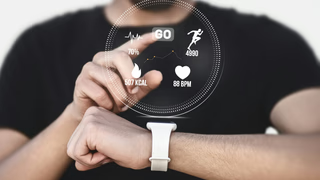
For those wanting data, HRV biofeedback wearables ($50 to $300 depending on the device) let users observe their nervous system state in real time. Clinical vagus nerve stimulation has shown response rates of 67.6% compared to 40.9% with treatment as usual, with remission rates of 43.3% versus 25.7% [UTHealth]. Consumer-grade tools are gentler, but the principle, training the nervous system through feedback, is the same.
“VNS is a long-term stabilization strategy, while other treatments manage acute episodes.” [UTHealth]
These Tools Are Not Magic Fixes
Neurowellness tools work best as daily maintenance, not emergency interventions.
 Photo by
 Using breathwork only during a panic moment builds minimal long-term vagal tone. Research on HRV training consistently shows benefits accumulating over weeks, not from single sessions.
Structural stressors also can’t be breathed away. Sleep deprivation alone reduces emotional regulation capacity significantly, undermining any tool’s effectiveness. A regulation practice layered on top of chronic sleep debt, poor nutrition, or unresolved trauma will hit a ceiling.
This doesn’t diminish the tools. It frames them realistically. They’re one layer in a broader approach, not a replacement for addressing root causes.
Building a Sustainable Practice
The most effective approach among people who stick with nervous system work tends to be gentle and small.
 Photo by
 - Pick one anchor habit. Five minutes of extended exhale breathing each morning, attached to something already routine, right after brushing teeth or before coffee.
- Track one simple metric. Morning resting heart rate or subjective sleep quality. Nothing elaborate. Self-monitoring increases behavior change success, and noticing real shifts keeps motivation alive.
- Add layers slowly. After two weeks of breathwork, consider adding a somatic element: humming during a commute, a cold water face splash before bed. Some people notice changes immediately; others need a month.
The free options, breathing techniques, humming, cold water, are genuinely effective starting points. Wearables and biofeedback devices can deepen the practice for those with budget and curiosity, but they’re not required.
Personalized neurostimulation tailored to physiological cycles is also emerging as a notable wellness trend [Outside Online], suggesting the field is moving toward even more individualized approaches.
Two minutes of intentional regulation daily, practiced consistently, tends to outperform an occasional hour-long wellness session.
The nervous system learned to survive constant noise. Neurowellness tools offer a way to gently teach it something different: that safety exists, that recovery is possible, that the alarm can quiet. None of this requires perfection or expensive equipment. It asks for consistency, realistic expectations, and a willingness to notice what the body is already communicating. One breath practice. Five minutes. Two weeks. A gentle enough starting point for anyone exploring this terrain.
Sources
- NIH - PTSD symptom prevalence during the COVID-19 pandemic among healthcare workers
- UTHealth Houston - Vagus Nerve Stimulation for Difficult-to-Treat Depression: Expert Consensus
- Frontiers in Neuroscience - HRV abnormality and psychocognitive performance outcomes
- Outside Online - Health and Wellness Trends 2026