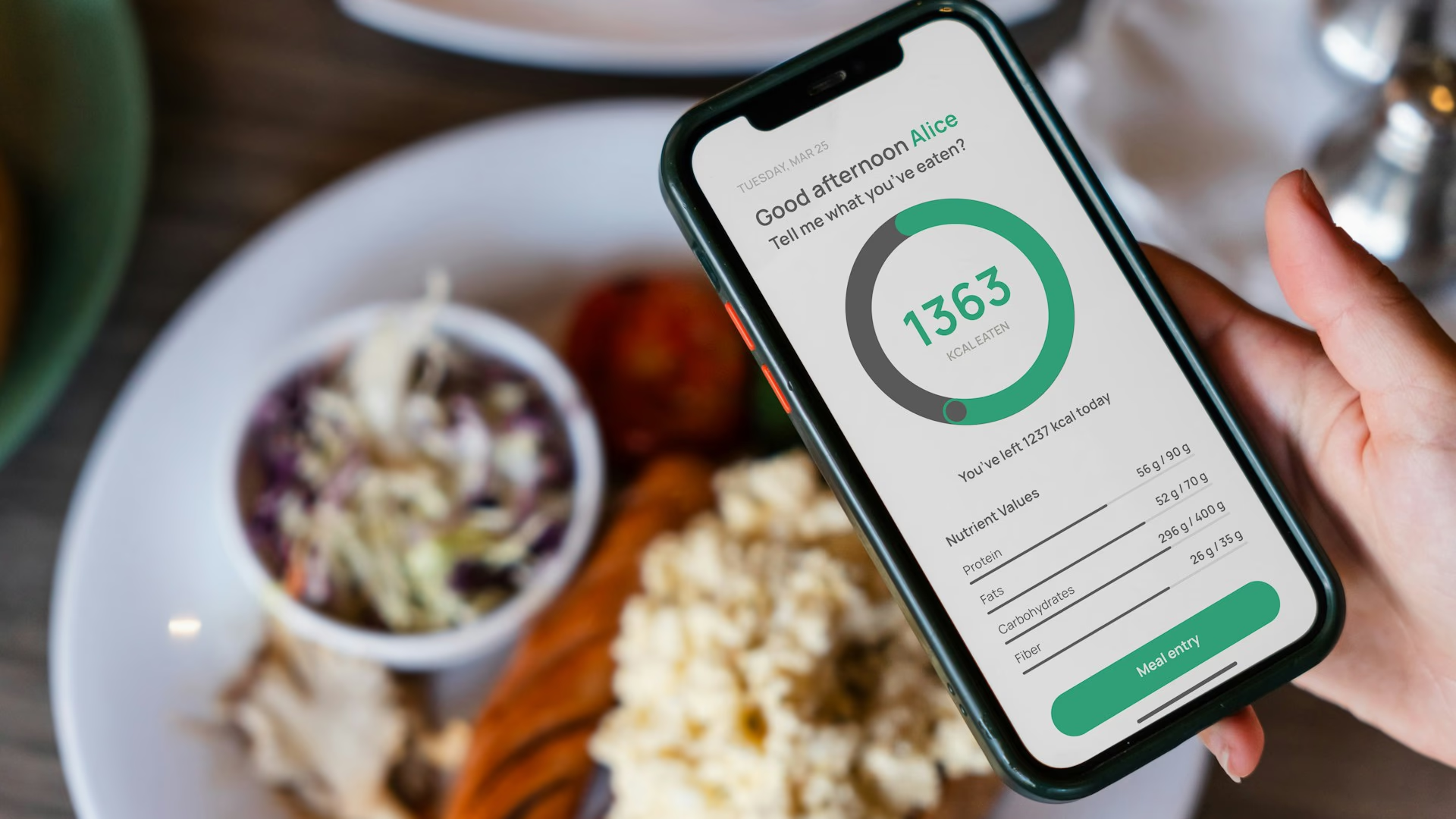
Most people who track their meals never hear back from the app. They log a sandwich, note a soda, and the data just sits there: a digital food diary nobody reads. A 2026 study published in JMIR suggests that breaking that silence, even with a brief screening message, may be the missing ingredient in app-based nutrition tools [JMIR]. As digital wellness platforms spread across Europe and North America, this Swedish research arrives at a moment when millions are already logging meals but few are changing what they eat. The finding is modest yet meaningful: it’s not the app that matters. It’s whether the app talks back.
From Logging to Listening
Food-tracking apps have spent years perfecting data collection.
 Photo by
 Calorie counts, macronutrient breakdowns, barcode scanners: the tools are sophisticated. Yet many people report that passive logging alone doesn’t shift their habits. Recording a meal without any response can feel like shouting into a void.
The Swedish research team behind the JMIR study took a different approach. They built a mobile app called Buddy that included six components, among them weekly screening paired with feedback delivered via SMS-linked questionnaires [JMIR]. Participants weren’t just logging. They were receiving gentle, personalized responses about their dietary patterns. That distinction turns out to be the active ingredient.
This reflects a broader evolution in wellness technology:
-
Passive tracking: Users record data, app stores it silently
-
Active screening: App asks targeted questions about food quality, not just quantity
-
Feedback loops: App reflects personal patterns back to the user in real time
The shift from passive to active marks a new generation of dietary tools, ones designed for outcomes rather than data accumulation.
What the Swedish Researchers Found
The study recruited participants from 18 universities and colleges across Sweden, focusing on individuals whose diets had clear room for improvement.
 Photo by
 Specifically, those consuming less than 500g of fruit and vegetables per day or drinking two or more units of sugary beverages weekly [JMIR]. Baseline fruit and vegetable intake averaged just 1.3 portions per day (SD 1.1), well below recommended levels.
After two months, participants receiving screening feedback showed a mean difference of 0.11 additional portions of fruit and vegetables daily (credible interval 0.02 to 0.24; probability of effectiveness 94.7%). By four months, that nudged slightly higher to 0.12 portions (credible interval 0.03 to 0.26) .
Those numbers may sound small. But consider the context: this wasn’t a clinical intervention with dietitians and meal plans. It was a free app sending periodic feedback. Without the screening feedback component, app engagement alone didn’t produce comparable shifts.
“Self-monitoring has been shown to be a potentially effective strategy for promoting healthy eating”
The study also observed a reduction in heavy episodic drinking, with an incidence rate ratio of 0.87 (credible interval 0.74 to 1.02; probability of effectiveness 95.2%) at two months . The screening feedback reached beyond the plate.
Why Personalized Feedback Works
Behavioral science offers a clear explanation.
 Photo by
 People respond more strongly to information that reflects their own data than to generic health advice. This self-relevance effect is well-documented: when a message says “your fiber intake was low this week” rather than “adults should eat more fiber,” motivation to act increases.
Timing amplifies this. The Buddy app delivered feedback close to the moment of dietary decision-making, not as an end-of-week summary buried in a dashboard. Immediate, contextual responses feel less like a lecture and more like a gentle conversation about food.
Repeated micro-feedback loops also appear to recalibrate internal standards over time. Rather than one dramatic dietary overhaul, users gradually adjust what a “good” meal looks like to them. Habit research suggests these consistent small nudges tend to be more durable than intensive one-time interventions.
Context Matters More Than Code
Sweden’s cultural backdrop deserves attention here.
 Photo by
 Nordic countries consistently rank among the highest globally for health literacy, and public dietary awareness runs deep. Participants drawn from university settings may have been especially receptive to nutritional feedback, a population already primed to engage with health information.
This raises a fair question: would the same app produce similar results in communities with lower nutritional literacy, different food access realities, or less trust in digital health tools? I found myself wondering whether the feedback mechanism works because of the technology or because of the cultural soil it was planted in.
Food environment research consistently shows that behavior-change tools work best when paired with accessible, affordable healthy options. A screening nudge to eat more vegetables carries different weight depending on whether fresh produce is available nearby or requires a 40-minute bus ride.
Honest Limits and Open Questions
The study relies on self-reported dietary data, which nutrition researchers widely acknowledge can underestimate or distort actual intake.
 Photo by
 Social desirability bias, the tendency to report eating better than one actually does, is a persistent challenge in this field.
Long-term durability also remains unproven. The study tracked outcomes over months, not years. Whether these modest improvements persist once app notifications stop is an open question that future research will need to address with objective biomarkers or observed intake data.
Still, the evidence adds something valuable. Health systems across Europe are increasingly exploring app-based screening as a scalable, low-cost complement to clinical dietary counseling. At a time when personalized digital health tools are multiplying rapidly, this study offers a grounded, if preliminary, case that feedback deserves a central place in app design.
The Swedish JMIR study makes a gentle but compelling case: when a food app moves from silent recorder to active companion, dietary choices can shift in meaningful directions. The effects are modest, fractions of a portion, but the mechanism is scalable, accessible, and rooted in sound behavioral science. Cultural context and self-reporting limitations temper the enthusiasm, and that honesty matters. For anyone already using a wellness app, it may be worth exploring its feedback or screening features. Those small, consistent nudges, applied over weeks, have a way of adding up.