Riiven Threads
Wireless Charging
The Committee Made It Boring
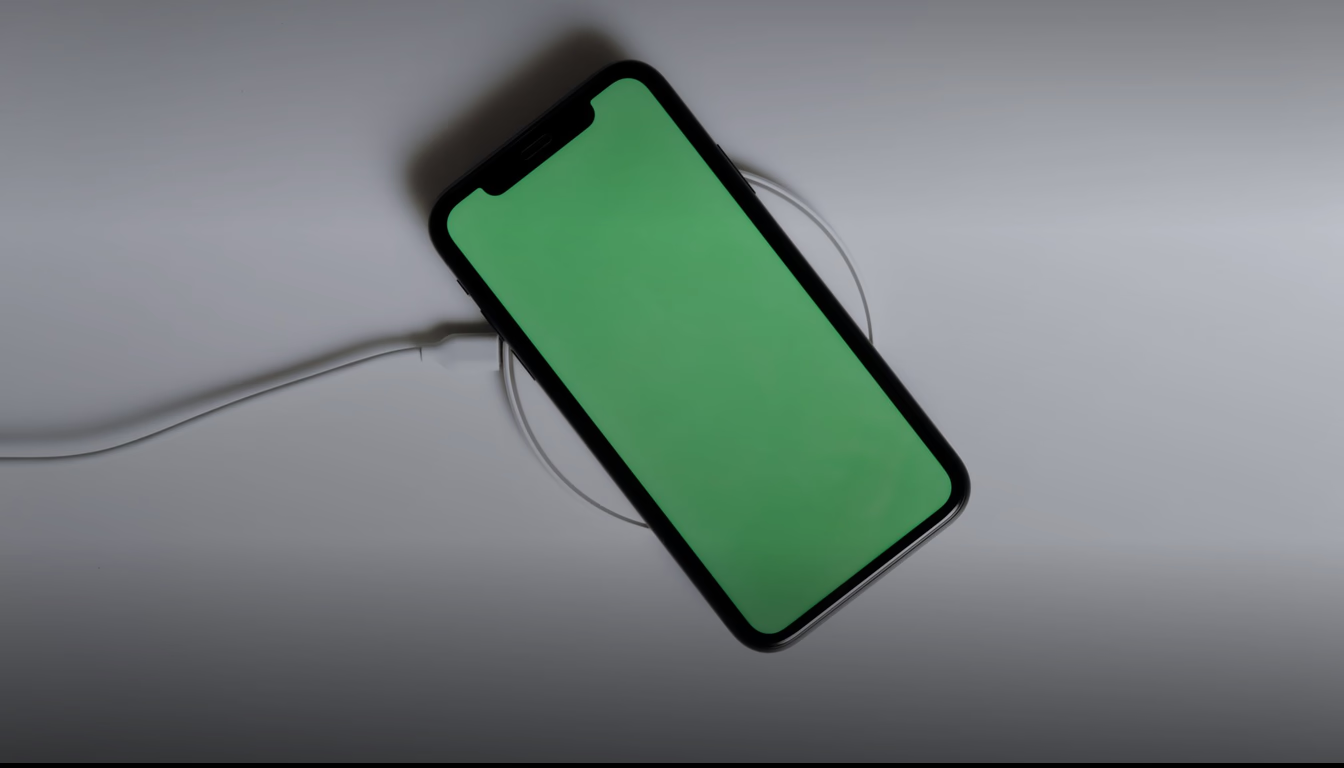
The pad on your nightstand does not ask what phone you own. You set your phone on it without checking if it's the 'right' charger, and it just works. That casual trust is the whole trick, and it is younger than the physics behind it. Magnetic coupling that carries power across a gap was demonstrated in the 1800s. The lithium cell shipped in 1991. Ferrite cores and heat sensors were solved problems by the 2010s. What did not exist was an agreement: a promise that any certified pad would talk to any certified phone. So the real question is not how the power crosses the gap. It is why competitors ever agreed to let it cross the same way.
- 73%
- Share of the wireless charging market that runs on the single Qi standard.
- 102.1°C
- How hot a stray screw gets in two minutes with no foreign-object detection.
- 30°C
- Extra peak heat in a wirelessly charged cell without electrochemical thermal control.
When the fields matured
Each field had to produce a specific result before Wireless Charging could exist as you know it. The timeline below shows when each one arrived.
Pull any thread, and the same story unravels.
In the order the story needs them, not the order they happened. Each card carries the year its field matured.
Keystone
The promise that any pad fits any phone
Before 2010, a wireless charger was a walled garden, matched to one brand and useless with the rest.
Flip over a wireless charger and you may find a small Qi logo. That mark is a promise, not a feature: this pad has passed the Wireless Power Consortium's certification and will charge any phone carrying the same mark. The consortium, formed in 2008, got rival manufacturers to agree on one shared rulebook so any certified pad would talk to any certified phone. Roughly 73% of the wireless charging market now runs on that one rulebook, and it is the scale behind it that made pads cheap. The science was ready years earlier. Coils, cores, and safety chips all worked. What no engineer could supply was the willingness of Samsung, Apple, and dozens of others to build to the same rules.
Without this field
Without Wireless Power Consortium standardization around Qi, wireless charging fragments into brand-specific protocols, forcing users to buy a different charger for each device. The lack of an agreed interoperability and certification framework undermines manufacturer confidence in cross-brand compatibility, sharply limiting ecosystem scale and slowing adoption across phones, wearables, vehicles, and infrastructure.
About 73% of the wireless charging market runs on Qi. Without a single standard, that share is what splinters into incompatible formats.
How we know
The Qi specification launched in 2010 at 5 watts for low-power devices, and certification requires interoperability testing against the WPC baseline before a product may carry the logo.
Source: IEEE Wireless Power Transfer Market Interoperability 2023 (2023) · tier1
A rulebook decides who may play. It cannot make the power cross efficiently; that job fell to a ceramic being refined in materials labs.
The dark tile that funnels the magnetic field
Slip a phone off its charger and the pad barely warms. Credit a brittle black ceramic tucked under the coil.
Under every charging coil sits a thin, dark tile of manganese-zinc ferrite, a ceramic that guides magnetic fields the way a channel guides water. Air lets the field spray in every direction and waste itself as heat. The ferrite gathers the flux, the magnetic field lines, and aims them at the receiving coil. J. L. Snoek's group at Philips worked out these ceramics in the 1940s, decades before anyone had a phone to charge with them. Measured against the same coils in open air, a ferrite-cored link holds the better efficiency across the whole useful transfer range, which is why every certified pad has one.
Without this field
Without soft ferrite cores, wireless charging coils couple mainly through air, cutting the coupling coefficient and raising flux leakage, eddy currents, and core losses at practical frequencies. Efficiency falls toward air-core baselines, forcing shorter transfer distances, lower power, and much tighter alignment for reliable charging.
How we know
Source: Study of Load Characteristics in Wireless Power Transfer System with Ferrite Core (2018) · tier2
Efficient coupling is safe only when the field finds a phone. Drop a coin on the pad and a different problem starts to cook.
The chip that notices a coin, not a phone
Leave a key on an active charging pad and it can grow too hot to touch within minutes.
Set a phone on the pad and it charges. Set a metal key there instead and the same field dumps its energy into the metal as heat. Foreign object detection is the pad's habit of watching for that mismatch: it tracks how much power leaves versus how much the receiver reports back, plus the Q-factor, a measure of how cleanly the coil resonates, and cuts off when the loss looks wrong. Without it, a small metal screw on a pad can reach 102.1 degrees Celsius in two minutes, hot enough to melt nearby plastic. Y. Zhang and J. Lu formalized the checks that let a transmitter renegotiate down or shut off.
Without this field
Without foreign object detection and closed-loop power control, pads keep driving full power even when coins, keys, or other metal sit in the field, causing rapid inductive heating that can exceed 100°C in minutes and melt plastic surfaces. Without power-loss and Q-factor negotiation, transmitters cannot renegotiate lower or shut down when excess loss flags a foreign object.
Without foreign object detection, a small metal screw on a charging pad can hit 102.1 degrees Celsius in two minutes.
How we know
Source: A review of foreign object detection (FOD) for inductive power transfer systems (2019) · tier1
The pad can deliver clean, guarded power. Something on the far side still has to store it without catching fire.
The cell that survives an uneven charge
Power arriving through a coil pulses and warms unevenly, and a bad battery answers with fire.
Inside the phone sits a lithium-ion cell, commercialized in 1991 by Akira Yoshino and John Goodenough. Its thin protective film on the anode, the solid electrolyte interphase, lets it absorb wireless charging's lumpy current safely. Without electrochemically tuned thermal control, an inductively charged cell can run about 30 degrees Celsius hotter, past the safe 0 to 45 degree window.
Without this field
Without battery electrochemistry, lithium-ion cells lack a stable solid electrolyte interphase and controlled intercalation, so they cannot safely accept the fluctuating, uneven currents and heat of inductive charging. Wireless chargers would either have no practical storage medium or drive lithium plating, thermal runaway, and rapid capacity loss, making consumer systems untenable.
Without electrochemistry-guided thermal control, an inductively charged lithium cell can run about 30 degrees Celsius hotter than optimized designs.
How we know
Source: Review on modeling of the anode solid electrolyte interphase (SEI) for lithium-ion batteries (2018) · tier1
Watch
A visual companion to the fields above.
Takeaway
The physics was never the bottleneck. Faraday showed fields could carry power in the 1830s, the lithium cell was a store-shelf item by 1991, and ferrite cores and safety chips were mature engineering before the first modern phone pad shipped. What arrived last was permission. In 2008 the Wireless Power Consortium formed, and by 2012 enough phone makers had committed to Qi that a certified pad became a safe bet in any drawer. The agreement is what turned four solved problems into a phone that charges on any pad you happen to find. That is why the honest hero here is the least technical one. A chemist, a materials scientist, and an engineer had each done their part in isolation. Their work only reached your nightstand once competitors signed the same rulebook and stopped shipping chargers that spoke only to themselves.
References
- IEEE Wireless Power Transfer Market Interoperability 2023 (2023) tier1
Wireless Power Transfer: A Paradigm Shift for the Next Generation, IEEE Trans Power Electronics, 2023
- Study of Load Characteristics in Wireless Power Transfer System with Ferrite Core (2018) tier2
Meng Wang, Jing Feng, Minghui Shen & Yanyan Shi, Progress In Electromagnetics Research M, vol. 74 (2018), 137-145. Measures a magnetic-resonance coupling link with and without a ferrite core and finds the cored version more efficient across the transfer region above the critical load.
- A review of foreign object detection (FOD) for inductive power transfer systems (2019) tier1
Yiming Zhang, Zhengchao Yan, Jiaqi Zhu, Siqi Li & Chris Mi, eTransportation, 2019. Surveys how inductive charging systems spot metal and living objects in the field, covering system-parameter, wave-based and field-based detection.
- Review on modeling of the anode solid electrolyte interphase (SEI) for lithium-ion batteries (2018) tier1
Wang, Kadam, Li, Shi, Qi, npj Computational Materials, 2018