Riiven Threads
Washing Machine
The Liberation Nobody Priced
The story you know
The washing machine was invented by a clever inventor who put a tub and a motor together, and that freed people from laundry drudgery.
What the record shows
The drum and motor were the least of it: detergent chemistry, vibration control, and efficiency policy each had to mature before the machine worked well and cheaply. Even the liberation story is contested, since household labor economics shows that time saved often turned into higher cleanliness standards rather than less work.
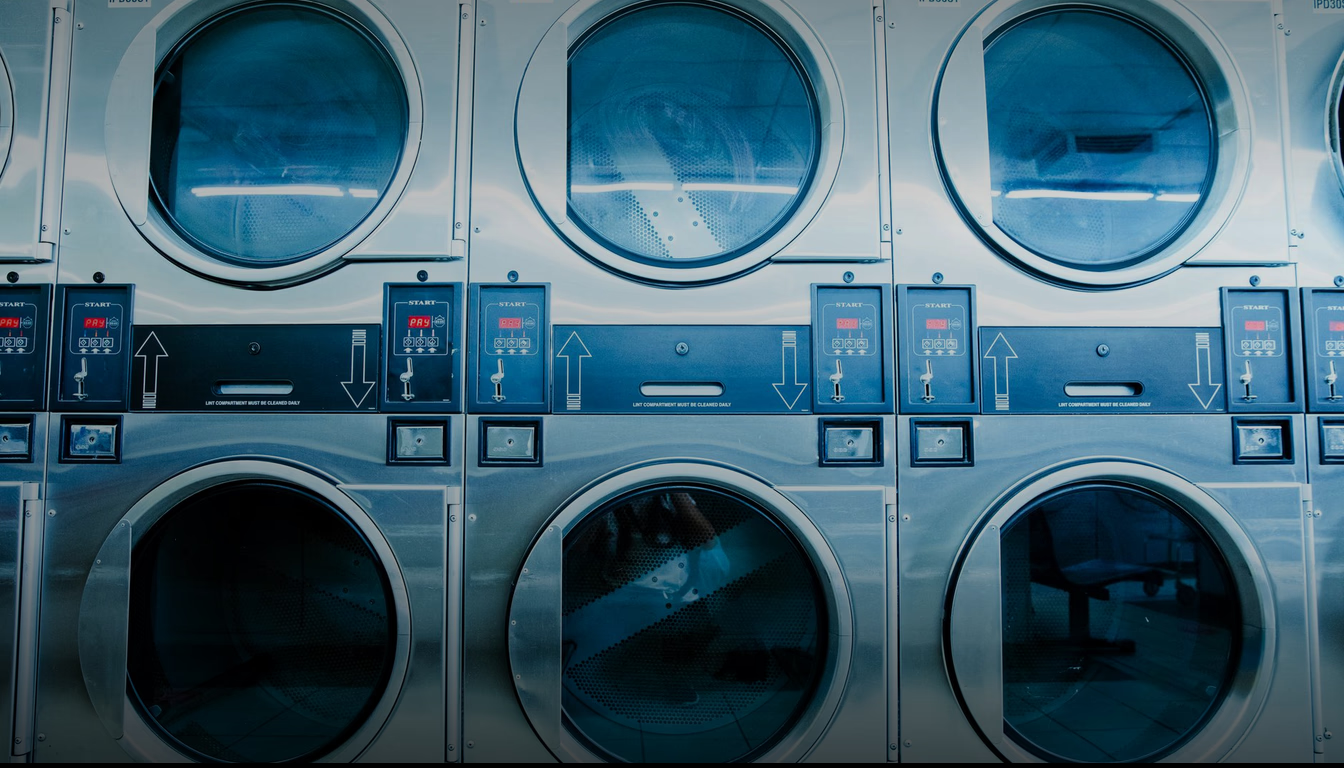
Thirty seconds after the Start button, a wet, lopsided load of towels is spinning at over 1,000 rpm, and the floor is not shaking. That calm is harder won than the drum. A metal tub that turns has been easy to build for a long time. The hard problems lived elsewhere. Plain water had to learn to lift grease off cotton. An off-center lump had to stop shoving the cabinet across the tiles. Buyers, and then the federal government, had to decide a machine was worth building well. Different people solved each of those while chasing different goals. So the question is not who invented the washing machine. It is how a chemist's soap, an engineer's springs, an economist's ledger, and a 1988 rulebook ended up inside the same white box.
- 4×
- How much worse resonance vibration was in a tested washer without its balancer and fixes.
- 3trillion gal
- Water DOE expects its later washer standards to save on machines shipped 2015 to 2044.
- 1,988year
- Federal efficiency standards for residential clothes washers first took effect.
- 1,946year
- Tide synthetic detergent arrives, giving the drum chemistry that can actually move grease.
When the fields matured
Each field had to produce a specific result before Washing Machine could exist as you know it. The timeline below shows when each one arrived.
Pull any thread, and the same story unravels.
In the order the story needs them, not the order they happened. Each card carries the year its field matured.
Keystone
Why a wet bath mat doesn't move the machine
A single wet bath mat can make a drum lurch. Tomas Nygårds and Vladimir Berbyuk modeled why, and how to stop it.
Throw one soaked bath mat into the drum and the load clumps on one side. At spin speed that clump drags the drum around in a circle. The pull travels through the springs and dampers (the washer's shock absorbers, like a car's) into the cabinet. Every suspended drum also has a resonance, a speed where it naturally wants to sway, the way a playground swing climbs from small, well-timed pushes. The spin must pass through that speed on its way up. Tomas Nygårds and Vladimir Berbyuk modeled this motion and studied ways to tame it, including an automatic balancer that shifts weight to offset the clump. Without those measures, vibration at resonance in the tested machine ran four times higher. Shaking like that is how some designs walk across the floor.
Without this field
Without vibration engineering, an uneven wet load would create rotating forces that shove the suspended drum and send vibration through the springs and dampers into the cabinet. Because the suspension has a low-frequency resonance, spinning up through that speed amplifies the motion. The machine could shake severely and, in some designs, walk across the floor.
Without the vibration fixes and automatic balancer, the tested washer shook four times harder at resonance.
How we know
Source: Modeling and Optimization of Washing Machine Vibration Dynamics (2008) · tier2
Long before engineers fought the wobble, chemists were working on a different failure: water that slides right off grease.
Teaching water to hold on to grease
Butter on a sleeve shrugs off plain water. In 1946 a synthetic detergent gave the drum something that could grab it.
A butter smear on a shirt sleeve survives plain water no matter how hard the drum churns. Oil and water refuse to mix, so agitation alone mostly pushes grease around. Surfactants fix that: one end of each molecule clings to oil and the other to water, like a handle the rinse can pull. Builders tie up hard-water minerals that would otherwise blunt the wash. When Tide arrived as a synthetic detergent in 1946, the machine gained a chemical partner that could lift oily soil and keep it from settling back.
Without this field
Without surfactants and detergent builders, water would wet oily soils poorly and fail to disperse grease for rinsing, and hard-water minerals would weaken cleaning further. A washing machine could still agitate and rinse fabric, but oily stains would be more likely to stay put or redeposit after the cycle.
How we know
Source: Development of Tide Synthetic Detergent (2006) · tier2
Detergent makers answered to shoppers, not regulators. The federal rulebook took shape decades later in Washington, with no interest in stains.
The rulebook that made thrift mandatory
Two washers can look identical on the showroom floor while one uses far more water. Since 1988, federal standards have set the floor.
A washer that sips water looks exactly like one that gulps it under showroom lights. Since 1988, the U.S. Department of Energy has set minimum efficiency standards for residential clothes washers, giving every maker the same floor to build above. Tougher rules were set in 2012 and became mandatory in 2015 and 2018. DOE estimates those later rules will save 3 trillion gallons of water across machines shipped from 2015 to 2044. The standards also gave buyers a common basis for comparing models.
Without this field
Without appliance efficiency policy, manufacturers would face less pressure to cut washer energy and water use, and shoppers would have less standardized information for comparing models. DOE standards have covered residential clothes washers since 1988, and later rounds are credited with large savings on energy bills and water.
Without the 2012 standards, mandatory in 2015 and 2018, the projected 3 trillion gallons saved on 2015 to 2044 shipments would be lost.
How we know
Source: Consumer Clothes Washers (2026) · tier1
Regulators counted gallons. Economists and historians, working separately, were asking what the machine actually did to a household's week.
The hours the machine was supposed to free
A washboard and a wringer once ate a full day. Economists asked what buying that day back was worth.
A tub, a washboard, and a wringer once filled a whole day. A 2005 paper co-written by Jeremy Greenwood argued that electrification and falling appliance prices let households trade money for that time. Historian Ruth Schwartz Cowan found the catch: machines cut the scrubbing, but laundry loads and cleanliness standards grew to fill the gap.
Without this field
Without household labor economics and domestic technology history, the washer's market case would miss how households weigh appliance costs against the value of their time and earnings, and how electrification and cheaper appliances drove adoption. The history also warns against assuming freed time is automatic: machines eased physical effort while laundry workloads and cleanliness standards expanded.
How we know
Source: Engines of Liberation (2005) · tier1
Watch
A visual companion to the fields above.
Takeaway
Strip away any one of these and the box on your laundry-room floor fails in a specific way. Without surfactants, the rinse leaves grease behind on the shirt. Without balancers and tuned springs, a 1,000 rpm load passes through resonance and the cabinet starts to travel. Without the 1988 standards and the rules that followed, a gulping machine and a sipping one sit side by side with nothing to tell them apart. Their overlap produced a washer that relies on chemistry to clean and suspension physics to stay put, and that sips water because a regulator made thrift the price of entry. The ledger still has one open line. Economists showed the washer bought back hours of scrubbing. Ruth Schwartz Cowan showed households spent much of that time washing more, to higher standards. The water savings are projected out to 2044. Nobody has yet priced whether the hours ever came back.
References
- Modeling and Optimization of Washing Machine Vibration Dynamics (2008) tier2
T. Nygårds, V. Berbyuk, A. Sahlén, Proc. MOVIC, 2008
- Development of Tide Synthetic Detergent (2006) tier2
American Chemical Society, Development of Tide Synthetic Detergent
- Consumer Clothes Washers (2026) tier1
U.S. Department of Energy, Consumer Clothes Washers
- Engines of Liberation (2005) tier1
Greenwood, Seshadri & Yorukoglu, Review of Economic Studies, 2005