Riiven Threads
Vacuum Flask
The Trust Problem
The story you know
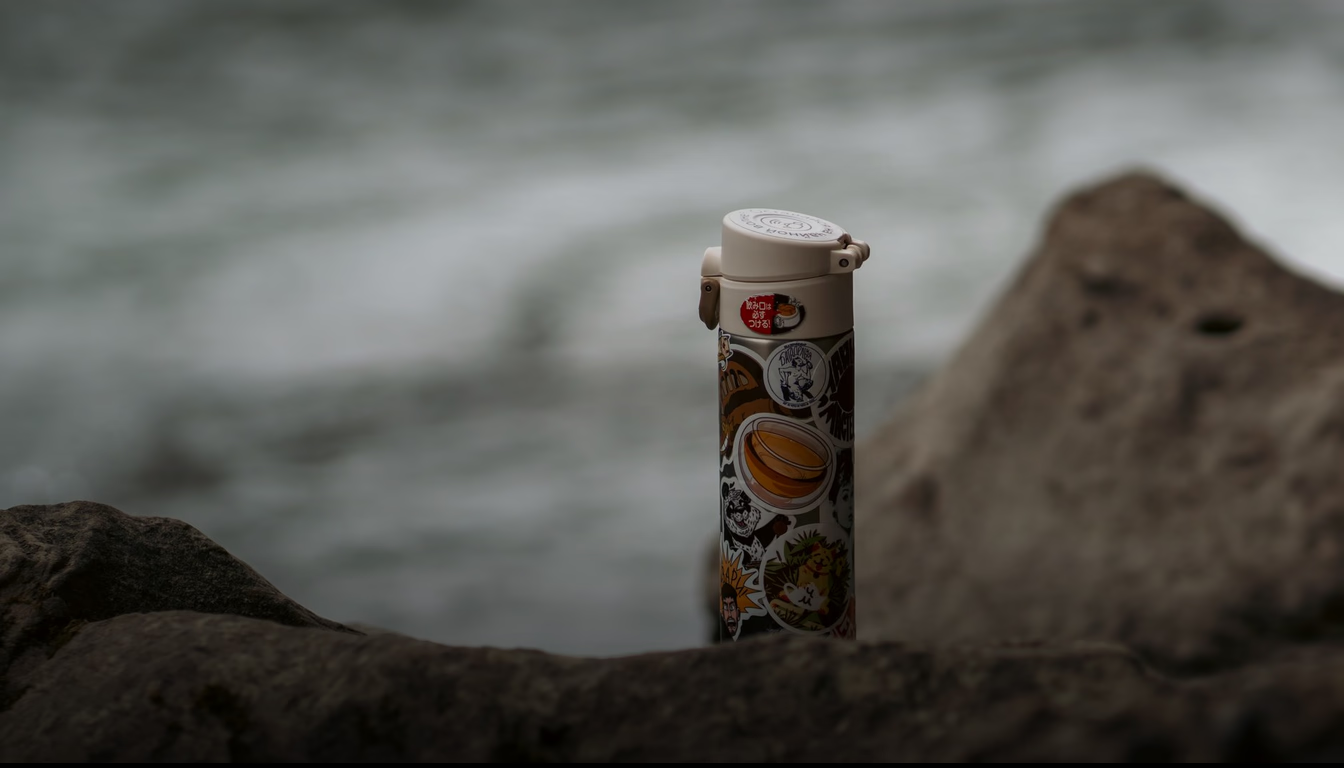
The vacuum flask was invented once, by James Dewar, and the Thermos company just packaged his lab equipment for kitchens.
What the record shows
Dewar's 1892 flask depended on borosilicate glass chemistry maturing the very same year and vacuum sealing engineering solving outgassing independently, and even then nobody could verify a flask's real performance until standardized thermal testing arrived over a hundred years later.
Pour coffee into your thermos and check the "keeps hot for 12 hours" label on the box. The physics behind that claim was settled in 1892, when James Dewar sealed a silvered glass vessel with the air pumped out of its walls and watched liquefied gases sit still instead of boiling away. Everything needed to hold heat existed by the end of that decade: the mechanism, the glass, the pump. What did not exist was any way for a buyer to check the hours on the box against the hours in the kitchen. Two flasks could look identical and lose heat at different rates, and nobody could say which was lying. So the question is not how a flask keeps coffee hot. It is why it took until 2000 to prove one did.
- 0mmHg
- Residual gas pressure reported between the walls of silvered Dewar flasks.
- 54°C
- Thermal shock a borosilicate wall survives, against 16 °C for ordinary soda-lime glass.
- 70°C
- Minimum temperature a mid-size flask must still hold six hours after filling.
- 0W/m²K⁴
- Stefan-Boltzmann constant, the rate heat radiates across an empty gap.
When the fields matured
Each field had to produce a specific result before Vacuum Flask could exist as you know it. The timeline below shows when each one arrived.
Pull any thread, and the same story unravels.
In the order the story needs them, not the order they happened. Each card carries the year its field matured.
Keystone
Kill the draft and two thieves remain
Pump the air out of a gap and you stop the draft. James Dewar's 1892 vessel had to stop two quieter losses.
Blow across hot soup and it cools fast, because moving air carries heat away. Empty the space between two glass walls and that mechanism is gone. What survives is heat conducted through whatever gas is left and heat radiated across the gap as infrared light, which crosses a vacuum happily. Dewar's flask attacks both: evacuate the gap to starve conduction, silver the facing surfaces so they reflect infrared instead of absorbing and re-emitting it. Radiated heat follows the Stefan-Boltzmann constant, 5.67 x 10^-8 watts per square metre per kelvin to the fourth, which is why a shiny low-emissivity coating matters as much as the pump. Without that split, you would evacuate a flask and still wonder why it cooled.
Without this field
With no account of radiation and solid conduction, a designer would suppress convection and stop there, leaving the two remaining heat paths uncontrolled and unreflected.
Without radiation physics, nothing predicts heat crossing the empty gap at the Stefan-Boltzmann constant, 5.67 x 10^-8 W/(m2 K4).
How we know
Source: History of the Vacuum Flask (1940) · tier1
Knowing gas conducts heat is one thing. Getting the gas out, and keeping it out for years, was a separate trade.
The gas that sneaks back in
A vacuum is not a state you reach. It is a state you defend against the walls themselves.
Glass and metal hold gas on their surfaces and slowly let it go, a process called outgassing, like a damp sponge drying into a sealed room. That is why pumping a flask once is not enough: the walls refill the gap from the inside. Early metal flasks made the point by going flat over time. Silvered Dewar flasks were reported down around 0.0001 mmHg of residual gas, roughly ten millionths of atmospheric pressure, which leaves almost nothing to conduct heat across the wall. Sealing the pump-off tip without cracking the glass is its own craft.
Without this field
Residual and readmitted gas restores a conduction path across the gap, and a slow leak quietly erases the flask's only insulating barrier.
Without evacuation and gas control, a flask never reaches the 0.0001 mmHg residual pressure reported for silvered Dewar flasks.
How we know
Source: Silvering and evacuating Pyrex Dewar flasks (1931) · tier2
A perfect vacuum is worthless in a vessel that cracks. Glass chemists were solving that problem for laboratory ware, not thermoses.
Making the number on the box checkable
Two flasks on a shelf, both promising twelve hours. For a century, nothing on the shelf could settle which one was right.
Heat retention depends on fill temperature, how full the flask is, room temperature and how long you wait, so any two testers got two answers. EN 12546-1, published in 2000, fixed those conditions and split flasks by capacity. A 401 to 600 ml flask has to still read at least 70 °C six hours after filling, measured the same way by anyone who repeats it. That gave buyers a comparable figure and gave manufacturers a pass or fail line to push their seals and silvering against.
Without this field
Without a common test, retention claims are not comparable across sizes or brands, and makers have no repeatable target to improve seals and vacuum against.
Without EN 12546-1, no verifiable basis exists for a 401 to 600 ml flask holding 70 °C after six hours.
None of that test matters if the vessel splits on the first pour of boiling water.
Glass that survives the first pour
Hot water into a cold glass cracks it. The inside of a flask lives at that boundary every morning.
Borosilicate expands less when heated, so the inner and outer walls fight each other less. It tolerates a 54 °C shock against 16 °C for ordinary soda-lime glass. That margin is what lets a thin double wall take boiling coffee daily.
Without this field
Mismatched expansion between the walls raises thermal stress on every fill, and the double-wall vessel becomes a cracking risk rather than a durable container.
Without borosilicate, thermal-shock tolerance drops from 54 °C to the 16 °C reported for soda-lime glass.
How we know
Source: Shattering glass cookware (2021) · tier2
Takeaway
Dewar's flask worked the first time and kept working, which is exactly why the gap lasted so long. A sealed silvered vessel that holds liquid oxygen looks like a finished problem, and for a laboratory it was. Consumers got something subtler: a sealed object whose performance is invisible from the outside, made by a company whose vacuum you cannot inspect. A slow leak shows up only in lukewarm coffee, hours later, when you have no way to blame it. EN 12546-1 turned the number on the box into a claim someone else can repeat: fill a 401 to 600 ml flask, wait six hours, measure at least 70 °C. That test did not improve the physics by one watt. It made the hours legible, and it gave manufacturers a pass or fail line to chase with better seals. The flask held heat from 1892. It held its word from 2000.
References
- History of the Vacuum Flask (1940) tier1
BRAGG, Nature, 1940
- Silvering and evacuating Pyrex Dewar flasks (1931) tier2
Bureau of Standards Journal of Research, 1931
- EN 12546-1:2000 Materials and articles in contact with foodstuffs, Insulated containers for domestic use, Part 1: Specification for vacuum ware, insulated flasks and jugs (2000) tier2
CEN, EN 12546-1:2000, specification and thermal test requirements for vacuum ware and insulated flasks.
- Shattering glass cookware (2021) tier2
R. Roeder, University of Notre Dame teaching paper, 2021