Riiven Threads
Infrared Thermometer
Reading Fever From Afar
The story you know
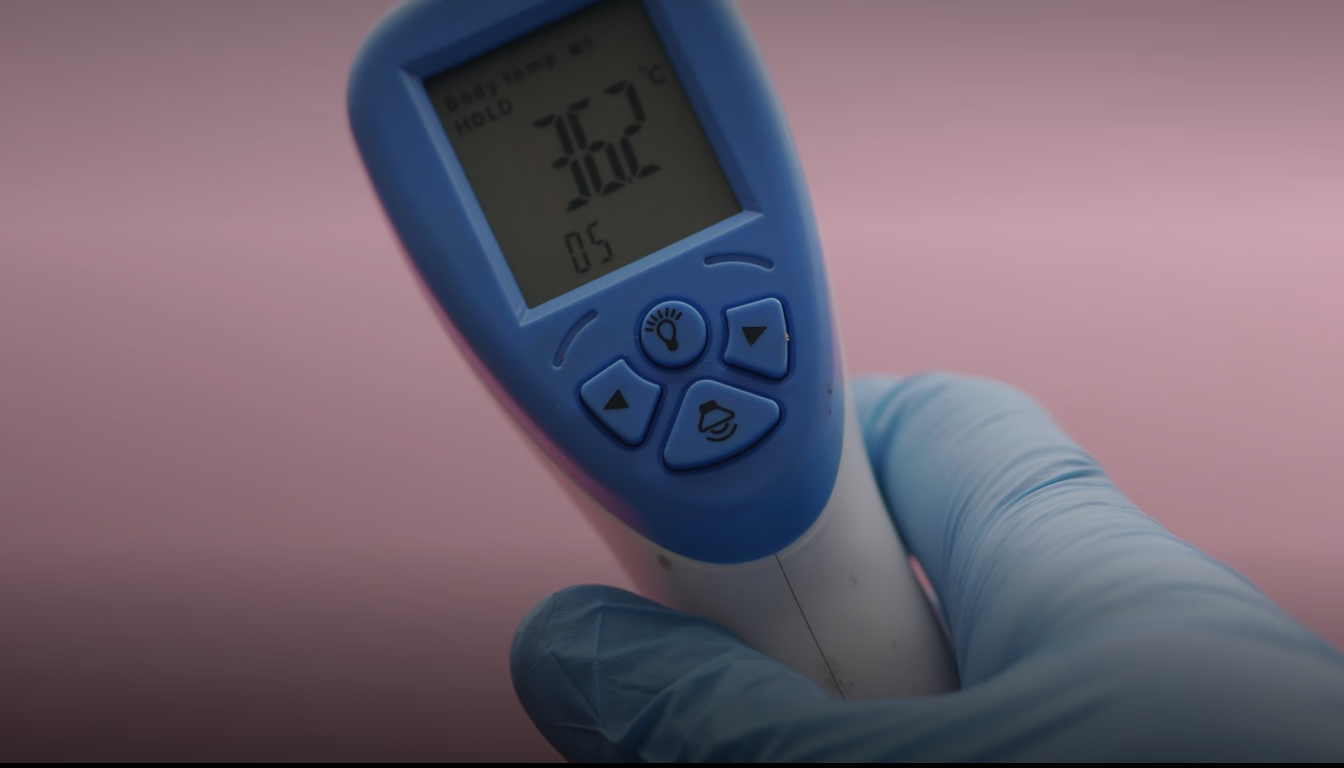
The infrared thermometer is a gadget that simply sees heat: point it at something and it reads the temperature directly, like a camera for warmth.
What the record shows
The device never sees temperature. It infers it from infrared radiance using Planck's law, through a detector, special non-glass optics in the 8 to 14 µm band, and calibration tied to temperature standards. Remove any one of these and the number has no documented meaning.
Someone points a small plastic gun at your forehead before you enter a building, and a number appears in under a second. Nothing touched your skin, which was partly the point. A mercury bulb under the tongue waits to feel your warmth. This device caught invisible light leaving your face, turned it into a tiny voltage, and translated that voltage into degrees. Each step belongs to a different discipline. One is a law of physics written down in 1900. Another is a detector built to sense almost nothing. A third is a lens that ordinary glass cannot be, and the last is a calibration trail tying one gun to every other. When the screen says 36.6 and the door opens, what exactly are you trusting?
- 4.4°C
- Equivalent error of a Planck-calibrated cutting-tool thermometer from 150 °C to 1000 °C.
- 0.1°C
- Resolution of the thermopile infrared thermometers tested in a 2010 study.
- 97%
- Average infrared transmission of a 2.2 mm germanium window; optical glass passed almost none.
- 0.3°C
- NIST calibration uncertainty for radiation thermometers between 700 °C and 900 °C.
When the fields matured
Each field had to produce a specific result before Infrared Thermometer could exist as you know it. The timeline below shows when each one arrived.
Pull any thread, and the same story unravels.
In the order the story needs them, not the order they happened. Each card carries the year its field matured.
Keystone
The 1900 equation that turns glow into degrees
A stove burner glows orange before you ever touch it. In 1900 Max Planck wrote down exactly how that glow tracks temperature.
Hold your hand near a hot pan and you feel heat without contact. Everything warmer than absolute zero sheds that kind of light, mostly as invisible infrared. In 1900 Max Planck published the curve linking how much light an object emits, at each wavelength, to its temperature. That curve is the dictionary an infrared thermometer reads from. Without it, the detector's output is a voltage with no meaning. The curve describes an ideal emitter, so real devices correct for emissivity, which measures how well a surface radiates compared with that ideal, the way matte black outshines polished chrome. A 2018 fiber optic thermometer built to watch cutting tools, calibrated with Planck-law band radiance, showed an equivalent temperature error of 4.4 °C from 150 °C to 1000 °C.
Without this field
Planck's law relates a target's spectral radiance to its temperature, which is what lets an infrared thermometer convert detected radiation into a temperature reading. Without it, the detector's signal could not be interpreted quantitatively as temperature. Practical readings also have to account for the target's emissivity.
A cutting-tool thermometer calibrated with Planck-law band radiance showed a 4.4 °C equivalent error between 150 °C and 1000 °C.
How we know
Planck's law gives spectral radiance as B(λ, T) = (2hc² / λ⁵) / (e^(hc / λkT) - 1), where h is Planck's constant, c the speed of light, k Boltzmann's constant, λ wavelength and T absolute temperature. A practical thermometer sees only a band of wavelengths, so its calibration integrates this curve over that band and scales it by the target's emissivity.
Source: Miniature Uncooled and Unchopped Fiber Optic Infrared Thermometer for Application to Cutting Tool Temperature Measurement (2018) · tier1
Planck settled the theory on paper. Turning a forehead's faint heat into a readable signal was a separate problem, worked out at the bench.
A chain of metal joints that feels warmth
Join two different metals and warm the joint, and a small voltage appears. A thermopile strings many of those joints together.
Touch two different metal wires together, heat the joint, and a trickle of voltage appears. That is the Seebeck effect, the same principle a gas furnace uses to confirm its pilot flame is lit. A thermopile links many such joints in series so absorbed infrared becomes a measurable electrical signal. Thermopile infrared thermometers in a 2010 evaluation had 0.1 °C resolution, the smallest temperature step they could distinguish. That study did not show the detector alone guarantees the figure.
Without this field
Without thermopile engineering, an infrared thermometer would lack a detector that converts absorbed infrared radiation into an electrical signal through the Seebeck effect. Thermopile thermometers have been documented with 0.1 °C resolution, though the evidence does not establish that detector engineering alone guarantees that resolution.
Thermopile infrared thermometers in a 2010 study had 0.1 °C resolution, fine enough to separate small temperature differences.
How we know
Source: Evaluation of Performance and Uncertainty of Infrared Thermometers (2010) · tier1
Detector builders chased a stronger signal. Whether two instruments agreed with each other was a question for metrology labs keeping their own standards.
Why two guns should give one number
Two kitchen scales can disagree about the same apple. Radiation thermometers faced that problem until labs gave them a shared reference.
Point two cheap thermometers at the same mug and they may disagree. Calibration fixes that by aiming each instrument at a blackbody, a cavity built to glow like Planck's ideal emitter. NIST assigns that cavity's temperature by contact or radiation thermometry and ties it to ITS-90, the international temperature scale every lab shares. NIST calibrated lightpipe radiation thermometers, which gather infrared through a thin rod much as a fiber carries light, from 700 °C to 900 °C with about 0.3 °C uncertainty. That documented chain is what makes a reading defensible.
Without this field
Without radiometric calibration tied to temperature standards, infrared thermometer readings would have no documented path to a common reference, and results from different instruments would be hard to compare reliably. NIST calibrates radiation thermometers against variable-temperature blackbodies whose temperatures are assigned through contact or radiation thermometry.
NIST calibrated lightpipe radiation thermometers between 700 °C and 900 °C to about 0.3 °C uncertainty, traceable to ITS-90.
How we know
The 2005 NIST work served rapid thermal processing, the fast heating of silicon wafers during chip manufacturing. Its 0.3 °C figure is a standard uncertainty at coverage factor k = 1, meaning one standard deviation, with results traceable to the International Temperature Scale of 1990 (ITS-90).
Source: Traceable Temperature Calibrations of Radiation Thermometers for Rapid Thermal Processing (2005) · tier1
None of that calibration helps if the radiation never reaches the detector, and that problem belonged to materials scientists rather than physicists.
A lens that cannot be made of glass
A window pane lets sunlight in yet holds back a room's heat. That same glass would blind an infrared thermometer.
Ordinary glass looks clear but is effectively opaque from 8 to 14 µm, wavelengths measured in thousandths of a millimeter. Germanium, a gray semiconductor that resembles dull metal, lets that infrared through. A 2.2 mm germanium window averaged more than 97% transmission from 7 to 14 µm, while optical glass passed almost none.
Without this field
Ordinary glass is effectively opaque in the 8 to 14 µm band, so a glass lens or window would block the thermal radiation an infrared thermometer needs to measure. Infrared-transmitting materials such as germanium let that radiation reach the detector, though their transmission depends on material, thickness, and coatings.
A 2.2 mm germanium window averaged more than 97% infrared transmission from 7 to 14 µm; optical glass passed negligible amounts.
How we know
Source: Infrared Thermography for Monitoring of Freeze Drying (2022) · tier1
Watch
A visual companion to the fields above.
Takeaway
By 1990 the pieces fit inside something you could hold in one hand: a thermopile behind a germanium window, electronics applying Planck's curve, and a calibration traced back to a reference blackbody. That year the handheld reached clinics and factory floors. Their meeting produced a temperature you can take without contact, in under a second, that still answers to the same international scale as a NIST laboratory blackbody. That last part is the fragile one. Planck's curve describes an ideal emitter, and skin bends the assumption with sweat, wind, and the chill of a cold lobby. The detector can resolve 0.1 °C while the forehead it watches has drifted for reasons no lens can see. Calibration proves the gun reads a blackbody correctly. It cannot prove the person in front of it behaves like one. So the number on the screen is only as honest as its least visible link, the gun shows no sign of which link is weak, and the weakest is usually the forehead.
References
- Miniature Uncooled and Unchopped Fiber Optic Infrared Thermometer for Application to Cutting Tool Temperature Measurement (2018) tier1
Authors not shown in search result, Sensors, 2018
- Evaluation of Performance and Uncertainty of Infrared Thermometers (2010) tier1
Evaluation of Performance and Uncertainty of Infrared Thermometers, 2010
- Traceable Temperature Calibrations of Radiation Thermometers for Rapid Thermal Processing (2005) tier1
NIST, Traceable Temperature Calibrations of Radiation Thermometers for Rapid Thermal Processing, 2005
- Infrared Thermography for Monitoring of Freeze Drying (2022) tier1
Infrared Thermography for Monitoring of Freeze Drying, 2022