Riiven Threads
Smoke Detector
A Century Late Alarm
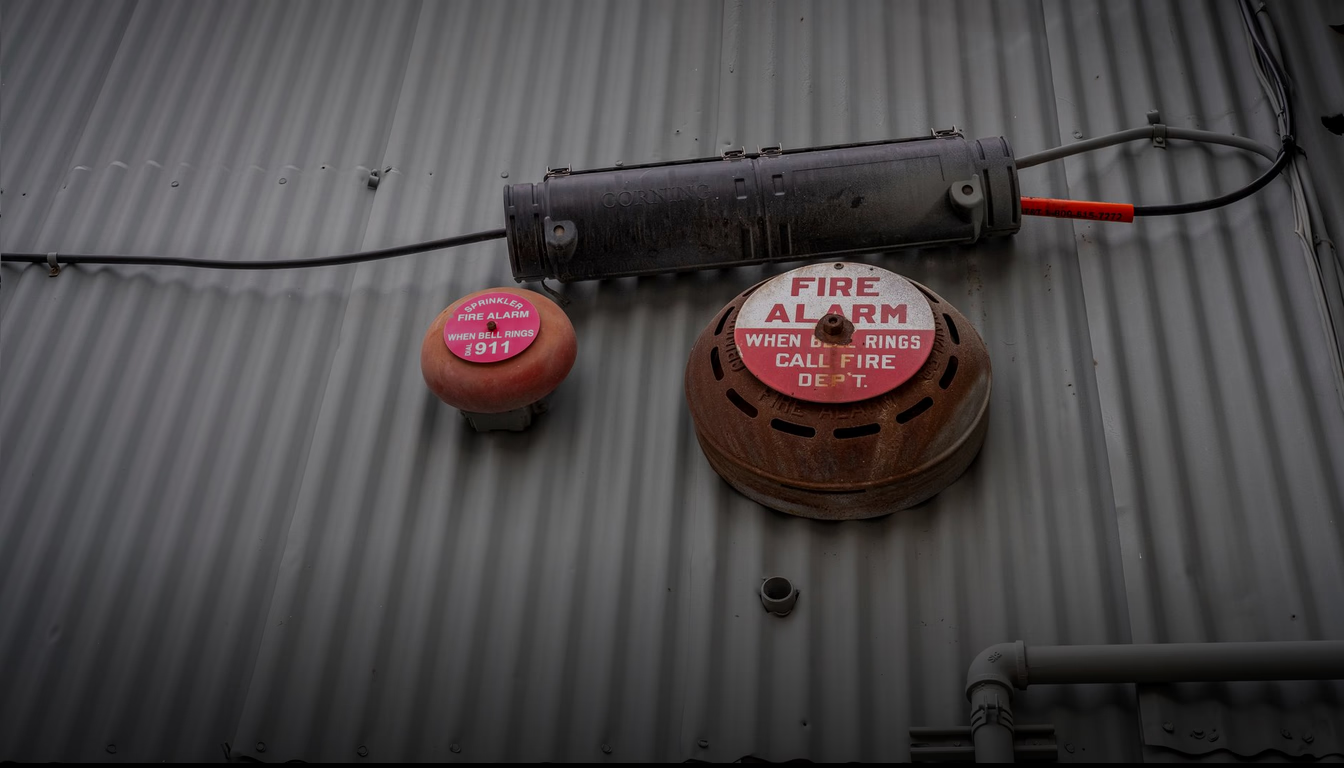
The toast catches, the ceiling shrieks, and you wave a dish towel at the box until it quits. You silence a false alarm from burnt toast without thinking twice. That casual annoyance is the tell. A gadget that can sort burnt bread from a house fire is doing something four separate disciplines spent a century learning, and none of them set out to build a smoke detector. A 1954 theory of noisy signals, a 1969 nuclear licensing rule, 1980 combustion chemistry, and optical engineering that only matured in 2019 all had to arrive before the alarm earned trust. The real question is why the thing stayed unreliable for so long after most of the parts were ready.
- 0.3µm
- The particle size where ionization sensing hands off to light scattering.
- 1µCi
- Americium 241 per detector, the limit that made unlicensed home sales legal.
- 6.6%/m
- The obscuration threshold NIST tuned photoelectric chambers to hold.
When the fields matured
Each field had to produce a specific result before Smoke Detector could exist as you know it. The timeline below shows when each one arrived.
Pull any thread, and the same story unravels.
In the order the story needs them, not the order they happened. Each card carries the year its field matured.
Keystone
The little beam that arrived last
Inside a photoelectric detector, an LED points past the sensor, not at it. Smoke is what bends the light onto it.
Inside the detector sits a tiny dark room with an LED aimed just past a photodiode. Clean air lets the light pass unseen. When smoke drifts in, its particles scatter the beam sideways onto the sensor, and the alarm reads that stray light as fire. The catch is Mie scattering, the rule that a particle bounces light hardest when it is roughly the size of the light's own wavelength. Get the LED color or the sensor angle wrong, and the chamber either ignores real smoke or screams at cooking steam. NIST's fire team only nailed the geometry that holds a tuned 6.6% obscuration per metre threshold in 2019. That late tuning is the reason the modern alarm can finally separate steam from smoke.
Without this field
Without photoelectric and Mie scattering engineering, detectors could not tune optical chambers to fire at the light-obscuration levels where testing shows reliable early warning. They would sit below sensitivity for real smoke or trigger constantly on benign aerosols.
Without tuned photoelectric Mie scattering, alarms lose the 6.6% obscuration per metre sensitivity, raising thresholds and delaying activation in fire tests.
How we know
Bukowski and colleagues at NIST (Tech Note, 2005) measured dual photoelectric/ionization alarms head to head, documenting how much later flaming and smoldering fires register on each sensor type and setting the case for pairing them.
Source: NIST 901648 dual photoelectric/ionization alarm study (2005) · tier1
Tuning the optics meant nothing until someone measured what smoke particles actually are, work done in a separate lab counting aerosols.
Someone had to count the smoke
Smoke is not one thing. A smoldering couch and a flaming pan throw off particles of wildly different sizes.
Through the early 1980s, Mulholland and Liu pushed monodisperse aerosols, clouds of droplets all one size, through detector chambers and watched what tripped them. They found the split that defines the whole industry. Ionization sensors react to particles smaller than about 0.3 micrometers, while light scattering only responds strongly above that size. Below that line a smoldering fire is nearly invisible to optics; above it, ionization struggles. Without those measured curves, engineers had no honest way to set a threshold, so a chamber would either miss slow fires or false-alarm on kitchen haze.
Without this field
Without combustion and aerosol chemistry, engineers would not know that ionization detectors respond almost linearly to particle size and favor particles under 0.3 micrometers, while light scattering favors larger ones. That ignorance would wreck threshold and chamber design.
Without aerosol sizing calibration, ionization detectors lose about 0.03 mg/m³ of sensitivity margin, forcing thresholds too high to catch early flaming fires.
How we know
Source: NIST JRES 85(3): Response of smoke detectors to monodisperse aerosols (1980) · tier1
Those ionization sensors leaned on a speck of radioactive metal, and whether it could legally sit in your hallway was a separate fight in Washington.
Why radioactive metal sits in your hallway
Every ionization alarm carries a sliver of americium 241, a radioactive metal. In a home. Legally.
An ionization detector ionizes the air, meaning it knocks electrons loose so a faint current flows until smoke interrupts it. The source that does the knocking is americium 241. Selling millions of radioactive products to families who hold no license required a rule stating that this little is safe. In 1969 the Atomic Energy Commission set the exempt limit at 1 microcurie of americium 241 per detector, small enough to distribute without a license. Without that line drawn, every household install would have needed its own radiation permit, and mass production would never have begun.
Without this field
Without nuclear source licensing policy, manufacturers could not rely on exempt frameworks that let ionization detectors ship while owners stay unlicensed. Regulators would lack activity limits and design criteria for household radioactive sources, blocking mass production.
Without the 1 microcurie americium 241 exempt limit per detector, each household install would need an individual radiation license.
How we know
Source: NRC SECY 78 492 ionization smoke detectors (1978) · tier1
Hardware and permits still left one problem: deciding, mathematically, when a jittery signal means fire. That answer came from a field born decades before any of this.
The rule for when to cry wolf
Every sensor faces the same bind: react to each flicker and cry wolf, or wait for certainty and react too late.
Signal detection theory gives a principled way to set that trigger point, trading misses against false alarms along a measurable curve. It is what lets an engineer say a chamber is better than a coin flip and prove it with a number, instead of tuning the threshold until the office stops complaining. Every alarm threshold is a chosen point on that curve, and choosing it is a decision about how many burnt-toast mornings you will tolerate to catch one real fire.
Without this field
Statistical signal detection theory gave detectors a framework to choose thresholds that balance hits and false alarms. Without it, design lacked any principled way to set operating criteria under noise, so alarms would trigger too easily or too rarely.
An area under the curve of 0.5 is the chance baseline. Detection theory is what lets a designer measure the distance above it rather than guess.
How we know
Source: Signal detection theory: a review of its basis and application (2020) · tier1
Watch
A visual companion to the fields above.
Takeaway
For decades the alarm overhead was a compromise. The chemistry knew what smoke was by 1980. The permit for a radioactive source was settled in 1969. The math for picking a threshold had been sitting there since 1954. What lagged was the optics: an LED and a photodiode tuned finely enough to read scattered light without mistaking shower steam or a seared steak for danger. When that optical tuning finally caught up in 2019, UL 217's eighth edition could demand dual sensors that pass the burnt-toast test and real smoldering fires alike. That is why the towel-waving annoyance is so recent. The device that cries wolf less often is not smarter about fire; it is better at listening to particles the size of light. The slowest part to mature, it turned out, was the part that looked simplest: a little beam in a dark box.
References
- NIST 901648 dual photoelectric/ionization alarm study (2005) tier1
Bukowski et al, Performance of Dual Photoelectric/Ionization Smoke Alarms, NIST Tech Note, 2005
- NIST JRES 85(3): Response of smoke detectors to monodisperse aerosols (1980) tier1
Mulholland GW, Liu BYH, J. Res. Natl. Bur. Stand. 85(3), 1980: response of six smoke detectors to nearly monodisperse aerosols from 0.05 to 1.3 micrometers.
- NRC SECY 78 492 ionization smoke detectors (1978) tier1
SECY 78 492 Ionization Type Smoke Detectors, NRC Staff Paper, 1978 (NRC, SECY report, 1978)
- Signal detection theory: a review of its basis and application (2020) tier1
A homily on signal detection theory, PMC, 2020