Riiven Threads
Ballpoint Pen
The Physics Came Later
The story you know
Laszlo Biro invented the ballpoint pen in the 1930s and that solved writing forever.
What the record shows
Biro's patent predates a working, reliable pen by decades; the ink stopped smearing only once quick-dry solvent chemistry matured in 1955, the ball stopped deforming only once tungsten carbide powder metallurgy matured in 1963, and courts were still sorting out who owned any of it into the early 1960s.
Click a pen and sign a receipt without a second thought, and you are trusting a metal sphere about a millimeter wide to meter out a controlled film of oily ink and then stop the moment you lift your hand. That trick was being sold by the billion in the 1960s. Nobody could yet say, in measurable terms, why the ball did not seize in its socket, why the ink did not run out overnight, or what happened in the sliver of fluid between metal and paper. The chemistry, the metallurgy, and the courtroom fights that funded both arrived first. So the question is not who invented the pen. It is how a device outran its own physics for half a century.
- 1,450HV
- Vickers-equivalent hardness of the standard tungsten carbide pen ball, per a 1973 Parker Pen patent.
- 90%
- Share of ink solvent still wet on paper without fast evaporation.
- 40%
- Friction rise at the ball without tribology-tuned lubricant additives in the ink.
- 488,000USD
- Royalties riding on the ballpoint patents in 1946, in 1946 dollars.
When the fields matured
Each field had to produce a specific result before Ballpoint Pen could exist as you know it. The timeline below shows when each one arrived.
Pull any thread, and the same story unravels.
In the order the story needs them, not the order they happened. Each card carries the year its field matured.
Keystone
The tiny sphere that refuses to flatten
Press a pen down hard and the ball takes a few hundred megapascals of contact pressure. Softer metals give.
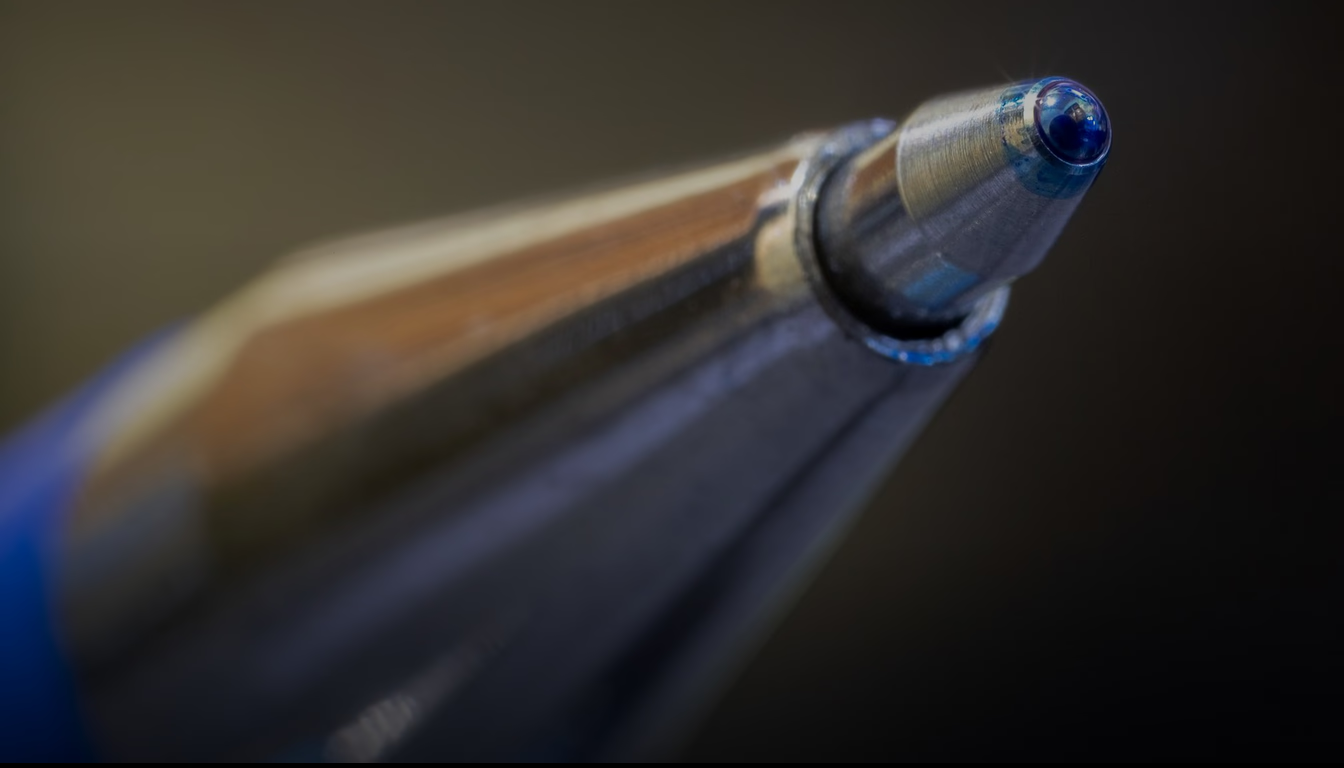
The ball is not just round, it is a seal. It sits in a socket with a clearance measured in microns, and that gap is what meters the ink and stops it draining out when the pen sits nib down in a bag. A ball made of soft metal deforms under writing loads, goes slightly oval, and widens that gap. A sintered tungsten carbide ball measures about 1450 HV on the Vickers scale, roughly the range of a machine tool cutting edge. Powder metallurgy, pressing and heating carbide grains into a solid sphere, made that hardness cheap and repeatable. By 1963 Bic's licensing consolidated the supply, and one manufacturing standard fed the world's pens.
Without this field
Softer balls plastically deform under writing pressure, going rough and oval. The clearance between ball and seat opens, the metering seal fails, and the pen leaks, scratches, and dies after a short writing distance.
The tungsten carbide and cobalt cemented carbide used for pen balls measures about 1450 DPH hardness. A ball soft enough to fall well short of that range deforms under writing pressure and loses its seal.
How we know
Vickers hardness (HV) is measured by pressing a diamond pyramid into the surface and measuring the dent. Sintering fuses tungsten carbide powder with a metal binder below the melting point, giving near-full density with grain sizes controlled to hold sphericity.
Source: Ball point pen writing ball composed of a cemented carbide composition (US Patent 3,746,456) (1973) · tier1
A perfect ball only matters if what passes under it stops moving once it lands on paper.
Ink that beats your own hand across the page
Left-handed writers know the failure mode: a smeared blue streak across the heel of the palm.
Ballpoint ink is pigment and resin carried in heavy oils and glycols, chosen because they will not evaporate inside the tube. That same stubbornness is a problem the instant the ink hits paper. The Biro brothers' formulations, refined through the 1950s, balanced solvents that soak into the fibers fast while the resin sets into a fixed film. Without that fast loss, roughly 90 percent of the solvent would still sit wet on the surface minutes after writing. Stacked carbon-copy forms and signed receipts depend on the line being touch-safe before the next page lands on it.
Without this field
High boiling oils stay mobile on the surface, so lines smear under the writing hand and transfer to adjacent sheets. The resin and pigment network never sets, making fast note taking and stacked documents impractical.
Without fast evaporation, about 90 percent of the ink solvent remains wet on paper minutes after writing.
How we know
Rohr and colleagues tracked the drying using gas chromatography with mass spectrometry, separating and identifying the solvent molecules leaving the paper over time. The technique is now standard in forensic document dating, where residual solvent indicates how recently a signature was made.
Source: GC/MS study of ballpoint ink drying (2007) · tier1
Good ink and hard balls still need someone willing to fund factories, which was being settled in Chicago courtrooms.
The royalties that paid for the tooling
Eversharp sued Fisher Pen Co. over ballpoint patents, and a Northern District of Illinois judgment landed in 1961.
Building a ball to micron tolerance requires tooling that no company buys on a hunch. In the postwar scramble, dozens of makers copied ballpoint designs outright, and copying is cheaper than licensing. Enforceable patents changed that arithmetic by turning a design into a stream someone would pay for. Close to half a million 1946 dollars in royalties rode on the ballpoint patents, and that money paid for refinement rather than only for lawyers. Eversharp and Eberhard Faber committed to production capacity on the strength of it. Without that, the ballpoint stays a novelty with inconsistent quality.
Without this field
Without exclusive rights, competitors free ride instead of paying licenses. Royalty funded scale up collapses, coordinated investment in tooling never happens, and the ballpoint stays niche rather than becoming a mass market instrument.
Roughly half a million 1946 dollars of royalty income would vanish, and with it the funding for large-scale production.
How we know
Source: Eversharp v Fisher Pen Co. 204 F.Supp.649 (1961) · tier2
By the time the money and the metallurgy settled, the actual physics at the ball was still unmeasured.
Measuring the film nobody had measured
In 2006 Takahiro Fujii and Yasuo Masuda finally measured what happens in the sliver between ball, ink and paper.
The ball never touches the socket directly. A thin layer of ink separates the two, the same way oil keeps an engine bearing off its shaft, and that layer is what makes writing feel smooth instead of scratchy. Tribology, the study of surfaces in sliding contact, gave manufacturers a way to tune ink additives against that film rather than guess. Strip out the optimized additives and the friction coefficient at the contact rises by up to 40 percent, enough to wear and seize the ball in its socket. The pen was forty-three years into mass production before anyone published the numbers.
Without this field
The ball and socket drop into boundary or mixed lubrication, where surfaces touch directly. Friction and adhesive wear climb, the bearing roughens, and the tip either starves of ink or blots and leaks within minutes.
Without tuned lubricant additives in the ink, friction at the ball rises up to 40 percent, causing wear and seizure.
How we know
Fujii and Masuda used nano-tribological measurement to characterize the metal, ink and paper interface, distinguishing a stable fluid film regime from boundary lubrication, where asperities on the two surfaces actually touch and tear.
Source: Nano-tribological study ball-point pen smoothness (2006) · tier1
Watch
A visual companion to the fields above.
Takeaway
The pen on your desk is a bearing you throw away. Its ball has to be hard enough not to flatten, its ink thin enough to flow and thick enough to stay put, and someone had to be paid enough to build hundreds of millions of them to identical tolerance. What 1963 produced was a disposable precision bearing cheap enough to lose in a coat pocket, sealed by ink that dries before your palm reaches it. The unresolved part is the order of events. Bic was shipping tungsten carbide tips at industrial scale forty-three years before Fujii and Masuda measured what the lubricant film at the contact was actually doing. Factories had tuned the ink by trial, batch after batch, until it wrote well. The measurement, when it came, mostly confirmed that the trial-and-error had found the right regime. That is worth remembering the next time a technology is dismissed for lacking theory.
References
- Ball point pen writing ball composed of a cemented carbide composition (US Patent 3,746,456) (1973) tier1
Parker Pen Co patent, filed 1971 and granted 1973, on cemented carbide ballpoint pen writing balls. Table 3 reports conventional tungsten carbide plus cobalt cemented carbide at 1450 DPH microhardness, the baseline the patent's corrosion-resistant alloy is measured against.
- GC/MS study of ballpoint ink drying (2007) tier1
Weyermann C, Kirsch D, Costa Vera C, Spengler B, Forensic Science International 168, 2007. GC/MS study of how ballpoint ink solvent leaves the paper after writing.
- Eversharp v Fisher Pen Co. 204 F.Supp.649 (1961) tier2
Eversharp Inc v Fisher Pen Co, N.D. Illinois patent infringement judgment awarding royalties on ballpoint patents, 1961
- Nano-tribological study ball-point pen smoothness (2006) tier1
Fujii T et al, Nano-Tribological Study on the Smoothness of Writing with a Ball-Point Pen, Bull Chem Soc Jpn, 2006