Riiven Threads
Radial Tire
The Patent That Waited
The story you know
Michelin invented the radial tire in 1946, patented it, and that settled how tires would be built forever.
What the record shows
The 1946 patent relied on 19th-century vulcanization chemistry and new steel-cord metallurgy, but the tire's flex-fatigue behavior wasn't rigorously modeled until viscoelastic polymer physics matured around 1983, and US regulators didn't standardize safety requirements until 1975, decades after the 'invention.'
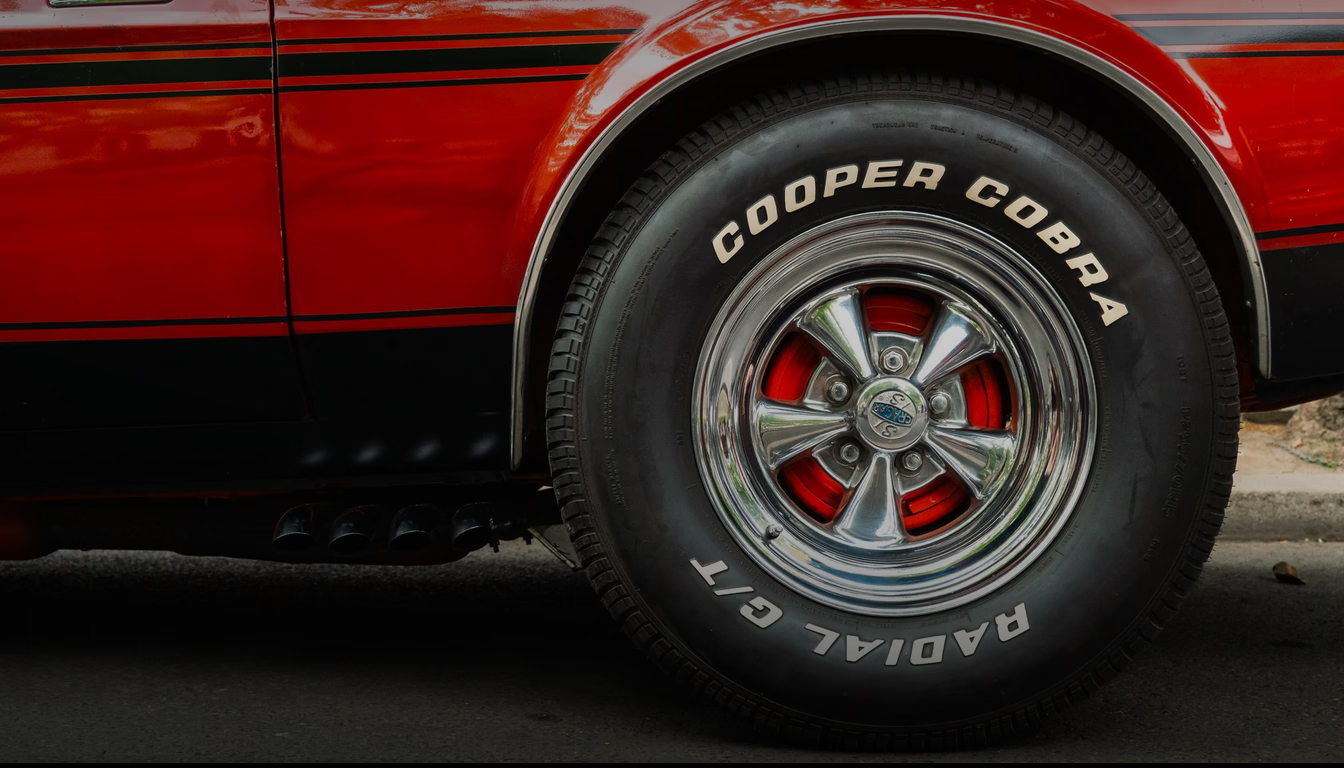
Crouch beside a parked car and read the sidewall. There is a DOT code, a load rating, a speed letter, all stamped into rubber that flexes and recovers a few hundred times a minute at highway speed. Michelin patented the radial layout in 1946, with the cords running straight across the tire and a steel belt hooped under the tread. It worked. Nobody could fully say why the rubber survived the flexing, because the physics of how rubber loses energy as heat was not pinned to rolling resistance in print until 1983. So a product was sold for nearly forty years ahead of its own explanation. The question is what finally made American drivers trust it.
- 2,800MPa
- Tensile strength class of the high-carbon steel cord hooping the tread.
- 90%
- Share of passenger-car rolling resistance traced to non-elastic rubber effects.
- 34hours
- Endurance run at rated load a tire must survive under standardized testing.
- 16.1minutes
- Cure time without an effective accelerator system, versus 2.9 for the fastest.
When the fields matured
Each field had to produce a specific result before Radial Tire could exist as you know it. The timeline below shows when each one arrived.
Pull any thread, and the same story unravels.
In the order the story needs them, not the order they happened. Each card carries the year its field matured.
Keystone
The rubber that stopped going sticky
Raw rubber softens in summer and takes a permanent dent under load. Charles Goodyear fixed that with sulfur in 1844.
Press a thumb into raw rubber and the dent tends to stay. Heat it with sulfur and something changes: short sulfur links form between the long rubber chains, so the material stretches and then pulls itself back. That recovery is the whole basis of a radial tire, where the sidewall flexes every single revolution and the tread squashes flat against the road millions of times over a tire's life. Without a working cure network, rubber creeps, gets tacky in heat, and loses the shape a belted casing depends on. Cure chemistry also set the factory clock. Later accelerator packages cut the time in the mold from 16.1 minutes to 2.9, which is what made the radial a mass product rather than a specialty item.
Without this field
Without sulfur vulcanization, tire rubber would soften, turn tacky and take permanent set under heat and load. The sulfur crosslink network is what lets rubber hold its shape through repeated flexing, and without it radial construction is not durable.
Without an effective sulfur cure system, optimum cure time reaches 16.1 minutes, against 2.9 for the fastest accelerator tested.
How we know
Source: Chemistry of the vulcanization and protection of elastomers: A review of the achievements (2002) · tier1
Cured rubber alone still bulges under load. The stiffening had to come from a wire mill, not a rubber lab.
A hoop of wire under the tread
Cut a radial tire open and the tread hides a mat of brass-coated wire. Pierre-Marcel Bourdon's 1946 design put it there.
The radial idea is simple to draw: cords straight across the casing, then a stiff belt wrapped around the crown so the tread sits flat instead of squirming. Drawing it is easy. Finding wire fine enough to bend forever and strong enough to hold the hoop was not. High-carbon steel cord in the 2,800 MPa tensile class supplied that reinforcement, stiff enough to stabilize the tread under load. The other half of the problem was glue. Brass plating on the wire lets rubber bond chemically to steel, and a weak bond at that interface is where belts peel away from tread.
Without this field
Without high-carbon steel belt cord, the tread would lack the high-modulus reinforcement that stabilizes the crown under load. The belt would deform more readily, and poor brass-coated cord adhesion could let the rubber separate from the steel.
Without steel cord in the 2,800 MPa tensile class, the radial loses the reinforcement that resists tread deformation under load.
How we know
Source: State of the Art for High Tensile Strength Steel Cord (1987) · tier2
The tire was already on European roads while the question of where its energy went sat unanswered in physics.
Why a warm tire is a fed tire
Touch a tire after an hour of driving and it is warm. That heat is fuel, and it took until 1983 to price it properly.
Rubber does not give back everything you put into it. Squeeze it and release, and a slice of the energy leaves as heat rather than push, which is why a rolling tire warms up and why the engine has to keep paying. A 1983 study tied radial-tire rolling resistance almost linearly to how much energy the tread compound loses per cycle, with roughly 90% of passenger-car rolling resistance attributed to those non-elastic rubber effects. Before that link was quantified, low-loss compounds were a matter of trying batches. After it, engineers could aim: pick a rubber whose losses at road frequencies are small, and the fuel number follows.
Without this field
Radial tires flex cyclically by design. Without viscoelastic polymer physics, engineers could not quantify energy loss per cycle or frequency-dependent stiffness, leaving rolling-resistance prediction and low-loss compound design to guesswork, and fuel-efficiency engineering unreliable.
About 90% of passenger-car rolling resistance comes from non-elastic rubber effects that could not be modeled without viscoelastic physics.
How we know
Source: Relationship of Tire Rolling Resistance to the Viscoelastic Properties of Rubber (1983) · tier2
None of that reached a buyer. What reached buyers was writing on the sidewall, argued out in regulatory committees.
The letters that made a tire buyable
A load rating and a speed letter mean nothing unless everyone measures them the same way. That agreement landed in 1975.
American drivers met radials as an import with a reputation for going flat differently than they expected. The obstacle was not rubber. It was that a load number from one plant and a durability claim from another rested on different test benches, which made ratings unarguable and liability murky. Standardized load, speed, durability and sidewall marking rules gave the radial a common language, including a 34 hour run at or near rated load to prove it could shed heat. Once the sidewall meant the same thing on every tire, a fitment could be specified rather than trusted.
Without this field
Without standardized load, speed, durability and sidewall identification requirements, radial tires would have no consistent basis for approval, selection or liability. Makers and carmakers would face incompatible test methods and unclear ratings, slowing adoption and raising the risk of unsafe tire-vehicle pairings.
Without standardized endurance testing, no tire would have to prove it resists heat buildup for 34 hours near rated load.
How we know
Source: More Than 50 Years of Standardisation (2015) · tier2
Watch
A visual companion to the fields above.
Takeaway
The 1946 patent was not the finish line. Steel cord gave the tread a hoop that would not squirm, sulfur chemistry gave the rubber a network that came back to shape, and the physics that explained the heat losses arrived last, in 1983. What sat between the invention and the driveway was trust. The 1975 US standards turned a French construction method into a legible American product: a stamped load rating, a speed letter, and a 34 hour endurance run behind both. That is why a tire shop can hand you a replacement without knowing your car, and why a physicist in the 1980s could still be measuring, in a lab, why the thing under your fender loses energy the way it does. The rubber was doing work nobody had the equations for yet.
References
- Chemistry of the vulcanization and protection of elastomers: A review of the achievements (2002) tier1
Coran, Journal of Applied Polymer Science, 2002
- State of the Art for High Tensile Strength Steel Cord (1987) tier2
Nippon Steel, technical report, year not stated in search result
- Relationship of Tire Rolling Resistance to the Viscoelastic Properties of Rubber (1983) tier2
Academic study linking radial-tire rolling resistance nearly linearly to tread-material hysteresis.
- More Than 50 Years of Standardisation (2015) tier2
ETRTO, More Than 50 Years of Standardisation, 2015