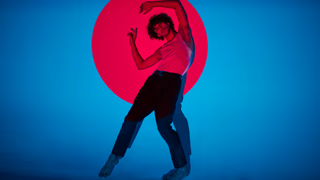
The performer falls. The audience gasps. For one held second, five hundred strangers share the same caught breath, with no screen between them and no replay button to soften the landing. That shared breath is the whole reason physical theatre festivals exist, and it’s also a quiet signal of where live performance is heading.
A Crowd Holds Its Breath
When five hundred people gasp together, the gasp becomes part of the show.
 Photo by
 The crowd isn’t just watching the work. It completes it.
That exchange runs both directions. “Liveness,” as theatre researchers call it, is the simple fact that performer and audience occupy the same air and respond to each other in real time. A dancer feels the room go still and slows down to let the silence stretch. The audience feels the dancer notice them and leans in a little closer.
Festivals concentrate this effect. Instead of one show, attendees move through several in a few days, and their openness builds across each visit. American Theatre captured it plainly in its reporting from Physical Theater Festival Chicago:
“physical theatre is not just about the bodies onstage. It is about bodies in space, together, sharing an ephemeral experience.” [American]
That shared, vanishing moment is exactly what a camera cannot pass along.
What Screens Cannot Give
Physical theatre speaks through the body first, and the body says things a flat frame cannot hold.
 Photo by
 A single camera angle catches one corner of the stage. A live spectator catches everything at once: the runner in the back, the trembling hand at the front, the shift of weight before a leap.
The small physical signals matter most. The faint sound of a foot landing, the visible effort of a lift, the breath you can almost hear from the third row. A 2024 scholarly study of contemporary physical theatre found that this kind of sensory engagement reaches audiences through their bodies, not only through following a story in their heads. [Jurnal]
Watching a person genuinely risk a fall produces a jolt of empathy that a screen tends to flatten. That visceral pull is why people come back the next year.
-
Live viewers take in the whole stage, not one framed slice
-
Subtle sound and effort register in the body, below conscious thought
-
Real physical risk creates empathy that recorded footage softens
Festivals Signal the Future
A festival doubles as a workshop in plain sight.
 Photo by
 Programmers seek out work that tests what a body can narrate, so each edition reads like a quiet forecast of where the form is going.
International lineups widen that vocabulary. When companies arrive carrying movement traditions absent from Western training, audiences leave reading the human body a little differently. Small-theatre festivals have long played a pivotal role in shaping contemporary theatre culture.
The festivals also stay stubbornly human at ground level. Organizers tend to frame an event like Physical Theater Festival Chicago as a community gathering, one that welcomes neighbors who have never set foot in a theatre and want to be blown away. After more than a decade of editions, audiences clearly keep arriving.
The person sitting beside you at a physical theatre festival might be a future maker of the form, watching it take its next shape in real time.
There’s a moment near the end of a strong physical theatre show when the performer goes utterly still and the room holds that stillness back. Gone the instant the lights shift, unrepeatable, impossible to archive. The next time a crowd around you catches its breath at once, notice that you’re not just watching the work. You’re one of the bodies in the room making it real, and no screen has ever been able to hand you that.