A Boy Standing in Sand
There is a drawing of a hat. Or perhaps it is a boa constrictor that has swallowed an elephant whole. The difference depends entirely on who is looking.
This is how Antoine de Saint-Exupéry opens 『The Little Prince』, his slender novella written in 1942 while exiled in New York and published there the following year, far from a war-torn France he would never set foot in again. The narrator, a pilot stranded in the Sahara, recalls how adults looked at his childhood drawing and saw only a hat. They advised him to put away his pencils and study geography instead. So he did. He became a grown-up who talked about bridge and golf and politics, and he lived very much alone.
I think about this opening often. Not because it is clever, though it is. But because I recognize the quiet devastation in it. Somewhere between childhood and now, most of us learned to see hats instead of elephants. We learned that the practical interpretation is the correct one, that wonder is a luxury we cannot afford, that the invisible things are less real than the visible ones.
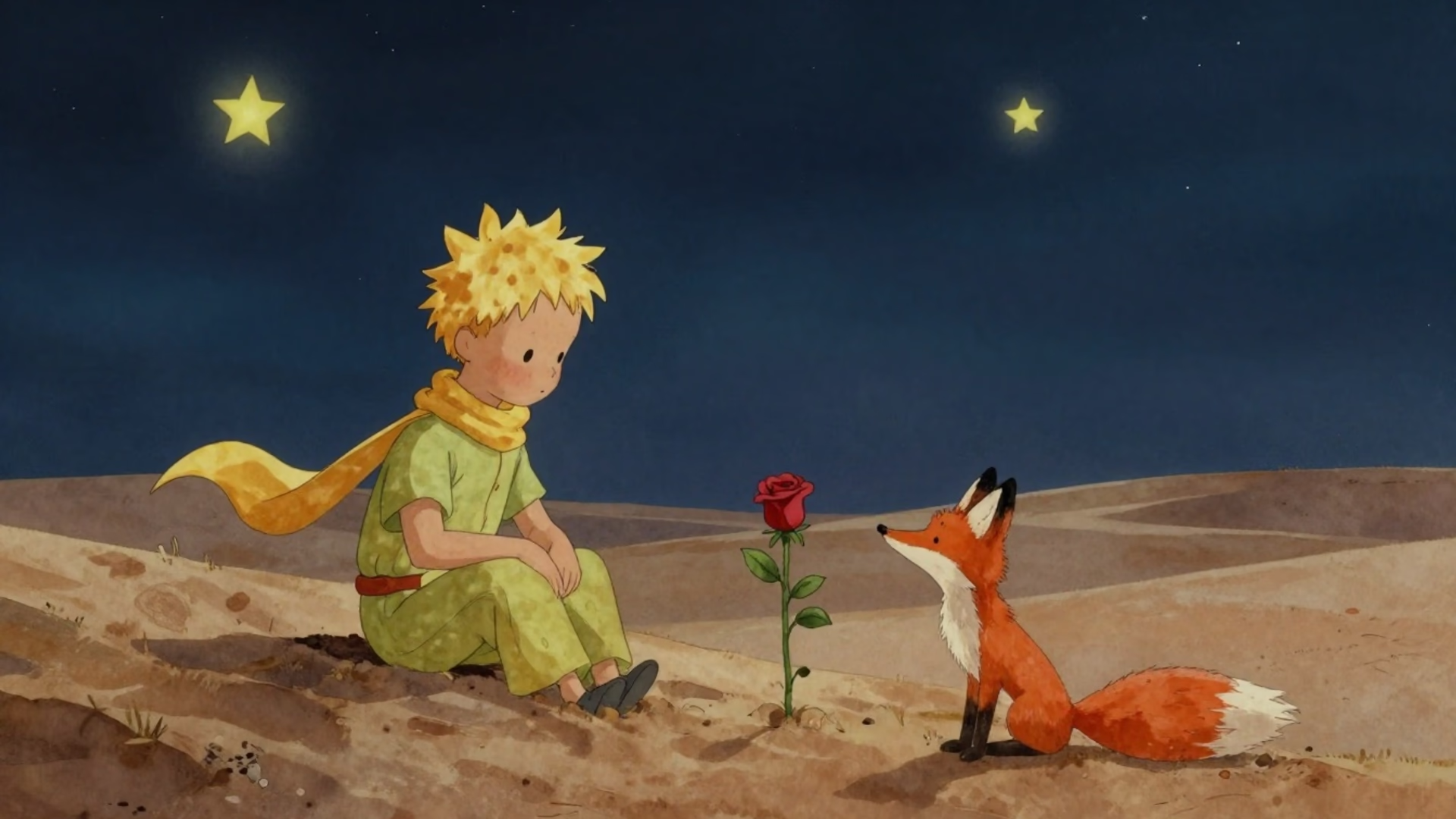
The desert in Saint-Exupéry’s story is vast and silent. It stretches in every direction with no landmarks, no water, no other human beings for a thousand miles. Into this emptiness falls a small boy with golden hair, who has traveled from an asteroid no bigger than a house. He asks the pilot to draw him a sheep. Not an explanation. Not a reason. Just a sheep.
The scene is absurd. A man facing death from thirst, his plane broken beyond repair, being asked to draw farm animals for a child who claims to live on a star. And yet something in the pilot responds. He draws. He fails. He draws again. Finally, frustrated, he sketches a box with three holes and says the sheep is inside.
The little prince is delighted. “That is exactly the way I wanted it.”
Here is a boy who can see through boxes. Here is a man who has forgotten how.
The Weight of What We Forget
 Photo by
 Saint-Exupéry wrote this book during one of the darkest periods of his life. He was a pilot grounded by age and injury, watching from across an ocean as his country burned. The loneliness in these pages is not invented. It rises from the text like heat from sand.
The little prince tells the pilot about his tiny planet, about his three volcanoes and his single rose. The rose is vain and demanding. She coughs to make him feel guilty. She asks for a glass dome to protect her from drafts. The prince loves her, but he does not understand her. So he leaves.
This is how we lose things, isn’t it? Not through dramatic betrayals, but through small misunderstandings we are too proud to repair. The rose cannot say “I love you” without wrapping it in thorns. The prince cannot hear it through all those thorns. They stand on the same tiny planet, and yet they are worlds apart.
On his journey through the universe, the little prince meets a series of adults, each one stranger than the last. A king who rules over nothing but commands everything. A vain man who hears only applause. A drunkard who drinks to forget that he is ashamed of drinking. A businessman who counts stars he will never touch, believing that owning is the same as having.
These portraits are funny at first. Then they become unbearable. Because we recognize them. The need to control. The hunger for validation. The cycles of shame we cannot escape. The way we accumulate things instead of experiencing them.
We do not grow up into these distortions; we grow down into them, sinking slowly like stones through water, until we forget there was ever a surface.The fox the little prince meets on Earth teaches him something the adults never could. “One sees clearly only with the heart,” the fox says. “What is essential is invisible to the eye.” This line has been printed on coffee mugs and graduation cards until it has almost lost its meaning. But read in context, in the middle of a story about a dying pilot and a boy who must return to his rose, it cuts deep.
What is essential is invisible. Not hidden, not secret. Invisible. It is there all along, in the same room, on the same small planet. We simply stop being able to see it.
The fox also teaches the prince about taming, about the patient work of becoming important to someone. You sit a little closer each day. You say nothing. You let trust build like morning light. And then, when you must part, you carry something of each other forever. The wheat fields will remind the fox of the prince’s golden hair, and he will love the sound of the wind moving through them.
This is what it means to love. Not to possess, but to be changed.
What We Carry Without Knowing
 Photo by
 I have read this book at different ages, and it has been a different book each time. At eight, I loved the adventure, the drawings, the talking animals. At eighteen, I thought I understood the sadness but I did not, not really. At thirty, with some roses of my own left behind on various planets, I could barely finish it.
The loneliness in this story is the particular loneliness of being surrounded by people who cannot see what you see. The pilot could not show his elephant to the adults. The prince could not explain his rose to anyone who had not tamed a rose. We walk around carrying invisible things, essential things, and there is no language for them that the busy world will accept.
Perhaps this is why we put them away. The drawings, the elephants, the roses. It is easier to talk about bridge and golf. It is easier to count stars than to look at them. The practical world rewards practicality. No one gives you a promotion for seeing with your heart.
But the essential things do not disappear when we stop seeing them. They wait. Like a rose under a glass dome, demanding and fragile and real. Like a sheep inside a box. Like an elephant inside a hat.
Saint-Exupéry disappeared over the Mediterranean a year after publishing this book, lost on a reconnaissance mission in circumstances that have never been established. His wreckage was found decades later. His body never was. There is something unbearable and fitting about this, the pilot swallowed by the sky, the way the prince was swallowed by the desert. Both returned to something invisible.
The Stars Are Laughing
 Photo by
 At the end of the story, the little prince lets a snake bite him so he can return to his asteroid. His body is too heavy to carry across the stars. The pilot finds no body the next morning, only the sand and the silence and the knowledge that somewhere, on a planet no bigger than a house, a boy is watching a rose.
Before he goes, the prince tells the pilot that he will be living on one of the stars, and laughing on it, so that when the pilot looks at the sky at night it will be as if all the stars are laughing. You, he says, only you, will have stars that can laugh.
This is the strange gift of the story. It does not resolve the loneliness. It does not fix what has been broken. The pilot returns to the world of adults, to bridge and golf and geography. But now, when he looks at the stars, he hears laughter. The invisible has become visible, not to his eyes but to his heart.
We cannot go back to being children. The practical world will not release us, and perhaps it should not. But we can remember. We can draw sheep in boxes. We can look at hats and wonder. We can sit a little closer each day to the people we are taming, saying nothing, letting trust build like light.
Somewhere, there is a rose we left behind. A small planet we abandoned because we did not understand.
Is it too late to return?