The Yellow Butterflies That Follow Us Home
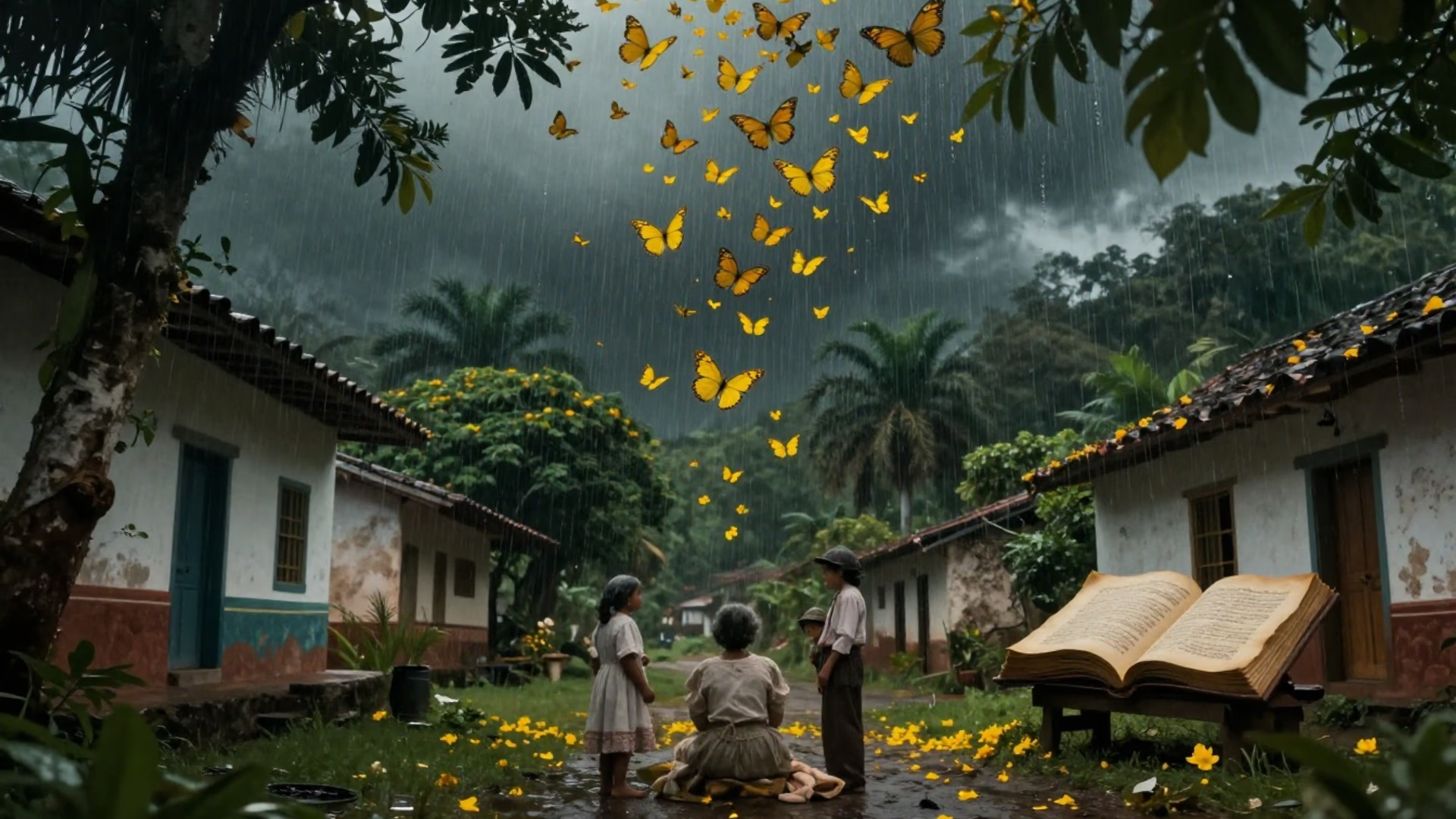
There is a house in a town that does not exist, and in that house lives a family cursed to repeat itself. The walls are thick with the residue of time, where alchemy experiments have left scorch marks on wooden tables, where love letters yellow in forgotten drawers, and where the scent of jasmine from a dead woman’s garden still drifts through windows that no longer close properly. In Gabriel García Márquez’s 『One Hundred Years of Solitude』, the fictional town of Macondo rises from the swamp like a fever dream, a place where the dead return to sit in rocking chairs and yellow butterflies announce the arrival of forbidden lovers.
I first read this book during a summer when I was trying to outrun something I could not name. The pages smelled of old libraries and someone else’s cigarette smoke, and I remember thinking that Márquez must have lived a thousand lives to write sentences that felt like weather. The Buendía family sprawled across generations, their names repeating like a prayer or a curse: José Arcadio, Aureliano, Remedios, Amaranta. Seventeen Aurelianos. Women named after women who were named after other women. The repetition was dizzying, and I kept losing track of who was who until I realized that was precisely the point. They were all the same person, dressed in different clothes, making the same mistakes in different rooms.
The novel opens with Colonel Aureliano Buendía facing a firing squad, remembering the afternoon his father took him to discover ice. That single image contains everything: mortality pressed against wonder, the child living inside the soldier about to die, time folding back on itself like a letter being returned to its envelope. Macondo exists outside of ordinary time. The rain falls for four years, eleven months, and two days. A woman ascends to heaven while hanging laundry. A baby is born with a pig’s tail because his parents ignored the warnings against incestuous love. The miraculous and the mundane share the same breath here, and neither seems to notice the other’s strangeness.
What the Mirrors Remember
 Photo by
 Beneath the lush surface of Macondo’s impossibilities lies something painfully recognizable. The Buendías are isolated not by geography but by something interior, some inability to truly reach one another across the space of their own skins. José Arcadio Buendía, the patriarch, spends his final years tied to a chestnut tree, speaking only in Latin to a ghost. Amaranta sews her own burial shroud for years, measuring her remaining life by the length of thread. Colonel Aureliano Buendía wages thirty-two civil wars and loses them all, then retreats to his workshop to make little golden fish, which he melts down only to make again. They are surrounded by family, by lovers, by children and grandchildren, and yet each one dies in the particular prison of their own solitude.
I think about this when I watch my own family gather for holidays. We sit in the same seats we have always sat in. We tell the same stories we have told for decades, and the stories have calcified into ritual, the words worn smooth as river stones. My uncle makes the same joke about the turkey. My mother asks the same worried questions. And I notice, with a chill that feels ancient, how I have begun to make my father’s gestures, how I reach for coffee at the same moment he would, how my irritations mirror his irritations, how I carry opinions I never consciously chose to hold.
We inherit not just the color of our eyes but the shape of our loneliness, passed down like heirloom silverware nobody asked for.The Buendías cannot escape their patterns because they cannot see them. They are fish who do not know they are wet. Each generation believes it is doing something new, believes its love is unprecedented, its ambition original. But the reader sees what they cannot: the repeating spiral, the names that circle back, the pig’s tail that was always waiting at the end of the bloodline. The family’s tragedy is not that they are cursed. The curse is simply the name they give to their blindness.
And yet Márquez does not write with judgment. His prose embraces the Buendías with a tenderness that feels almost maternal. He describes their failures with the same wonder he uses for their miracles. When Úrsula, the matriarch who lives beyond any reasonable human span, finally loses her sight, she learns to navigate the house by memory and smell. She knows her family better blind than she ever did with open eyes. There is wisdom in this. Sometimes we must lose one kind of seeing to gain another.
The Thread That Runs Through All Our Houses
 Photo by
 We do not need magical realism to recognize the truth Márquez is offering. Every family has its curses, its patterns that persist despite our best intentions. The father who swore he would never raise his voice finds himself shouting at his children in the same register his own father used. The daughter who fled her mother’s anxiety discovers it blooming in her own chest when she holds her newborn. We marry partners who resemble our parents in ways we cannot admit. We build lives designed to escape our origins, only to find we have recreated them in a different city, with different furniture, but the same old ghosts sitting down to dinner.
This is not fate in the way the ancients understood it. It is something subtler and perhaps more troubling. We are not controlled by gods or prophecies. We are controlled by what we refuse to see. The Buendías perish not because some external force demands their destruction but because they cannot step outside the grooves their ancestors have worn into the world. The manuscript that foretells their doom was written before they were born, but it was written in a language they could have learned to read. They chose not to. Or perhaps they never knew the choice existed.
Time in Macondo is not a river but a wheel. The town rises and falls and rises again. Lovers are separated and reunited across generations. The civil wars repeat with different names but the same blood. And at the center of it all stands solitude, the great unspoken inheritance, the thing none of them can give away no matter how desperately they try. They reach for each other through sex, through war, through obsessive projects that consume decades. They build empires and watch them crumble. And still the distance remains, the cold space between one consciousness and another that no amount of love can fully warm.
We know this distance. We have felt it lying next to someone we adore, suddenly aware of how little we truly know them. We have felt it in crowded rooms where laughter surrounds us but does not include us. We have felt it most sharply, perhaps, in the moments when we cannot explain ourselves even to ourselves, when we act against our own interests and cannot say why.
What We Carry Into Tomorrow
 Photo by
 The town of Macondo is eventually erased, swept away by a biblical wind that leaves no trace. The last Buendía finishes reading the prophecy at the exact moment of its fulfillment. There will be no second chance, no return, no one to remember that this place ever existed. It is an ending that feels both devastating and strangely peaceful. The wheel has finally stopped turning.
But we who close the book are still here, still spinning on our own wheels, still carrying names that belonged to someone before us. The question Márquez leaves us with is not whether we can escape our patterns. It is whether we can become conscious of them while there is still time to choose differently. The Buendías were given one hundred years. We are given whatever remains of our own span, however many days or decades that might be.
I return to this novel every few years, and each time I find a different mirror waiting. In my twenties, I saw the romance, the doomed lovers, the passion that burns through generations. In my thirties, I noticed the parents more, their blind devotion, their terrible mistakes made from love. Now I find myself watching the old ones, the ones who have seen everything repeat and still get up each morning to make coffee, to tend gardens, to love the grandchildren who will forget them.
What patterns are you walking that you did not choose? What names do you carry that were given before you could refuse them? And somewhere beneath the inheritance, beneath the weight of all that came before, is there a door you have not yet tried? Macondo is gone. But we are still here, still standing in houses that remember more than we do, still free, if we dare, to learn a language that could change everything.