The Question That Haunts
Have you ever done something wrong and told yourself it was justified?
Not a small wrong, not a white lie or a parking violation, but something that sat heavy in your chest afterward, something you had to work to forget. And in that working to forget, did you construct elaborate architectures of reasoning, building towers of logic to explain why your case was different, why the rules that applied to others didn’t quite apply to you?
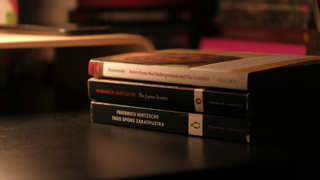
This is the question that Fyodor Dostoevsky placed at the center of his 1866 novel 『Crime and Punishment』, and it is a question that has lost none of its uncomfortable relevance in the century and a half since he wrote it. The story follows Rodion Raskolnikov, a former law student living in crushing poverty in St. Petersburg, who convinces himself that murdering an elderly pawnbroker would be not just acceptable but almost noble. She is a parasite, he reasons. A louse preying on the desperate. And he, he believes himself to be one of those rare “extraordinary” people who exist above conventional morality, who can transgress ordinary laws for the greater good.
The murder itself takes only a few pages. The psychological aftermath consumes the rest of the novel.
What makes Dostoevsky’s question so disturbing is not that it asks whether evil exists. We know evil exists. The question is subtler, more personal. It asks whether we might be capable of convincing ourselves that our particular evil is somehow different. That we are somehow exempt.
The Architect of His Own Prison
 Photo by
 Dostoevsky wrote Crime and Punishment while drowning. Not literally, though there were moments it might have felt that way. He was buried under gambling debts, having lost catastrophic sums at the roulette tables across Europe. His brother had died, leaving Dostoevsky responsible for his family’s financial obligations. Creditors circled. Prison loomed as a real possibility.
He wrote the novel in installments, racing against deadlines, selling chapters before the ink had dried on them. There is something almost too perfect about this, an author exploring the consequences of desperate choices while himself making desperate choices, writing about poverty while poor, about the seductions of twisted logic while his own mind must have been generating countless justifications for his gambling addiction.
Raskolnikov’s theory is elegant in its horror. He divides humanity into two categories: ordinary people who must obey laws and moral codes, and extraordinary people, the Napoleons and Newtons of the world, who are permitted to step over obstacles, including human obstacles, in pursuit of their higher purposes. It is a philosophy that would feel at home in certain corners of the internet today, dressed up in different language but carrying the same seductive poison.
The brilliance of Dostoevsky’s portrayal lies in how he shows us that Raskolnikov half-believes his theory and half-knows it’s a lie from the very beginning. The murder is botched, panicked, nothing like the cold rationality his philosophy demanded. He kills not just the pawnbroker but her innocent sister who stumbles upon the scene. He barely escapes. He takes almost nothing of value.
And then the real punishment begins, not from the police, not from the courts, but from within.
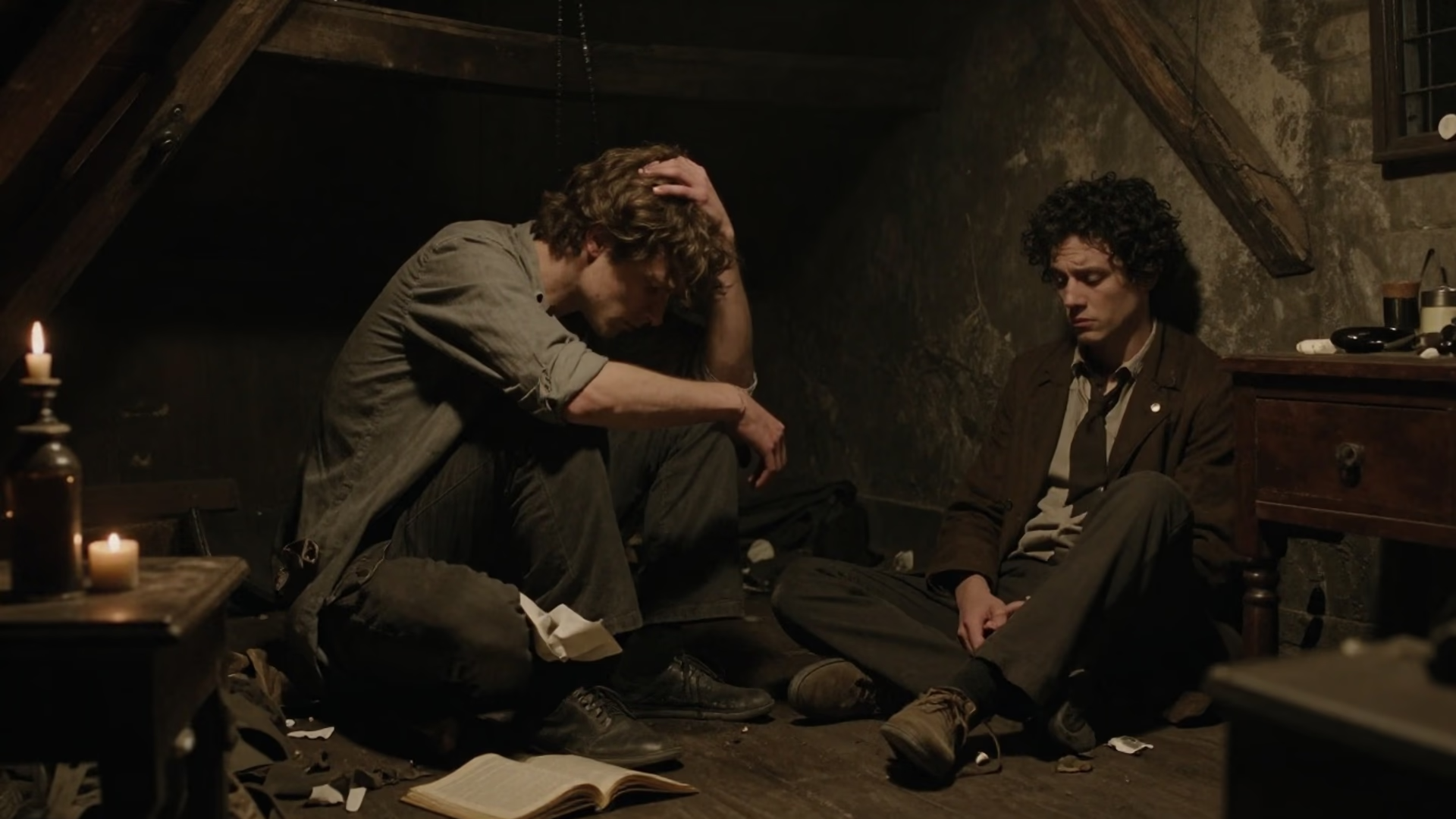
Raskolnikov wanders through St. Petersburg in a fever state, talking to himself, nearly confessing to strangers, drawing suspicion through his bizarre behavior. He is physically ill, psychologically fractured. The extraordinary man who was supposed to feel nothing, who was supposed to stride forward unburdened by conventional guilt, can barely stand. His conscience, it turns out, did not receive the memo about his special status.
The detective Porfiry never catches Raskolnikov through evidence. He catches him through understanding, through recognizing the particular torture of a man trying to live with an unlivable truth about himself. “Suffering is a great thing,” Porfiry tells him, and in Dostoevsky’s moral universe, this is not cruelty but invitation. The suffering is the way back.
The Lies We Live With
 Photo by
 I think about Raskolnikov sometimes when I find myself constructing justifications for small cruelties. The sharp word that someone “deserved.” The corner cut because I was busy, because I was stressed, because my situation was different. The promise broken with elaborate explanations about changed circumstances.
We are all, in our minor ways, tempted by the logic of exceptionalism.
The employee who skims from the company because they’re underpaid, because the corporation can afford it, because the CEO makes obscene money anyway. The student who cheats because the system is unfair, because everyone else does it, because one test doesn’t really measure intelligence. The spouse who lies because the truth would hurt, because what they don’t know won’t harm them, because sometimes love requires protection from reality.
None of these are murder, of course. But they share the same DNA, the same whispered assurance that our particular case exists outside the rules. And they carry, in smaller doses, the same poison.
What Dostoevsky understood, and what makes his novel feel freshly written every time someone reads it, is that the lie we tell others is nothing compared to the lie we tell ourselves. We can survive being thought a villain by the world. We cannot survive knowing ourselves to be villains while insisting on our heroism. The cognitive dissonance will crack us open.
I have watched people I love destroy themselves this way. Not through dramatic crimes, but through the slow accumulation of self-deceptions, each one requiring a larger lie to cover the last, until they no longer recognized the person looking back at them in the mirror. The confession, when it finally came, was never punishment. It was release.
What Redemption Looks Like
 Photo by
 The novel ends not with Raskolnikov’s arrest, which comes almost as an afterthought, but with his imprisonment in Siberia and the slow, tentative beginning of something like renewal. Sonya, the prostitute who sells herself to support her family, who has every reason to be hard and cynical but remains somehow capable of faith, follows him there. Her love is not earned and makes no logical sense, which is precisely the point.
Dostoevsky was not interested in tidy redemption narratives. Raskolnikov does not have a dramatic conversion, does not suddenly see the error of his ways in a flash of insight. The novel ends with him sick, confused, still wrestling. But there is a Bible under his pillow, placed there by Sonya, and the narrator suggests that this might be the beginning of “gradual renewal, gradual transition from one world to another.”
This is the vision Dostoevsky offers, not of instant transformation but of the possibility that we can stop running from ourselves. That confession, real confession, is not the end of hope but the beginning of it. That the extraordinary thing is not to place ourselves above morality but to accept our ordinary, broken humanity and keep going anyway.
We will not murder pawnbrokers. Most of us will never commit crimes that require courtrooms and sentences. But we will fail. We will justify. We will whisper to ourselves in the dark that our case is different.
The question is whether we will keep building the lie, adding floors to that tower of self-deception until it collapses under its own weight, or whether we will find the terrible courage to tear it down ourselves.
Somewhere in St. Petersburg, in the narrow streets Dostoevsky walked while writing, Raskolnikov is still wandering. And somewhere in each of us, a small voice is constructing a theory about why the rules don’t quite apply. The question the novel leaves us with is not whether we will be caught.
It’s whether we can stand to go uncaught.