The Face in the Doorway
There is a door that closes at the end of 『The Godfather』, and in that single image, Francis Ford Coppola captured something we spend our whole lives trying to understand. Kay Adams stands watching as her husband’s men gather around him, as the door swings shut between them, and in that narrowing sliver of light we see a man she no longer recognizes. The Michael Corleone who returned from war, who sat with her in restaurants talking about his family with embarrassed distance, who promised her he was different from them, has become someone else entirely. He has become his father.
This is the contrast that haunts the film and, I think, haunts us all. The person we intended to be stands forever separated from the person we have become. We do not notice the door closing. We are too busy making decisions that feel necessary, compromises that seem small, choices that appear to have no other option. Then one day we look up and find ourselves on the other side of something we cannot cross back over.
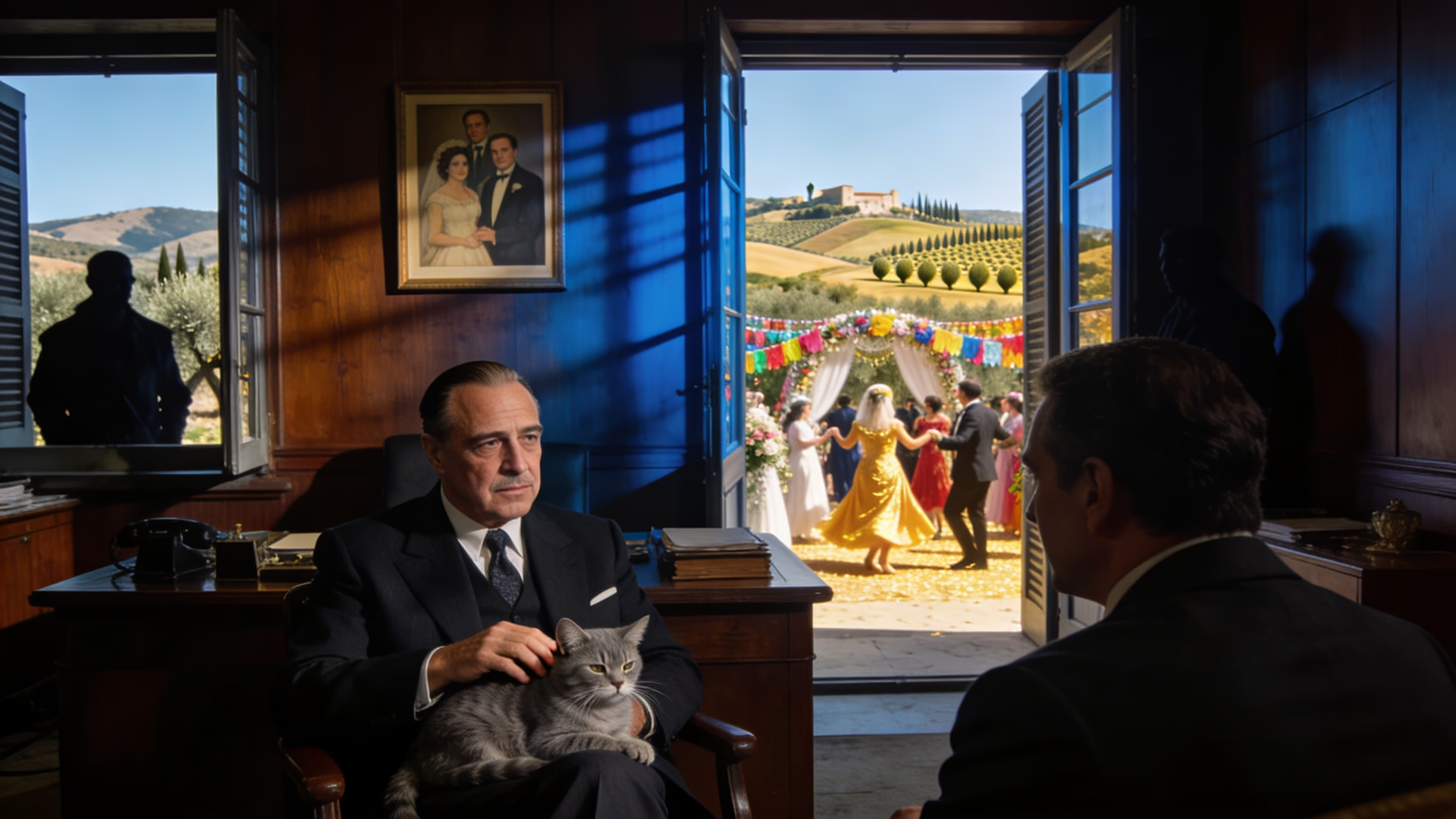
Michael begins the story in a Marine uniform, a war hero, the family member who was supposed to go legitimate. His father Vito had plans for him, senator, governor, something clean. And Michael had plans for himself too. He sits at his sister’s wedding like a visitor from another country, explaining the family business to Kay with the detachment of an anthropologist. “That’s my family, Kay. That’s not me.” He believes this. We believe it too. That’s what makes what follows so devastating.
The transformation does not happen through one dramatic fall. It happens through a series of rational responses to impossible situations. His father is shot. Someone has to act. His brother Sonny is too volatile, Fredo too weak. The logic of circumstance pushes Michael forward, and with each step, the door behind him closes a little more.
What We Tell Ourselves on the Way Down
 Photo by
 We like to imagine that good and evil stand clearly apart, that we would recognize corruption if it came for us, that we would refuse it. But the film offers a more troubling vision. Michael does not embrace darkness. He steps into it reluctantly, telling himself each time that this is temporary, this is necessary, this is for his family. The first person he kills, he kills to protect his father. The empire he builds, he builds to keep his family safe. Every terrible act carries its own justification.
This is how it happens in our own lives too, though usually with smaller stakes. We compromise a little here, bend a principle there, always with good reasons. We stay silent when we should speak because the timing isn’t right. We participate in systems we know are broken because we have mortgages and children and no clear alternative. We become people our younger selves would not recognize, and we do it one reasonable decision at a time.
The genius of Coppola’s film lies in how it makes us complicit. We root for Michael. We want him to succeed, to outwit his enemies, to protect his family. The operatic violence feels almost beautiful, Gordon Willis’s shadows turning murder into something resembling art. We are seduced alongside Michael, pulled into a moral universe where loyalty trumps law and family justifies everything. Only later, when Kay’s face registers horror, do we remember that we have been watching something monstrous.
The corruption is so gradual that we begin to mistake it for growth.Consider the distance between two scenes. Early in the film, Michael sits in the hospital protecting his wounded father, his hands shaking as he holds a gun for the first time. Near the end, he stands godfather to his nephew while his men execute every rival family head in the city. The hands no longer shake. The face betrays nothing. This is what mastery looks like, and it is terrifying. He has become perfect at something that has cost him everything else.
Vito Corleone, for all his crimes, retained a certain warmth. He played with his grandchildren in the garden. He loved his family in ways that felt genuine even as he ordered deaths without hesitation. But Michael’s love calcifies into something harder. He becomes all strategy, all control. By the final film in the trilogy, he will admit that he murdered his own brother, that his children fear him, that the man who wanted to be different became worse than his father ever was.
Across All Our Generations
 Photo by
 This tension between intention and outcome, between the self we imagine and the self we create, is not unique to twentieth-century crime dramas. It runs through every generation’s stories about power and family and the costs of ambition.
The ancient Greeks understood it. Oedipus runs from his fate and runs directly into it. Agamemnon sacrifices his daughter for favorable winds and sets in motion his own destruction. The stories insist that we cannot escape what we become through our choices, no matter how hard we try to choose differently.
Shakespeare understood it too. Macbeth knows that murder will damn him and commits it anyway, telling himself there is no choice. “I am in blood stepped in so far that, should I wade no more, returning were as tedious as go o’er.” Once you cross certain lines, the logic of continuation takes over. You have already paid the price. Why not take what you paid for?
Every family carries some version of this inheritance. Values pass from generation to generation, but so do compromises. Children watch their parents make choices and learn that this is what adults do, that this is how the world works. Michael learned from Vito, and his children learned from him, and somewhere in that transmission the original reasons fade while the methods remain.
We see it in our own families when we recognize our parents’ worst habits emerging in ourselves. The temper we swore we would never inherit. The coldness we criticized but somehow absorbed. The small dishonesties we watched and despised and now practice without thinking. The door closes so quietly we do not hear it.
This is why the film resonates across cultures and decades. It is not really about the Mafia, any more than Macbeth is really about Scottish succession. It is about the terrible ease with which we become what we never intended, the way power reshapes us even as we believe we are reshaping it, the gap between who we love and how we treat them.
The Light Through the Closing Door
 Photo by
 So we return to that final image, Kay watching the door close, understanding finally who her husband has become. There is no confrontation in this moment, no dramatic speech. Just the quiet recognition that passes between them in the narrowing light.
Michael chose his family. He chose to protect them, to provide for them, to build an empire they could inherit. And in making those choices, he lost them. His wife looks at him with horror. His brother he will eventually kill. His children will grow up in a house full of shadows. The thing he killed for, he killed.
Perhaps this is the question the film leaves us with, one we might carry into our own ordinary lives. Not whether we will face Michael’s dramatic choices, most of us will not, but whether we can recognize the smaller doors closing around us. The moments when necessity becomes habit. The times when protecting what we love starts to damage it. The gradual hardening that feels like strength but might be something else entirely.
We all carry some version of Michael’s promise: that’s not me. We all imagine ourselves different from the compromises our lives require. And maybe that imagination matters, maybe it keeps some small part of us alive on the other side of all those closed doors. Or maybe it is just another story we tell ourselves on the way down.
The door closes. We become what we become. And somewhere, the person we intended to be watches with Kay’s eyes, measuring the distance we have traveled from who we were.