
The Stillness at the Center
There is something unbearable about a mouth opened wide with no sound escaping. Or perhaps the sound is everywhere, saturating the air, the water, the blood-orange sky, so completely that we can no longer distinguish it from silence. This is the paradox that greets us in Edvard Munch’s 『The Scream』, painted in 1893, and it is a paradox we carry with us still, more than a century later, into our own moments of wordless terror.
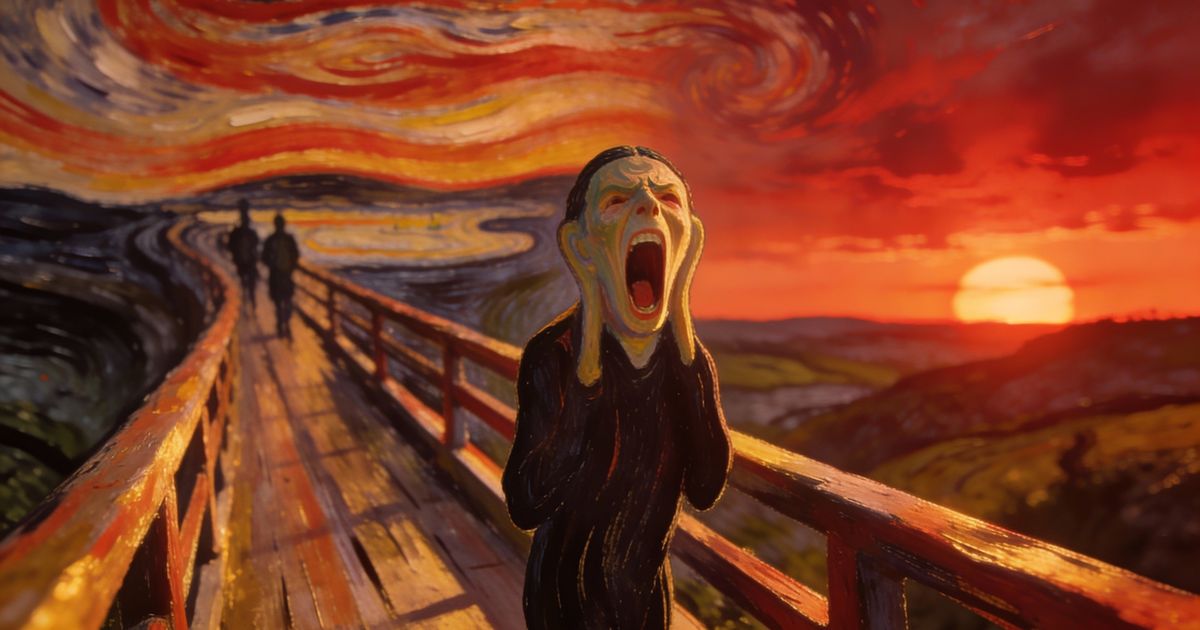
The figure in the painting stands on a bridge, hands pressed against its skull-like face, mouth stretched into an oval of anguish. Behind it, two figures walk away, seemingly oblivious. The sky writhes in bands of red and yellow. The water below echoes the same sickening waves. Everything is movement, distortion, chaos. And yet the figure itself appears frozen, caught in the amber of its own despair. Here is the first great contrast: all that visible turbulence surrounding a body that cannot move, cannot flee, cannot do anything but stand and receive the assault of existence.
Munch wrote in his diary about the evening that inspired this image. He was walking with friends near the Oslofjord when a wave of exhaustion stopped him in his tracks. The sky turned blood-red. He sensed what he called “an infinite scream passing through nature.” His companions walked on. They noticed nothing. And there it is, the second contrast, perhaps the more devastating one: the scream that only one person hears, while everyone else continues with their evening stroll.
We know this moment. Not always in such dramatic colors, but we know it. The meeting where your chest tightens and the room seems to tilt, while your colleagues discuss quarterly projections. The family dinner where grief rises like bile in your throat, and you smile and pass the bread. The 3 a.m. waking when dread pools in your stomach for reasons you cannot name, and the person sleeping beside you breathes on, peaceful, unreachable. The loudest screams are often the ones that never leave our bodies.
Two Figures Walking Away
 Photo by
 Look again at those two figures in the background of Munch’s painting. They are not cruel. They are not ignoring the anguished figure out of malice. They simply do not perceive what is happening. The scream exists in a frequency they cannot detect. And this, I think, is what makes the image so enduring, so honest about the nature of human suffering. Our inner turmoil rarely announces itself in ways others can recognize.
We live in parallel realities. You sit across from someone at a coffee shop, and you see a person scrolling through their phone, perhaps a bit tired, nothing remarkable. But inside that ordinary body, an entire weather system might be raging. Memories of a dead parent. Fear of a diagnosis not yet spoken. The slow erosion of a marriage. The corrosive drip of inadequacy that started in childhood and never stopped. None of this shows on the surface. The face remains a face. The hands hold the cup steadily enough.
This is one side of the contrast: our isolation within our own experience, the impossibility of truly transmitting what we feel to another consciousness. Munch’s genius was to externalize the internal, to paint the sky the color of the scream, to warp the landscape into the shape of panic. But in life, the landscape stays stubbornly ordinary. The coffee shop plays its same playlist. The fluorescent lights buzz on. The world refuses to mirror our distress.
And yet, there is another side. Because if we cannot fully transmit our suffering, we also cannot fully perceive the suffering of others. Those two figures walking away from the screaming figure, they could be us. They probably are us, more often than we would like to admit. How many times have we walked past someone in the grip of invisible anguish, noticed nothing, continued on our way? How many screams have passed through the air around us, unheard?
This is not an accusation. It is simply the condition of being human, of being locked inside one skull, receiving the world through one set of senses, processing it through one tangle of memories and fears. We are all, simultaneously, the screaming figure and the oblivious walkers. We contain both roles within us, sometimes switching between them in the space of an hour.
The painting does not resolve this tension. It holds both truths at once: the unbearable reality of suffering alone, and the unbearable reality that we cannot always reach each other across the divide of separate minds. Perhaps this is why the image has never lost its power. It does not offer comfort. It offers recognition.
Echoes Across the Centuries
 Photo by
 Munch painted The Scream at the end of the nineteenth century, a time of rapid industrialization, urbanization, the fraying of old certainties. Nietzsche had declared God dead. Darwin had placed humanity among the animals. The old stories that had given meaning to suffering were losing their hold. And into this void came a new kind of terror, the suspicion that existence itself might be meaningless, that we might be alone not just in our individual pain but cosmically, fundamentally, forever.
We could call this existential dread, and philosophers have written libraries about it. But the feeling predates the terminology. The book of Ecclesiastes, written perhaps two thousand years before Munch picked up his brush, speaks of vanity and vexation of spirit, of a world where “all is meaningless, a chasing after wind.” The Buddhist texts describe dukkha, the unsatisfactoriness woven into the fabric of existence. Every human culture has found ways to name this unease, this sense that something is fundamentally wrong, or at least incomplete.
What changes across eras is not the feeling but its context. Munch’s figure stands on a bridge, a manufactured structure spanning natural water. Behind it, the fjord and the sky. The modern world and the ancient world meeting at the point of maximum distress. Today, we might imagine the same figure staring at a smartphone, the notification badges piling up, the scroll of bad news infinite, the face reflected in the screen distorted by the blue light into something not quite human.
The technologies change. The cities grow. The pace accelerates. But the scream remains, updated in its setting, unchanged in its essence. Surveys tell us that anxiety disorders are rising, that young people report unprecedented levels of loneliness, that the sheer volume of information we process daily would have been unimaginable to someone in Munch’s time. We have invented countless ways to distract ourselves from the scream, and countless new triggers to provoke it. The figure on the bridge now has access to meditation apps and antidepressants and online therapy, and still the sky turns red some evenings, and still the friends walk on ahead, and still the mouth opens in soundless alarm.
This is not pessimism. It is simply acknowledgment. The scream is part of being human. It does not mean we are broken. It does not mean our era is uniquely cursed. It means we are alive, conscious, aware of our own mortality, capable of imagining futures that frighten us and pasts that wound us. The scream is the price of sentience.
Returning to the Bridge
 Photo by
 So we return to where we began, to that figure frozen on the bridge, hands against its face, the world melting around it. The contrast that opened this reflection, between the silent scream and the violent sky, between the isolated sufferer and the oblivious companions, has not dissolved. We cannot resolve it neatly, tie it up with a lesson learned.
But perhaps we can hold it differently now. The painting does not show what happens next. The figure might remain there forever, trapped in that moment of maximal anguish. Or it might, eventually, lower its hands. Take a breath. Continue across the bridge to wherever it was going. The scream might fade, not because it was answered, but because even the worst feelings eventually change into other feelings. This is not a cure. It is simply duration, the strange mercy of time passing.
And those two figures walking ahead, they might turn around eventually. They might notice the absence of their companion and retrace their steps. They might not have the right words, because there are no right words for this kind of thing, but they might simply stand there, present, bearing witness to what they cannot fully understand. Sometimes that is enough. Sometimes it has to be.
We are all walking our own bridges, over our own dark waters, beneath skies that sometimes turn the color of alarm. We cannot prevent the scream from arising. We cannot always make others hear it. But we can remember that we are not the first to feel this way, and we will not be the last. The figure in Munch’s painting has become a kind of companion itself, a recognition that this too is part of the human story.
What remains, then, is a question we each must answer in our own way: When the scream comes for us, and it will, how do we want to meet it? And when we are the ones walking ahead, what might it take to turn around?