The Midnight Battlements
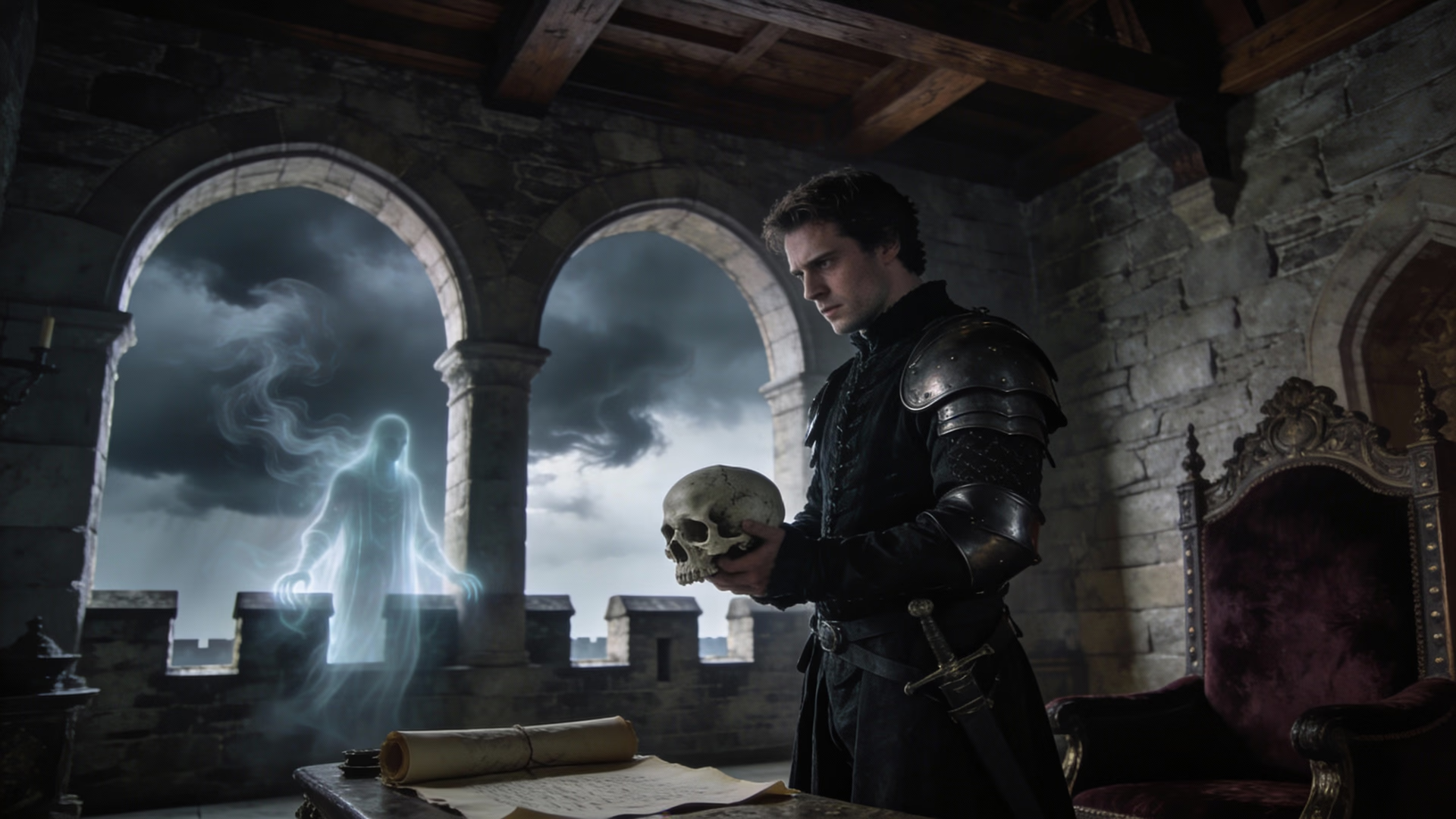
There is a coldness that seeps through stone. You feel it in the opening scenes of William Shakespeare’s 『Hamlet』, written in 1601, when guards pace the battlements of Elsinore Castle in the dead of a Danish winter. The torches flicker. Breath hangs visible in the air. Something is wrong, though no one can name it yet. The men speak in half-whispers, their eyes scanning the darkness beyond the walls, waiting for a ghost they hope will not appear.
And then it does.
The specter of a murdered king drifts across the ramparts, armored and silent, pointing toward a truth that will unravel everything. Young Hamlet, the prince who returned home for a funeral and stayed for a wedding, follows this apparition into the night. What he learns there will poison the rest of his days. His father was murdered by his uncle, who now wears the crown and shares a bed with his mother. The ghost demands revenge. Justice, it insists, requires blood.
But here is where Shakespeare turns away from the expected. In any other revenge tragedy of his era, the hero would draw his sword immediately. The path would be clear, the violence swift, the ending inevitable. Instead, Hamlet stands frozen. He thinks. He questions. He delays. For five acts, through nearly four thousand lines of text, the longest play Shakespeare ever wrote, a young man with every reason to act finds himself unable to move.
I return to this scene often, not because I face murdered fathers or usurping uncles, but because I recognize that paralysis. We all do. There are moments in life when we know what must be done, when the right path seems obvious to everyone around us, and yet we stand on our own battlements, watching our breath cloud in the cold air, waiting for a sign that may never come.
What Knowing Costs Us
 Photo by
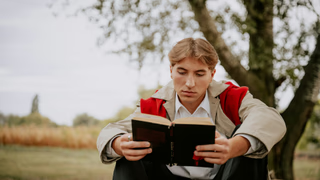
 The easy reading of Hamlet is that he is weak. Indecisive. A man who thinks too much and does too little. Generations of scholars have debated whether his hesitation stems from cowardice, from moral scruple, from an Oedipal complex, from melancholy that we might now call depression. But I think they miss something essential.
Hamlet’s problem is not that he thinks too much. His problem is that he sees too clearly.
Before the ghost’s revelation, Hamlet is already drowning. His father died suddenly. His mother remarried within a month, to a man Hamlet despises. The world has revealed itself to be inconstant, treacherous, “an unweeded garden that grows to seed.” He wears black when everyone else has moved on to celebration. He alone refuses to pretend that things are fine.
The ghost’s message does not create his crisis. It confirms it. Now he has proof that the rot he sensed runs deeper than anyone imagined. His uncle is a murderer. His mother is, at best, willfully blind. The court that surrounds him is built on lies. And he, alone among them all, carries the weight of this knowledge.
To see the world as it truly is, Shakespeare suggests, is to be paralyzed by it.This is not weakness. This is the burden of consciousness. Hamlet cannot simply kill Claudius because he understands what that act would mean, what it would make him, how it would ripple outward into consequences he cannot control. He watches his uncle pray and stays his hand, not because he is afraid, but because he is thinking about the state of Claudius’s soul, about whether killing him in a moment of repentance would send him to heaven instead of hell. It is absurd, overthought reasoning. But it is also deeply human. We do not simply act. We imagine outcomes. We weigh costs. We consider what our choices say about who we are.
The people around Hamlet do not suffer this way. Claudius acts without hesitation, poisoning his brother, seizing power, moving through the world with the confidence of those who never question their own desires. Laertes, when his father is killed, rushes back to Denmark with an army, ready to tear down the kingdom to avenge his loss. These men are effective. They get things done. But Shakespeare does not ask us to admire them.
Instead, he gives us Hamlet, pacing in his chamber, speaking to himself about whether existence itself is worth the trouble. “To be or not to be” is not a statement about suicide, not really. It is a question about whether consciousness is a gift or a curse. Is it better to feel everything, to see everything, to carry the weight of knowing, or to simply not exist at all?
We stand with Hamlet in that question more often than we admit.
The Universal Hesitation
 Photo by
 I think of the decisions I have delayed. Not the small ones, not what to eat or what to wear, but the ones that matter. Leaving a job that was slowly hollowing me out. Speaking a truth that would change a relationship forever. Choosing a path when both options meant losing something precious.
In those moments, I told myself I needed more information. More time to think. A clearer sign. But the truth, I suspect, was simpler and more painful. I did not want to become the person that choice would make me. Every significant decision is also a death, the closing of one version of yourself so another can emerge. Hamlet understands this instinctively. To kill Claudius is to become a killer. To take revenge is to enter a cycle of violence that has no clean ending. To act at all is to accept that the world will never be what he thought it was, that innocence is gone forever.
We hesitate at thresholds because we know, on some level, that we cannot go back. The relationship will never be the same after the conversation. The career will never return to what it was. The belief we held about ourselves or the world will shatter, and we will have to build something new from the pieces.
Hamlet’s tragedy is not that he delays too long. It is that when he finally acts, it is too late. The poison has spread through everything. Ophelia drowns. Laertes conspires. The queen drinks from the wrong cup. By the final scene, the stage is littered with bodies, including Hamlet’s own. He achieves his revenge, but the cost is total destruction.
This is what Shakespeare knew that we often forget. Action and inaction both carry prices. There is no safe choice. The world does not pause while we deliberate. It moves forward, indifferent to our hesitation, and sometimes the delay itself becomes the disaster.
What Remains Unanswered
 Photo by
 So what do we do with this knowledge? Shakespeare offers no comfort, no formula for when to leap and when to wait. Hamlet’s final words are “the rest is silence,” and the play ends not with resolution but with the sound of marching soldiers come to claim an empty throne.
Perhaps that is the only honest ending. We cannot know, standing on our own battlements in the cold, whether action or restraint will lead to ruin. We cannot calculate our way to safety. The ghost demands one thing, our conscience whispers another, and the world keeps spinning regardless of our choice.
What Hamlet offers, four centuries later, is not guidance but companionship. Someone else stood where we stand. Someone else felt the weight of knowing too much, the paralysis of seeing clearly, the terror of becoming something new. We are not alone in our hesitation.
But the question remains, and Shakespeare leaves it with us like a ghost we cannot exorcise. When does thinking become hiding? When does caution become cowardice? And how do we know, in the moment that matters most, whether we are waiting for wisdom or simply afraid to move?
The battlements are cold. The torch flickers. Somewhere beyond the walls, the future waits for us to decide.