The Question That Winter Asks
What does a tree look like when it has lost everything?
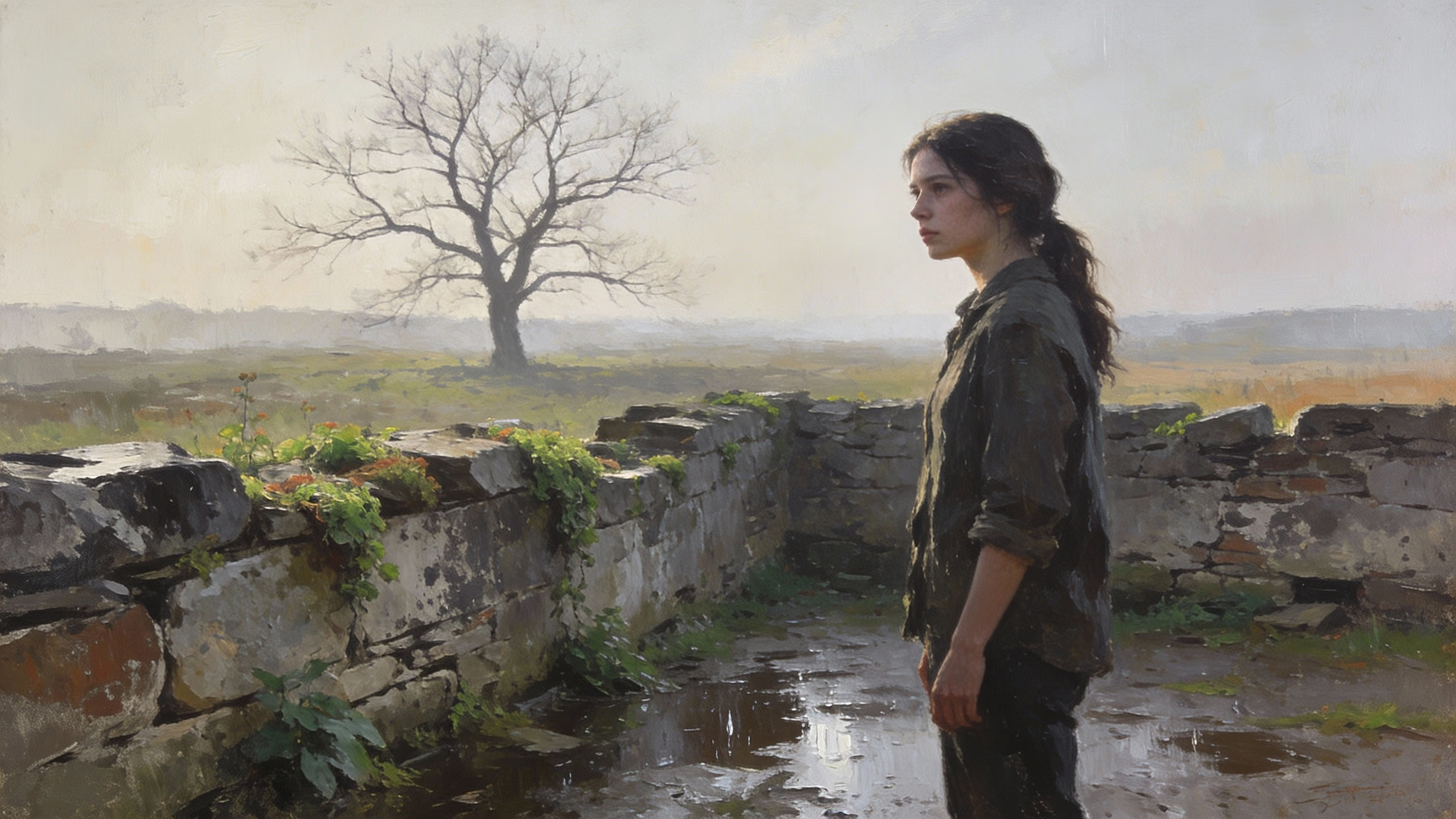
Not the postcard version of autumn, with its dignified reds and golds drifting picturesquely to the ground. I mean the aftermath. The stark branches against a grey sky, the exposed architecture of something that was once full and alive, now reduced to its most essential form. We avert our eyes from such trees in winter. They remind us of things we would rather not see.
And yet there is a word in Korean for this particular nakedness. Namok. The naked tree. It carries no shame in the naming, only observation. Park Wan-suh chose this image for the title of her 1970 debut novel, 『The Naked Tree』, and in doing so she asked a question that reverberates across decades: What remains of us when everything we thought defined our lives has been stripped away?
The novel emerged from Park’s own experience of the Korean War, a conflict that tore through her family and left her, like millions of others, standing in the rubble of what used to be a future. Her brother, whom she adored, did not survive. The life she had imagined for herself vanished in the smoke of a divided nation. She was twenty years old, and she had to keep living.
This is the question the naked tree poses to all of us who have stood in the cold wind of loss, wondering who we are now that the person we loved is gone, or the dream we held has shattered, or the world we trusted has revealed itself to be fragile beyond imagining. The tree does not ask whether you will survive. It asks what you will become.
The Portrait Painter and the Wreckage
 Photo by
 In The Naked Tree, we meet Lee Kyung, a young woman navigating the strange landscape of post-war Seoul. She works at an American PX, selling portraits to soldiers who want to send images of themselves back home. The irony runs deep: here she is, a Korean woman whose country has just been devastated by foreign armies, painting flattering likenesses of the very men whose presence marks her nation’s dependence and humiliation. She paints them handsome. She paints them whole. And all the while, she carries within her the jagged pieces of her own shattered world.
Park Wan-suh drew from her own years working in just such a place. She too had stood before American soldiers with a brush in her hand, offering them pretty pictures while her heart was still raw with grief. The experience gave her something unexpected: not healing, exactly, but a strange vantage point from which to observe the absurdity of human survival. We do not stop needing to eat just because our hearts are broken. We do not stop needing money, or shelter, or the small dignities of daily work. Life insists on itself, even when we are not sure we want it to.
What strikes me most about the novel is its refusal of easy catharsis. Lee Kyung does not have a dramatic breakdown followed by a triumphant recovery. She does not find salvation in love or revenge or political awakening. She simply continues. She wakes up. She goes to work. She paints portraits of strangers. And slowly, almost imperceptibly, something shifts. The act of seeing others, of rendering their faces on canvas, begins to teach her something about her own existence.
Park waited nearly two decades after the war to write this story. She was forty years old when she finally put the words on paper. Perhaps she needed that distance to see clearly. Perhaps she needed to become a mother, to build a new life from the ruins, before she could revisit the young woman she had been. The naked tree had to grow new leaves, had to lose them again and again through many winters, before it could tell its own story.
There is wisdom in this patience. We often feel pressure to make meaning of our suffering while we are still in its grip. We want the lesson now, the silver lining visible before the clouds have even passed. But sometimes understanding arrives only in retrospect, when we have enough distance to see the shape of what we survived.
The Art of Continuing
 Photo by
 I think about the people I know who have weathered their own winters. A friend whose marriage ended after twenty years, who spent months moving through her days like a ghost before she realized she was slowly becoming someone new. A colleague who lost his father suddenly and found himself sitting at his desk six weeks later, answering emails about quarterly reports as if the world had not fundamentally changed. My own grandmother, who buried a child and never spoke of it directly but planted a garden every spring with a ferocity that I now understand.
We do not survive by forgetting. We survive by finding something small enough to hold onto while the storm rages, and then another small thing, and then another, until one day we look up and realize we have built a life from these fragments.The portrait work in Park’s novel carries this truth. Lee Kyung cannot paint herself whole. She cannot paint her brother back to life or restore the country of her childhood. But she can mix colors. She can study the planes of a stranger’s face. She can create something that did not exist before her hands touched the canvas. This is not transcendence. It is something more modest and perhaps more honest: the dailiness of survival, the quiet accumulation of moments that eventually become a life.
I have noticed that the people who navigate loss most gracefully are rarely those who make grand gestures of recovery. They are the ones who show up. They cook dinner when they don’t feel like eating. They call a friend even when conversation feels impossible. They take a walk, not because it will fix anything, but because their body needs to move through space. They do not wait until they feel ready to live. They live, and somewhere along the way, readiness catches up with them.
This is what the naked tree teaches us. It does not will itself to survive the winter. It does not positive-think its way to spring. It simply stands there, exposed and vulnerable, trusting in the process that has carried it through countless seasons before. Its roots go deep. Its branches reach toward whatever light they can find. And when the warmth returns, it blooms again, not despite its bareness but because of it. The stripping away was not a tragedy to be overcome. It was part of the cycle.
What the Winter Reveals
 Photo by
 There is a particular beauty in the naked tree that we miss if we only long for spring. The architecture becomes visible. The essential structure, usually hidden by leaves, stands revealed against the sky. You can see where the limbs have broken and healed over. You can trace the history of its growth in the patterns of its branches. Nothing is hidden. Nothing is pretended.
Park Wan-suh titled her novel Namok because she understood that this exposure, painful as it is, also contains a kind of freedom. When we have lost the ornaments we thought made us who we are, we finally get to see what was underneath all along. Sometimes we discover strength we didn’t know we had. Sometimes we find wounds we had been covering over for years, wounds that can finally begin to heal now that air and light can reach them.
I do not want to romanticize suffering. The winters of our lives are genuinely cold. The losses are real, and they hurt, and no amount of philosophy makes them hurt less. But I have come to believe that there is a difference between pain and despair. Pain is the honest acknowledgment of what has been taken from us. Despair is the belief that nothing will ever grow again.
The naked tree stands as testimony against despair. Not because it promises that everything will be fine, or that loss has hidden meaning, or that we will someday be grateful for our suffering. It makes no such promises. It simply demonstrates, year after year, that life continues. That what seems like an ending is also a waiting. That beneath the frozen ground, roots are gathering strength.
So perhaps the question is not what remains when everything falls away. Perhaps the question is what becomes possible. What can we see now that we couldn’t before? What can we reach toward, unencumbered by the weight of what we used to carry? What new growth might emerge from this stark and honest ground?
The winter does not last forever. But while it does, the naked tree stands beautiful in its bareness, neither hiding nor pretending, simply being what it is. And maybe that is enough. Maybe that is everything.