The Threshold Between Worlds
There is a tunnel at the edge of a forest, and a girl does not want to walk through it.
She clutches the back seat of her parents’ car, watching the stone mouth of the passageway grow larger in the windshield. The air is heavy with the particular stillness of abandoned places. Her father stops the car at the mouth of it and gets out, and her parents walk in on foot, the way adults always seem to, into darkness without hesitation.
This is how Hayao Miyazaki’s 『Spirited Away』 begins, not with magic, but with the ordinary terror of being taken somewhere you did not choose to go. Ten-year-old Chihiro slouches in the back seat, surrounded by moving boxes, dragged away from everything she knows. Her old school, her old friends, her old bedroom, all of it disappearing behind her as the car climbs deeper into unfamiliar mountains.
The tunnel leads to what appears to be an abandoned theme park, its streets empty, its buildings faded like photographs left too long in the sun. But as evening falls and lanterns begin to flicker, the empty restaurants fill with shadows that solidify into spirits. Her parents, who have been greedily eating food that did not belong to them, transform into pigs. And Chihiro finds herself stranded in a world where humans are unwelcome, where the rules make no sense, and where a witch named Yubaba will take her name in exchange for work.
Sen. That is what she becomes. Just Sen.
I remember watching this scene for the first time and feeling something catch in my throat. Not because of the fantasy, but because of how precisely Miyazaki captures the sensation of losing your footing. The ground beneath you shifts, and suddenly you are somewhere you do not recognize, and the person you were yesterday feels very far away.
What We Carry, What We Leave Behind
 Photo by
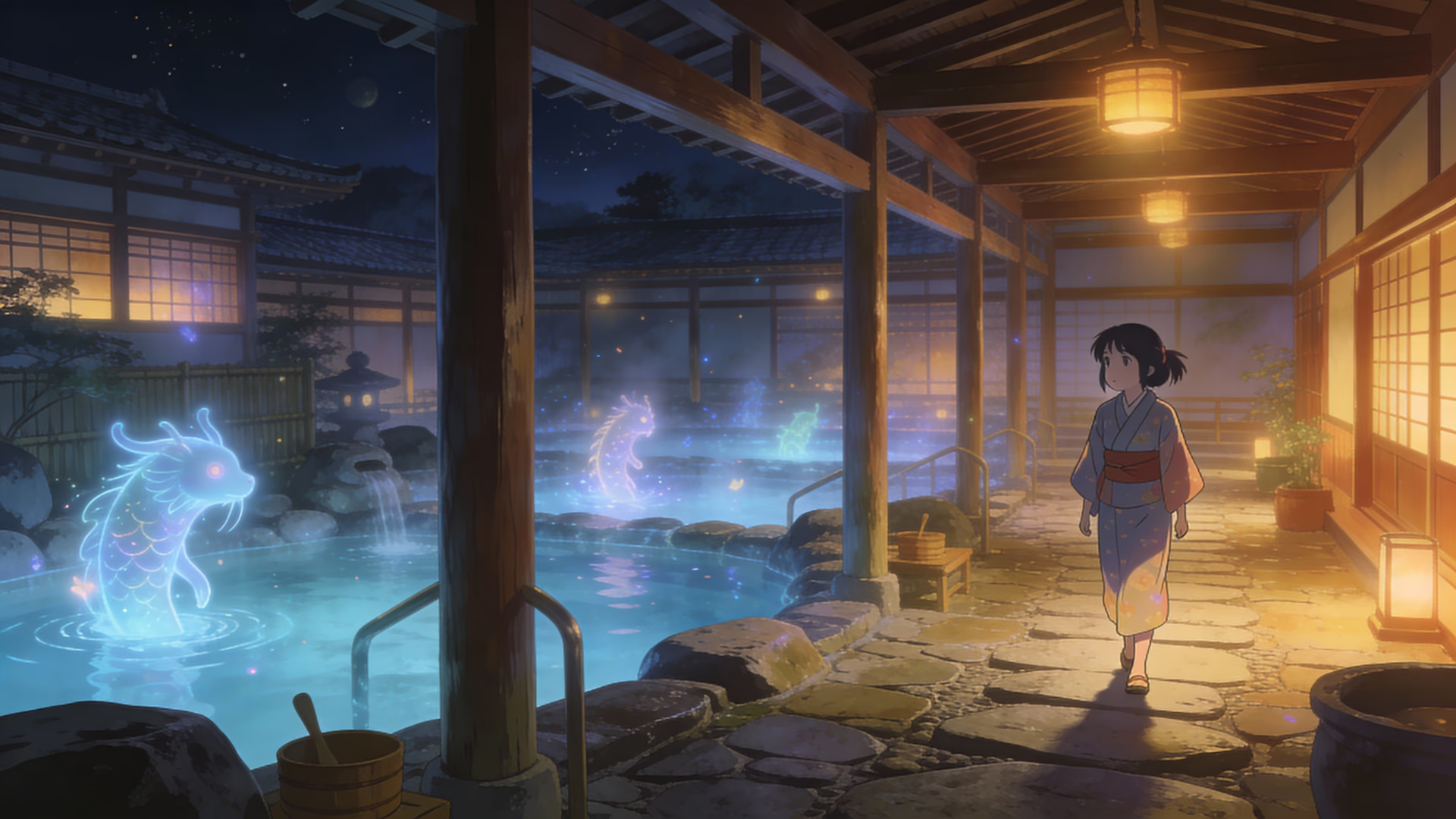
 The bathhouse where Chihiro works is a towering structure of impossible architecture, all wooden beams and steaming pools and endless corridors. It exists to serve the gods, the spirits of rivers and radishes and nameless ancient things that arrive exhausted from the human world. They come to be cleansed. They come to rest. And Chihiro, now called Sen, must scrub their tubs and carry their burdens and remember to bow at exactly the right angle.
Beneath this strange labor, something quieter unfolds.
Yubaba takes names because names are power. Without her full name, Chihiro cannot remember who she was before the bathhouse. The longer she stays, the fainter her memories become, like trying to hold water in cupped hands. She watches another worker, Haku, and learns that he too has forgotten his true name. He has been serving Yubaba so long that his original self has become a ghost, something he once was but can no longer touch.
This is perhaps the most honest thing the film shows us: that we can lose ourselves not through dramatic tragedy, but through the slow accumulation of days spent answering to someone else’s version of who we should be.We do not need a witch to steal our names. We give them away piece by piece. In the office where we swallow our opinions to keep the peace. In the relationship where we reshape ourselves to fit another person’s expectations. In the long years of doing what we were told would make us successful, until one morning we look in the mirror and cannot remember what we actually wanted.
Miyazaki created this film in the aftermath of Japan’s economic bubble collapse, when an entire generation found themselves adrift in a world their parents’ promises had not prepared them for. But the story reaches beyond that specific moment. It speaks to anyone who has ever felt the slow erosion of self that comes from surviving in systems that were not built with your flourishing in mind.
Chihiro survives the bathhouse not by becoming hard or cynical, but by refusing to forget. What saves her is not something she wrote down. It is a goodbye card from a friend she was leaving behind, still in her pocket from the old life, with her name on it in someone else’s hand. She holds onto the memory of her parents, even when it would be easier to let them blur into nothing. She chooses to remember, even when remembering hurts.
The Courage of Soft Things
 Photo by
 There is a scene midway through the film where Chihiro must face a spirit so polluted, so overwhelmed with the refuse of the human world, that everyone else flees in disgust. A stink spirit, they call it. A god so fouled that its original form has been buried beneath layers of garbage and sludge.
Chihiro does not run. She takes a deep breath and begins to pull.
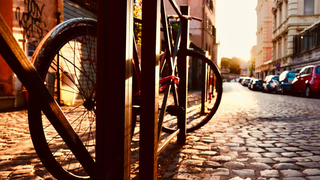
Out comes a bicycle. Then a fishing line. Then an endless stream of human trash, all the things we have thrown away, all the carelessness we have dumped into rivers and forests and forgotten about. Underneath it all, the spirit is revealed as a great and ancient river god, finally free.
This moment stays with me because it inverts everything we think we know about heroism. Chihiro does not fight the pollution. She does not conquer it with force or cleverness. She simply does the unglamorous work of cleaning, of caring, of attending to what others have neglected. And in doing so, she restores something sacred.
We live in a world that celebrates dramatic gestures. The grand resignation. The bold reinvention. The moment of triumphant transformation. But most of our lives are not made of such moments. They are made of small choices, repeated daily. The decision to be kind when we are tired. The effort to remember someone’s real self beneath the armor they wear. The willingness to do work that no one will applaud.
Chihiro’s courage is not the absence of fear. Throughout the film, she trembles. She cries. She stumbles down stairs because her legs have not stopped shaking. But she keeps going. She extends kindness to a creature everyone else sees as a monster. She shares her food with a spirit that has no face. She holds onto love even when love seems foolish.
This is the quiet heroism Miyazaki offers us. Not the warrior who feels no fear, but the child who is terrified and acts anyway. Not the chosen one with special powers, but the ordinary person who refuses to let her circumstances define her entirely.
What Returns to Us
 Photo by
 Near the end of the film, Chihiro remembers something. She remembers falling into a river as a child, remembers the feeling of drowning, remembers being carried to safety by something she could not name. The river was called Kohaku. And Haku, the boy who has helped her, the boy who forgot his own name, was once the spirit of that river before it was drained and paved over for apartment buildings.
She gives him back his name. In doing so, she breaks the contract that bound him.
There is something unbearably tender about this exchange. Two lost souls, finding each other across impossible distances, returning to each other the selves they had almost forgotten. Chihiro saves Haku not with a sword or a spell, but with memory. With the simple act of saying: I remember you. I remember who you really are.
We carry pieces of each other. The teacher who once saw something in us we could not see ourselves. The friend who held space for our grief without trying to fix it. The stranger whose kindness on a terrible day reminded us that the world could still be gentle. These people give us back our names in ways they may never know.
And we do the same for others, whether we realize it or not. Every time we see someone clearly. Every time we speak to the person beneath the performance. Every time we remember who someone was before life asked them to become something else.
Chihiro walks back through the tunnel at the film’s end. Her parents, human again, do not remember anything that happened. The car is covered in dust and leaves, as if years have passed. She looks back at the darkness one last time.
We are not told what she is thinking. We are not given a neat lesson about what she learned. Miyazaki trusts us to feel it ourselves, the weight of everything she has carried, everything she has become.
I think about Chihiro often, in moments when I feel the ground shifting beneath me. When I find myself in strange new places, when the old rules no longer apply, when I cannot remember exactly who I was before everything changed.
What would it mean to hold onto your name in a world that wants to take it from you? What would it look like to do the quiet, unglamorous work of caring, even when no one is watching? And who, right now, might be waiting for someone to see them clearly enough to return what they have lost?
The tunnel is still there, at the edge of the forest. We all pass through it eventually, one way or another. The question is what we choose to remember on the other side.