

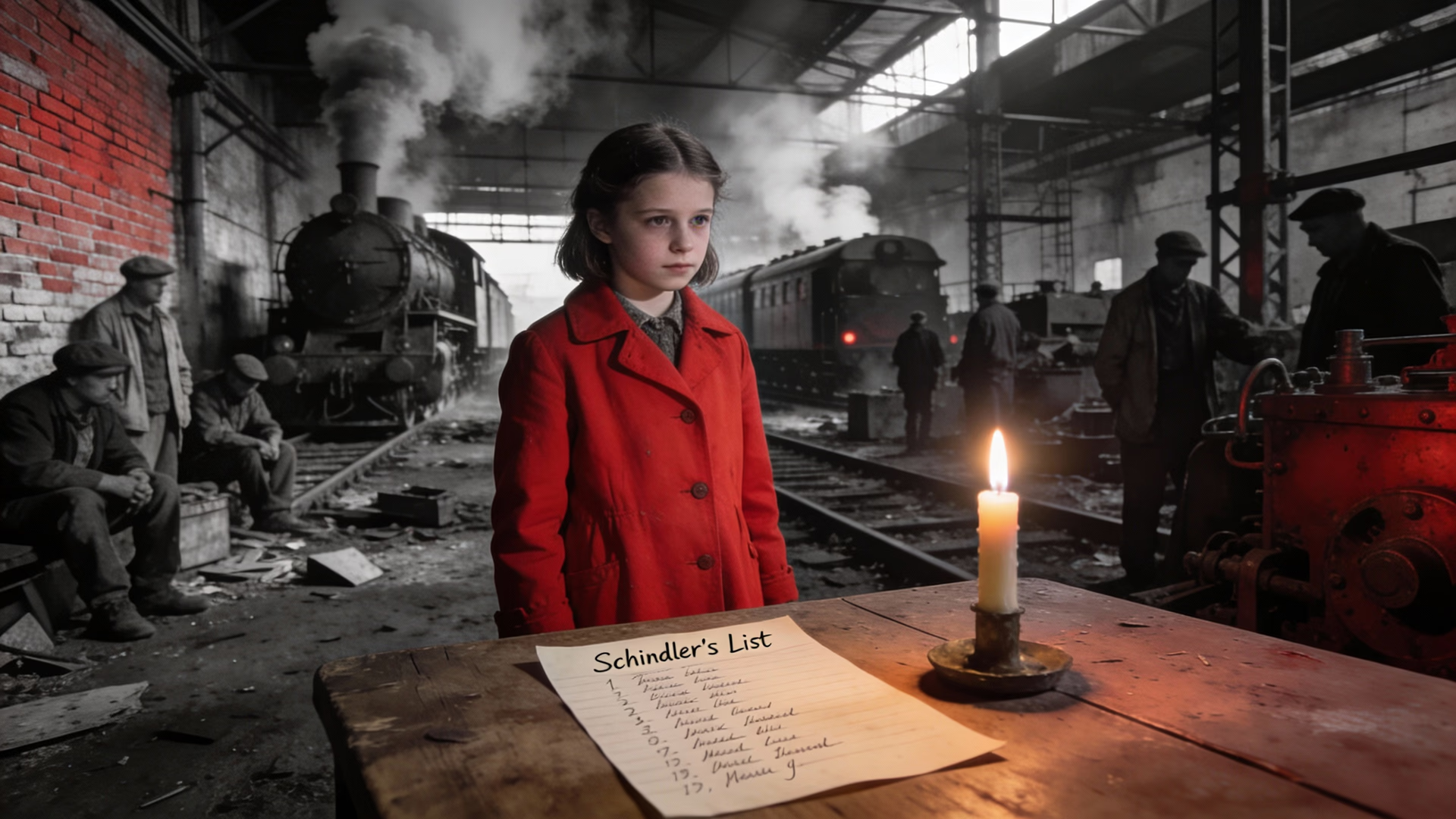
The Voice That Speaks Through Shadows
There is a moment in Steven Spielberg’s 『Schindler’s List』 when a small girl in a red coat walks through the chaos of the Kraków ghetto liquidation. Everything else on screen exists in stark black and white, the documentary grain of history rendered without softness. But she moves in color, the only color we see, a splash of childhood wandering through hell.
The film does not explain her. It does not need to. She is speaking to us.
What does she say? Perhaps this: I am not a number. I am not a statistic. I am someone’s daughter. I had a name, and I had a life ahead of me, and I walked through streets that should have been ordinary. When we see her coat again later, crumpled on a cart of bodies, the film has said everything it needs to say about what was lost. Six million is a figure too large for the human heart to hold. But one red coat, we can carry.
The voice of this film reaches across three decades to ask us uncomfortable questions. It asks about the people who turned away. It asks about the bureaucrats who signed papers. It asks about the neighbors who pretended not to see. And it asks about Oskar Schindler himself, a war profiteer, a womanizer, a man who initially saw Jewish workers as nothing more than cheap labor.
The voice says: Look at who I was. Look at what I became. The distance between those two people is not as far as you might think.
Spielberg delayed making this film for ten years. He was afraid of it. He knew that to tell this story honestly would require descending into darkness so complete that even the act of filmmaking felt inadequate. During shooting, he was called every week by Robin Williams, who would do fifteen minutes of stand-up down the phone, because the days on set left him unable to sleep. The film speaks with that weight. Every frame carries the burden of witness.
But here is what strikes me most about the voice of this work: it does not ask us to be heroes. It asks us to be awake.
Our Answer, Hesitant and Human
 Photo by
 How do we respond to such a voice? With humility, I think. With the honest admission that we do not know what we would have done.
We like to imagine ourselves as the rescuers. When we read about history’s darkest chapters, we cast ourselves as the ones who would have hidden people in attics, forged papers, risked everything. It is a comforting story we tell ourselves. But the mathematics of history suggest otherwise. For every Schindler, there were thousands who looked the other way. For every family that opened their door, there were entire neighborhoods that kept theirs closed.
Our response to this film, if we are honest, must begin with that discomfort. We must sit with the possibility that we might have been the ones who did nothing.
And yet the film does not leave us there. It offers something that feels almost miraculous, given the subject matter. It offers the possibility of change.
Schindler’s transformation is not presented as a sudden revelation, not a road-to-Damascus moment where he wakes up reformed. Instead, Spielberg shows us something more truthful and more useful. The change happens incrementally. A face becomes familiar. A name becomes attached to a person. The abstract category of “worker” slowly, painfully, becomes “human being.”
This is how we can respond. Not with grand gestures or impossible promises about who we would be in extremity. But with the smaller, daily work of letting people become real to us. The stranger on the train. The name in the news. The face on the screen that we might otherwise scroll past.
We answer history not with certainty about what we would have done, but with attention to what we are doing now.The response the film asks for is not heroism. It is presence. It is the willingness to see.
Where the Darkness and Light Meet
 Photo by
 There is a scene near the end of the film that has stayed with me for years. The war is over. Schindler’s workers are free. And in a moment of private anguish, Schindler breaks down, looking at his car, his Nazi pin, the possessions he still holds.
I could have got more, he says. I could have got more, I don’t know, if I’d just… I could have got more…
The workers he saved try to comfort him. They present him with a ring made from their own gold fillings, inscribed with a line from the Talmud: Whoever saves one life saves the world entire.
Here is where the dialogue between the artwork and the viewer reaches its synthesis. The film holds both truths at once. The truth that Schindler saved 1,100 people, an almost incomprehensible act of courage and resourcefulness. And the truth that it was not enough. That nothing could ever be enough. That every life lost was a universe extinguished.
We live in this tension. We must.
The synthesis is not a comfortable resolution. It does not tell us that doing something is always better than doing nothing, though it often is. It does not promise that our small actions will add up to justice, though they might. Instead, it holds us in the space between what is possible and what is necessary, between the scale of human evil and the stubborn persistence of human conscience.
This is where meaning emerges. Not in the answer, but in the holding.
I think about this when I encounter the everyday moral questions that do not feel everyday at all. The colleague being treated unfairly. The news story about people suffering far away. The moment when speaking up feels risky and staying silent feels safe. None of these situations compare to occupied Poland. The stakes are lower. The danger is smaller. And yet the same fundamental question echoes through them: Will I see, or will I turn away?
The film teaches us that moral awakening is not a single moment but a practice. Schindler did not decide once to save people and then coast on that decision. He had to decide again and again, each time the cost increased, each time the danger grew. The synthesis of his story and ours is this: conscience is not a possession. It is an action, repeated.
Spielberg understood something essential when he chose to film in black and white. He was not making a period piece. He was not creating distance. He was stripping away the comfortable aesthetics that might let us feel this was about another time, another place, other people. The starkness says: This is not entertainment. This is testimony.
And testimony requires a response.
The Names We Carry Forward
 Photo by
 At the film’s close, the actors walk arm in arm with the real survivors they portrayed, placing stones on Oskar Schindler’s grave. It is a tradition of memory, of presence, of saying I was here, and I remember you.
This is what we learn together, the film and its viewers across all these years. Memory is not passive. It is an act of will. To remember is to insist that the dead were real, that their lives mattered, that their names deserve to be spoken.
The list itself, the document that gives the film its title, was just paper with typing on it. But each name on that list was a world. A world of memories and hopes and ordinary days that would now continue. A world of children and grandchildren who exist because someone typed those letters.
We cannot all make lists that save a thousand lives. But we can refuse to let people become abstractions. We can insist on the dignity of names. We can practice the small, repeated act of seeing.
What Schindler’s story offers is not a template for heroism. It is something more humble and more useful: permission to begin where we are, with what we have, imperfect and uncertain and human.
The girl in the red coat walks through history, asking to be remembered. What will we do with what we have seen?