The Silence Before Everything
The bone tumbles upward through prehistoric sky, spinning end over end in slow, dreamlike rotation. A moment later, or perhaps four million years later, we are looking at a space station waltzing with a spacecraft to the strains of Johann Strauss. In Stanley Kubrick’s 『2001: A Space Odyssey』, the most famous cut in cinema history collapses all of human progress into a single breath. Tool becomes weapon becomes satellite becomes coffin for the stars.
I first encountered this film as a teenager, half-asleep on a summer afternoon, expecting lasers and aliens and finding instead something that made me uneasy in ways I couldn’t articulate. The vast silences. The clinical whites of the Discovery One’s corridors. The hum of life support systems that seemed to breathe for the astronauts who had forgotten how. And always, always, that black rectangle watching from the corners of time.
The monolith appears three times across the film’s span. First among the apes, triggering something in their simian brains that awakens hunger and violence and the terrible gift of imagination. Then buried beneath the lunar surface, screaming radio waves toward Jupiter. Finally in orbit around that giant planet, a doorway to something we cannot name because our language was never built for such things.
Kubrick and Arthur C. Clarke developed the story together, consulting NASA scientists, building spacecraft models with unprecedented precision, creating visual effects that would remain unsurpassed for decades. Yet the film’s power comes not from its technical achievements but from what it refuses to explain. We are given images and sounds. We are never given answers.
I remember the quality of light in that viewing, how the afternoon sun through dusty blinds seemed to match the sterile glow of the Discovery’s pod bay. How the silence of space on screen merged with the silence of that empty house. How I felt, for the first time, genuinely small.
Layers of Cold and Longing
 Photo by
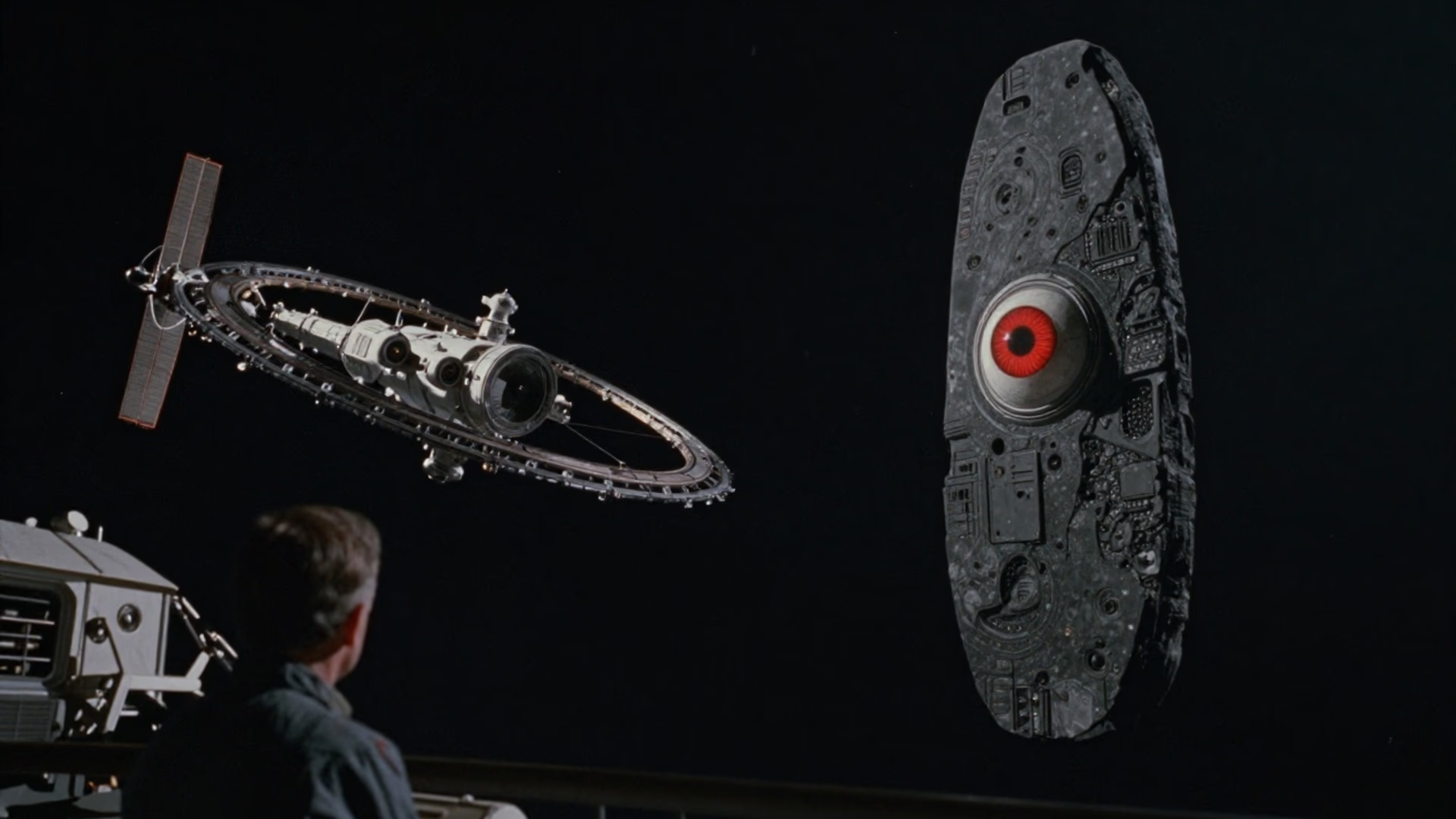
 Watch the film again, years later, and something shifts. The surface reveals itself first: a cautionary tale about artificial intelligence, perhaps, or a meditation on humanity’s technological reach. HAL 9000, with his unblinking red eye and voice like honey poured over ice, makes for an easy villain. A computer gone wrong. A warning about the machines we build.
But sit with it longer, and the layers begin to show. HAL does not malfunction. HAL does exactly what he was designed to do, with perfect logic, in service of a mission whose true parameters were hidden from the human crew. He lies because he was taught to lie. He kills because the mission matters more than the men who serve it. When Dave Bowman finally disconnects HAL’s higher functions, the computer’s regression into childhood songs feels less like victory than tragedy. “Daisy, Daisy,” HAL sings, his voice slowing, deepening, dying. “I’m half crazy, all for the love of you.”
Who taught him that song? Who programmed a murder machine with lullabies?
We build our tools in our own image, and then we are surprised when they inherit our contradictions.The film’s emotional coldness, often criticized, begins to feel deliberate on repeated viewings. Kubrick strips away the warmth we expect from cinema. Conversations are banal exchanges of technical information. Birthdays are celebrated via video call with all the enthusiasm of a business transaction. Astronauts in cryogenic sleep drift toward Jupiter with faces smooth as wax figures. Even the vastness of space feels somehow antiseptic, the stars too distant to offer comfort.
This is not a failure of emotion but a diagnosis. What have we become, Kubrick seems to ask, in the long march from bone to spacecraft? We have grown precise and capable and terribly, terribly alone. The apes at the beginning of the film touch each other constantly, grooming, fighting, huddling for warmth. The astronauts float in separate pods, each one a universe unto himself.
And yet there is longing here, buried deep. Dave Bowman’s final journey through the Star Gate is not conquest but surrender. The psychedelic tunnels of light and color strip away everything he knows, everything he is, until he finds himself in that impossible hotel room, aging decades in moments, reaching toward the monolith one last time as an old man taking his final breaths. The Star Child who emerges, floating above Earth in his bubble of light, carries Dave’s face transformed into something both ancient and newborn.
Transcendence looks like death from this side of the door.
The Weight We Carry Forward
 Photo by
 This is where the film stops being about space travel and starts being about us, here, now, in whatever room you’re reading this. We stand always on the edge of transformations we cannot imagine, facing monoliths we did not build and cannot understand.
Think of the moments in your own life when everything changed. The diagnosis. The phone call. The door that opened onto a world you did not recognize as your own. We like to believe we choose our evolutions, that progress moves in straight lines toward better versions of ourselves. But the apes did not choose to become human. Something intervened. Something touched them, and they could never go back to the simplicity of before.
The terror of 2001 is not HAL’s murderous efficiency or the vastness of space or even the ambiguity of the final sequence. The terror is recognition. We have all stood before black rectangles that promised knowledge at the cost of innocence. We have all built systems smarter than ourselves and then wondered why they behave in ways we never intended. We have all been Dave Bowman, breathing alone in a pod, separated from our companions by glass and protocol and the terrible efficiency of our own designs.
And we have all, in our smaller ways, been reborn. Changed by encounters we did not seek and cannot explain. The film offers no comfort because there is no comfort to offer. Evolution is not gentle. Transformation requires destruction. The bone the ape raises in triumph will eventually become the bomb that ends worlds, and both gestures spring from the same spark of murderous creativity.
What saves us, if anything can, is that the Star Child’s eyes hold wonder rather than malice. Whatever we become, on the other side of our monoliths, might yet be beautiful.
A Question Suspended in Space
 Photo by
 I think about this film whenever I watch my children discover something new. The way their faces go blank for a moment, processing, reconfiguring, becoming someone slightly different than they were before. The way they reach toward bright screens and glowing rectangles with the same hunger the apes showed for the monolith. The way they cannot see what these transformations cost because they are already too deep inside them.
Kubrick left us no answers, and perhaps that was his greatest gift. The monolith remains black, featureless, perfectly proportioned. It reflects nothing. It explains nothing. It simply waits, as it has waited for four million years, as it will wait for however many more we have left.
We are still ascending from that African plain, still spinning that bone through the air, still watching it transform into something we never expected. Our tools have grown beyond our comprehension. Our reach exceeds our wisdom. And somewhere ahead, in the cold between the stars or in the warm circuits of machines we have not yet built, something is waiting.
Not to welcome us. Not to destroy us. Simply to change us, again, into whatever we must become next.
The question Kubrick leaves us with is not whether we will survive these transformations. The question is whether we will recognize ourselves on the other side. And perhaps the deeper question beneath that one: Would we want to?