The Origin of Small Rebellions
In 1982, Stephen King published a story about a man who refused to let prison walls define the boundaries of his soul. It was a quiet tale, a novella really, tucked inside a collection called Different Seasons. Five years later a young filmmaker named Frank Darabont paid King a token fee for the rights, and then held them for another five, waiting, believing that someday he would find the right moment to bring it to life.
When 『The Shawshank Redemption』 finally arrived in theaters in 1994, it entered the world without fanfare. Critics appreciated it, but audiences stayed away. The film seemed destined to disappear, another well-crafted work lost in the noise of a crowded season. But here is where the story becomes something more than cinema. Here is where art begins to mirror the very truth it contains.
The film tells us about Andy Dufresne, a banker wrongfully convicted of murdering his wife and her lover. He enters the gray fortress of Shawshank Prison with nothing but his mind and a strange, unshakeable composure. Over nineteen years, he carves out a life inside those walls. He builds a library. He helps guards with their taxes. He befriends a man named Red, played with weary grace by Morgan Freeman. And all the while, he is doing something else entirely, something invisible, something patient beyond measure.
We watch Andy and we think we understand him. But Darabont understood something deeper. He knew that the real story was not about escape at all. It was about what we choose to carry with us through the darkest passages of our lives.
The Long Work of Becoming Free
 Photo by
 There is a scene in the film that haunts me still. Andy locks himself in a room and plays an aria from Mozart’s The Marriage of Figaro over the prison loudspeakers. The music spills across the yard where hardened men stand frozen, their faces turned upward as if receiving rain after a drought. For a few minutes, the walls dissolve. The men are somewhere else entirely.
Red later says that he had no idea what those Italian ladies were singing about. It did not matter. What mattered was that for those few minutes, every man in Shawshank felt free.
We have all known walls. Perhaps not stone and iron, but walls nonetheless. The job that swallows our days. The relationship that diminishes us slowly. The illness that rewrites the rules of our existence. The grief that follows us into every room. We know what it means to look at the calendar and see the same gray stretch extending forward without end.
What the film asks us to consider is not how to tear down those walls with force. Andy’s triumph comes from something far more subversive. He refuses to let the institution own his inner life. He reads books. He writes letters, one a week, then two, year after year, until the state finally sends the funds for his library. He plays chess by mail with people he will never meet. He teaches a young man to read.
Freedom, the film whispers, is not always about changing your circumstances. Sometimes it is about refusing to let your circumstances change you.Darabont struggled to make this film. Studios wanted bigger names, faster pacing, a more conventional ending. He held firm. He believed in the slow accumulation of small moments, the way trust builds between two men over decades, the way hope survives through acts of defiance so minor they go unnoticed by the guards.
The film never came close to recouping its costs in theaters. And then something remarkable happened. People found it on home video. They told their friends. They watched it again on quiet Sunday afternoons. The film that nobody wanted to see became one of the most beloved works in cinema history. It has sat at the top of IMDb’s user ratings since 2008.
There is a lesson here about the nature of things that matter. They do not always arrive with trumpets. Sometimes they need time to find us.
What the Walls Cannot Hold
 Photo by
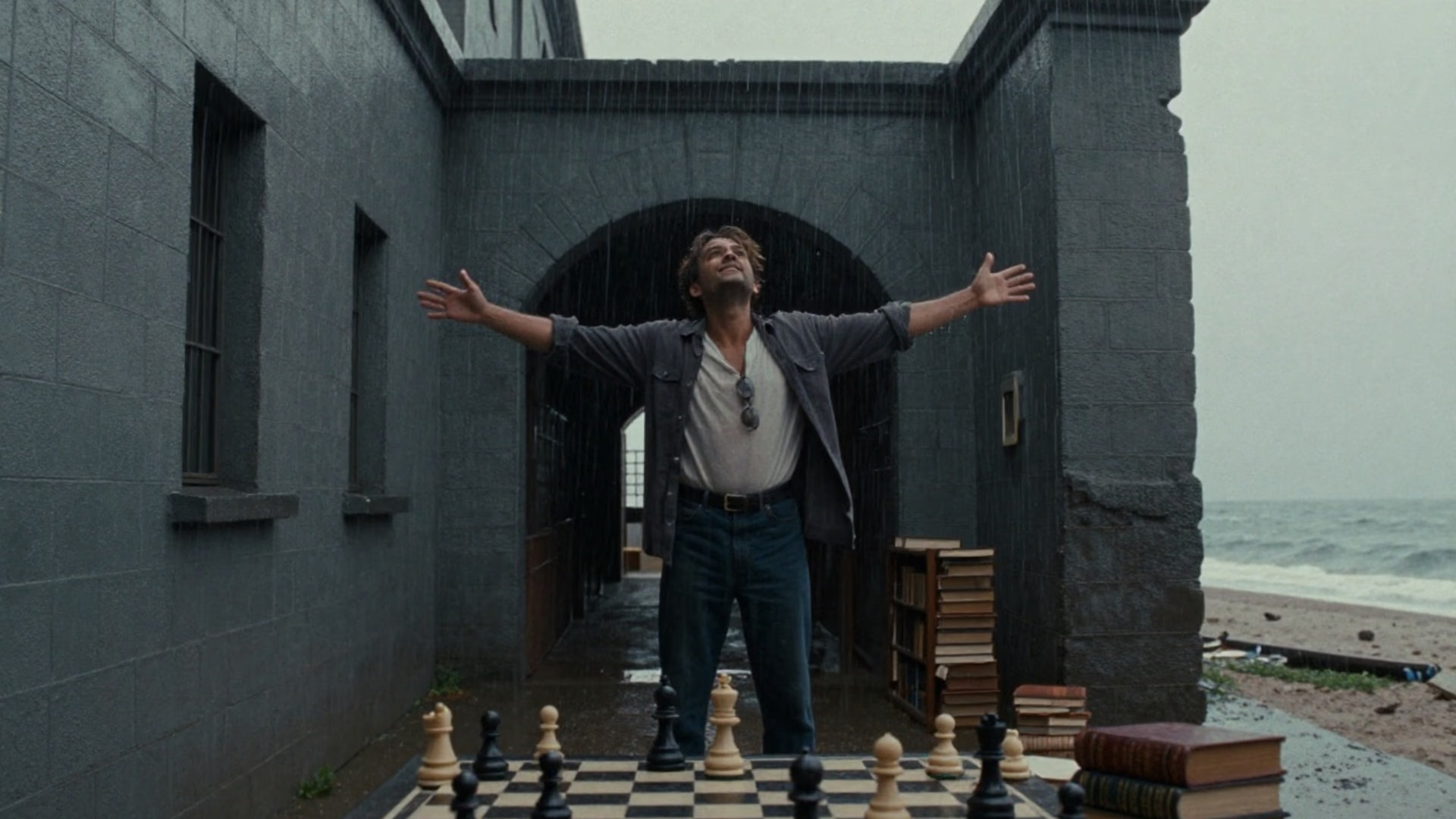
 The ending of the film is famous now, but let me recall it anyway. Andy escapes through a tunnel he has been digging for nearly twenty years, using a small rock hammer hidden inside a Bible. He crawls through a river of sewage and emerges clean on the other side, arms raised to the rain in what has become one of cinema’s most iconic images.
But I find myself returning more often to the moments before. To Red sitting in his cell, wondering if his friend was simply a man who needed a hobby to pass the time. To the quiet accumulation of ordinary days. To the posters that covered the hole in the wall, Rita Hayworth first and Raquel Welch at the end, beautiful and unknowing.
Andy’s escape works because it is not about a single dramatic act. It is about years of invisible labor, tiny handfuls of rubble carried out in his pants and scattered across the exercise yard. Each morning he wakes inside those walls and makes a choice that no one else can see. He chooses to believe in an elsewhere.
This is what sustains us when we are trapped. Not grand gestures, but small ones. The letter we write. The book we read. The conversation we have with someone who understands. The way we tend the garden of our mind even when nothing seems to grow.
The warden keeps a plaque on his wall that reads “His judgment cometh and that right soon.” He thinks it refers to the prisoners under his authority. He does not realize it speaks to him. We are all subject to the slow justice of time. What we build in secret eventually comes to light. What we hide eventually reveals itself.
Andy hid a tunnel. The warden hid corruption. Both men spent decades constructing something behind the surfaces of their lives. The difference was in the direction. One was digging toward light.
The Invitation
 Photo by
 I do not know what walls surround you as you read this. I cannot see the shape of the tunnel you might be digging, or whether you have even begun. But I believe, as Andy believed, that hope is a discipline. It is something we practice, not something we simply feel.
There is a line near the end where Red, finally released, considers what his friend taught him. “Hope is a good thing,” he remembers Andy writing, “maybe the best of things, and no good thing ever dies.”
It sounds almost naive when you say it out loud. And yet the film earns that sentiment through its honesty about how long the work takes. Hope in Shawshank is not optimism. It is not a feeling that everything will be fine. It is an act of resistance against the forces that want us to give up.
What small rebellion are you tending? What letter are you writing that no one has answered yet? What music are you playing for yourself when the walls feel close?
The film ends with two men reuniting on a beach in Mexico, blue water stretching to the horizon. It is a fantasy, perhaps, but a necessary one. We need to imagine the place where we might finally be free. Not because imagination replaces action, but because it makes action possible.
Somewhere, right now, someone is holding a rock hammer. They are measuring the distance in years, not days. They are believing in something they cannot prove.
Maybe that someone is you.