Two Women, One Storm
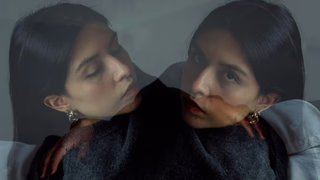
There is a painting where a woman sits beside herself. Not metaphorically, not in the abstract way we speak of being “beside ourselves” with grief or rage, but literally. Two versions of the same person, sharing a bench, holding hands, their hearts exposed and connected by a single artery that threads between them like a lifeline.
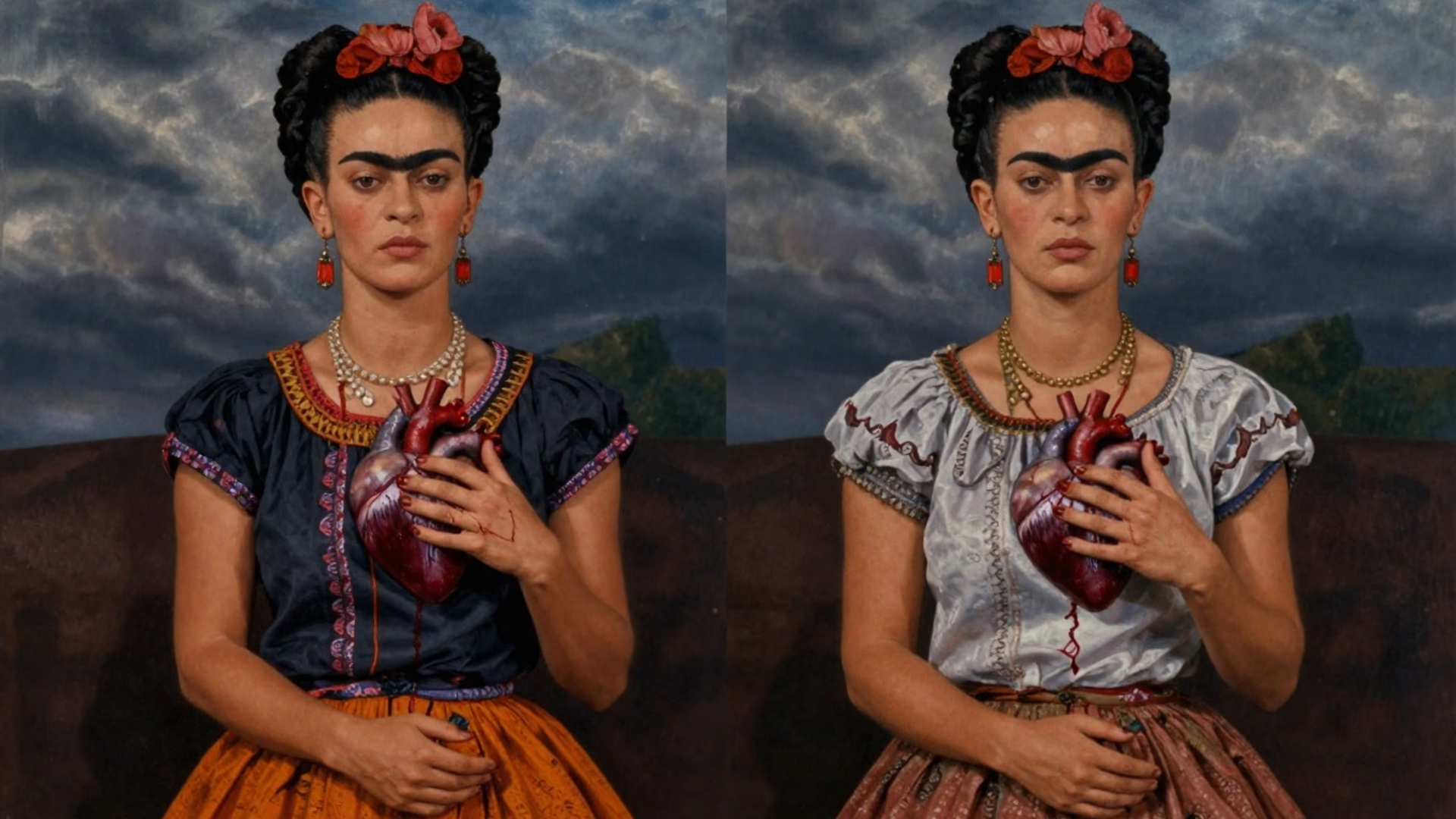
When Frida Kahlo completed 『The Two Fridas』 in 1939, she had just ended her marriage to Diego Rivera. The canvas is massive, nearly six feet across, as if the scale of her internal fracture demanded that much space to breathe. On the left sits a Frida dressed in white Victorian lace, the kind of European refinement her German father might have recognized. On the right sits another Frida in the traditional Tehuana dress her Mexican mother wore, the costume Diego once loved to see her in. Both women stare out at us with the same unflinching gaze, but they are not the same woman at all.
This is the contradiction that stops me every time I encounter this work. The rejected Frida, in her colonial white, holds surgical forceps that have clamped an artery, but blood still drips onto her skirt, staining the fabric. The beloved Frida clutches a small portrait of Diego as a child, and her heart remains whole. They are connected, these two selves, but one is bleeding out while the other survives. The sky behind them churns with gray clouds, indifferent to the surgery happening below.
We have all sat on that bench. Maybe not after a divorce, maybe not with our chests literally open to the wind, but we have all known the strange vertigo of becoming two people at once. The person we were before the loss and the person we are becoming after. The self that belonged somewhere and the self that no longer fits. The version of us that others needed and the version that we actually are.
The Space Between Belonging
 Photo by
 What does it mean to be split? Not broken, exactly, but divided. Kahlo understood this question in her bones. Born to a German father and a Mexican mother of indigenous and Spanish descent, she grew up navigating between worlds that did not always speak to each other. The colonial legacy of Mexico meant that European culture carried prestige, while indigenous traditions were often dismissed as primitive. To be both was to be neither fully. To honor one heritage could feel like betraying the other.
The Two Fridas makes this invisible conflict visible. The European Frida wears the corset and the high collar, the costume of respectability and restraint. Her heart is dissected, laid open for anatomical study, as if even her emotions must be presented in an acceptable, clinical form. The Mexican Frida wears loose cotton and embroidered flowers, her heart whole and beating, connected to the tiny image of Diego that she refuses to release. One self conforms. The other self loves. And Kahlo paints them both without choosing between them.
This refusal to choose feels radical, even now. We live in a world that constantly asks us to pick a side, to simplify ourselves into something legible. Are you traditional or modern? Emotional or rational? Strong or vulnerable? The pressure to flatten our contradictions into a single story begins early and never quite stops. We learn to present the acceptable version in job interviews, at family gatherings, on social media. We tuck the other self away, hoping no one notices the seams.
But Kahlo paints the seams. She paints the artery that runs between her two halves, the literal lifeline that keeps both selves alive even when one is hemorrhaging. To be whole, she seems to say, is not the same as being undivided. We can hold our contradictions. We can let them sit side by side, hands clasped, without requiring them to merge into something simpler.
I think about the immigrant families I know, the children who speak one language at home and another at school, who code-switch so fluidly that they sometimes forget which self is speaking. I think about the friends who left their small towns for the city and now feel like tourists in both places. I think about anyone who has ever loved someone their family could not accept, or chosen a path their culture did not anticipate. The Two Fridas are everywhere, once you learn to see them.
The blood on the white dress is the cost of this division. Kahlo does not pretend that holding two selves is painless. The rejected Frida is dying, slowly, drip by drip. She has clamped the wound but cannot fully stop it. This is the grief of becoming someone new while the old self lingers, refusing to vanish quietly. We cannot simply amputate the parts of ourselves that no longer serve us. They bleed. They leave stains.
The Long Echo of Division
 Photo by
 Kahlo painted this work over eighty years ago, but its emotional logic has not aged. If anything, our capacity for self-division has only grown more elaborate. We curate different versions of ourselves for different platforms, different audiences, different moments. The self we present to our employers rarely resembles the self we show our closest friends. The person we are at midnight, alone with our thoughts, may be a stranger to the person we perform in daylight.
This is not always dishonest. Sometimes it is simply survival. We learn early that certain rooms are safer for certain selves, that some truths must be rationed, that vulnerability is a currency we cannot spend everywhere. But the cost accumulates. The artery between our divided selves grows thin. We forget which version holds the small portrait of who we actually love, and which version is slowly bleeding out.
Across cultures and centuries, artists and thinkers have circled this same wound. The ancient Greeks spoke of the divided soul, torn between reason and appetite. Religious traditions describe the battle between the earthly self and the spiritual self. Psychoanalysis gave us the ego, the id, the superego, a whole committee of selves negotiating in the dark. What Kahlo offers is something more tender than theory. She offers a portrait of two women who do not fight. They hold hands. They share a heartbeat. They endure the storm together.
Perhaps this is the only resolution available to us. Not integration, not the triumphant merging of all our fragments into a single coherent identity, but coexistence. The acknowledgment that we will always be multiple, always in conversation with versions of ourselves that do not quite agree. The European Frida and the Mexican Frida will never become one person. But they can sit together. They can keep each other alive.
Hands Clasped Against the Sky
 Photo by
 I return to that clasped hand at the center of the painting. It is the quietest detail, easy to overlook amid the exposed hearts and the turbulent sky, but it anchors everything. The two Fridas are not enemies. They are not competing for dominance. They are simply holding on.
This is what we do, in the end, when we cannot reconcile our divided selves. We hold on. We let the contradictions coexist without demanding resolution. We accept that the person we were before the heartbreak will always sit beside the person we became after, and that both are real, both are us, both deserve a place on the bench.
The blood keeps dripping. The sky keeps churning. And still, the hands remain clasped.
Maybe the question is not how to become whole. Maybe the question is simpler, and harder. Can we learn to hold our own hands? Can we stop abandoning the parts of ourselves that bleed? Can we, like Kahlo, find the courage to paint what we see when we look in the mirror and discover that we are more than one?