The Question in Her Eyes
Have you ever felt someone’s gaze rest upon you and known, in that fraction of a second, that something wordless had passed between you? Not a stare, not a glance, but something more tender and more unsettling. A question posed without language, requiring no answer yet demanding everything.
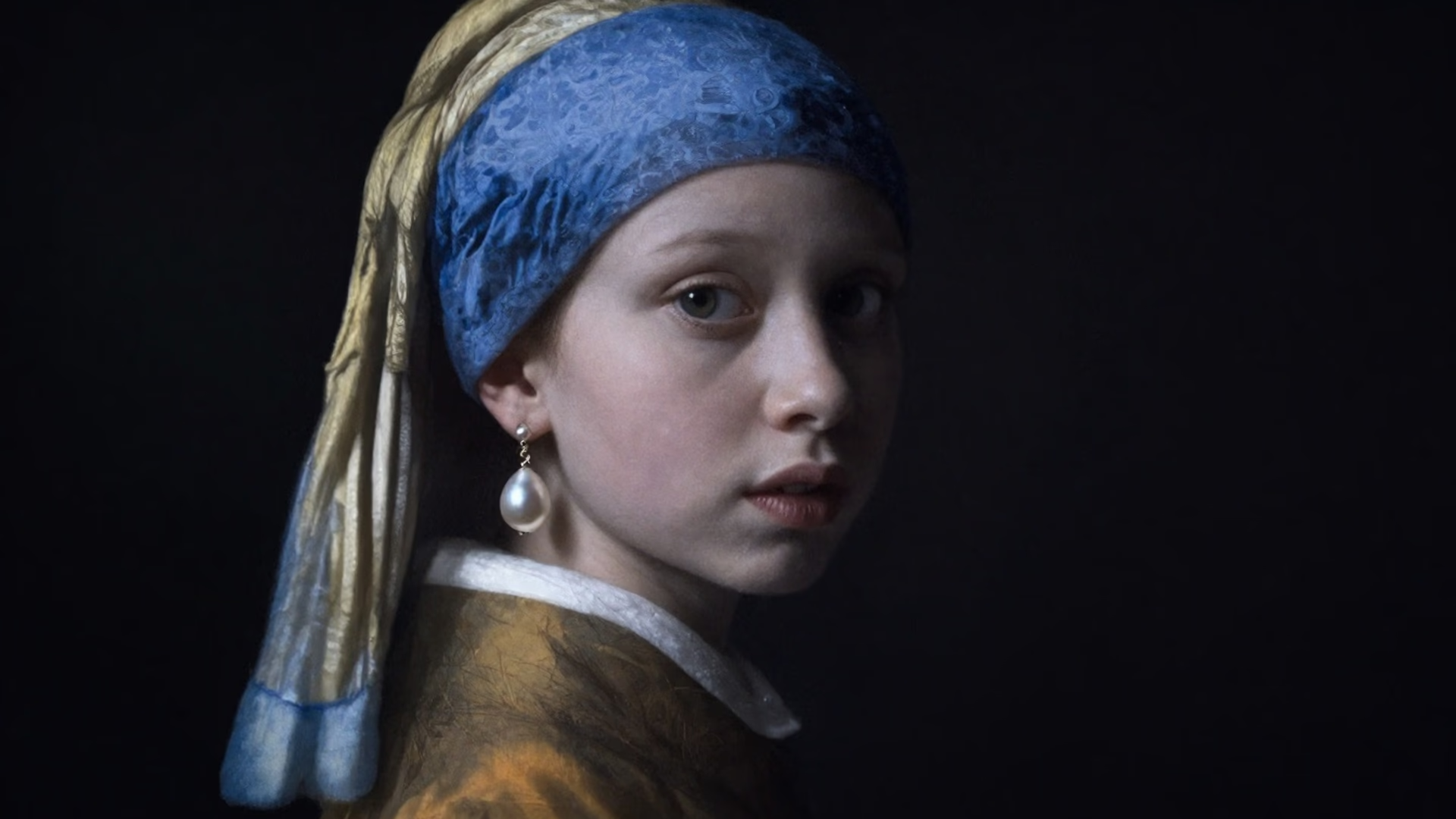
This is how 『Girl with a Pearl Earring』 greets us. Johannes Vermeer’s masterpiece from around 1665 hangs in the Mauritshuis museum in The Hague, yet it refuses to stay contained within its frame. The young woman turns toward us, her lips slightly parted as if she’s about to speak or has just finished speaking. The pearl at her ear catches light from some unseen source, luminous against the dark background. And her eyes, those impossible eyes, hold a question we’ve been trying to answer for over three hundred years.
What is she asking? Or perhaps the better question is this: what are we seeking when we meet her gaze?
We live in an age of constant visual noise. Faces scroll past us by the hundreds each day on screens we carry in our pockets. We see without seeing, look without witnessing. Yet occasionally, something stops us cold. A stranger’s expression across a crowded room. A photograph that makes us pause mid-scroll. The face of someone we love caught in a moment of unguarded thought. These encounters remind us that looking and truly seeing are different acts entirely.
Vermeer understood this distinction. He built his entire artistic life around it.
Light Falling on an Ordinary Day
 Photo by
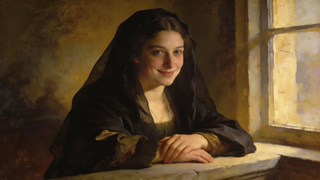
 The Dutch Golden Age was a time of unprecedented prosperity in the Netherlands. Merchants grew wealthy, cities flourished, and a new middle class emerged with money to spend on art. But where Italian masters painted gods and kings, Dutch painters turned their attention to something revolutionary: ordinary life.
Vermeer worked in Delft, a modest city known for its pottery and beer. He was not a prolific artist. His entire surviving body of work consists of only about thirty-five paintings. He ran an inn, dealt in art, had fifteen children, eleven of whom survived infancy with his wife Catharina, and painted slowly, deliberately, obsessively. Each canvas received his complete attention, sometimes for months or even years.
The girl in the painting was not a specific person, not a commissioned portrait of a wealthy patron’s daughter. She belongs to a genre called “tronie,” a Dutch word for face or expression. Tronies were character studies, explorations of type and mood rather than records of individual identity. This makes her both everyone and no one, a face drawn from life yet freed from the particularity of a single existence.
Vermeer posed her in a turban of blue and gold, exotic fabrics that suggest faraway places. He gave her that extraordinary pearl, impossibly large and perfectly lit, a symbol of purity and wealth that hangs like a drop of frozen moonlight. And then he captured the moment she turns to look over her shoulder, as if we’ve just called her name.
The painting’s power lies in what it withholds: we will never know who she was, what she was thinking, or why she looked back at us in just this way.This mystery is intentional. Vermeer was a master of light, and light in his work does more than illuminate surfaces. It creates intimacy. The soft glow on the girl’s face, the wet gleam on her lower lip, the pearl’s gentle luminescence against shadow, all of these draw us into closeness with a stranger. We lean in. We want to understand. And in that wanting, we reveal something about ourselves.
The painting has been called the “Mona Lisa of the North,” and the comparison is apt. Both works feature young women with enigmatic expressions, both refuse to yield their secrets, and both have inspired centuries of speculation. But where Leonardo’s subject sits distant and composed, Vermeer’s girl engages us directly. She is not a riddle to be solved but a presence to be encountered.
When Eyes Become Doors
 Photo by
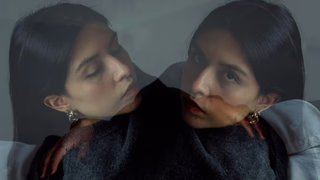
 I remember the first time I truly looked at someone and felt seen in return. Not the social seeing we perform daily, the acknowledgment of presence that smooths our passage through crowded spaces. This was different. I was young, sitting across from someone I barely knew, and for a moment the ordinary machinery of conversation stopped. We simply looked at each other. The world contracted to the space between us.
Nothing dramatic happened afterward. We talked, we parted, we went on with our separate lives. But that moment of mutual recognition stayed with me, a small stone I’ve carried in my pocket for years. It taught me that intimacy can happen in an instant, that two people can share something profound without exchanging a single word.
This is what Vermeer offers us, this same quality of encounter. The girl’s gaze creates a private space, a room within the room where viewer and subject meet. We bring ourselves to that meeting. Whatever we’ve lost, whatever we’re seeking, whatever we hope to find in another person’s eyes, we carry it with us when we look at her.
Perhaps this is why the painting moves us: it mirrors our own longing for genuine connection. In a world that often feels fragmented and hurried, where attention is a scarce resource constantly under siege, the girl’s steady gaze reminds us what it feels like to be fully present with another being. She gives us her attention without condition or reservation. She asks nothing of us except that we look back.
And looking back, we remember. We remember the people who have truly seen us, who looked past our surfaces to something more essential. We remember the times we’ve offered that same quality of attention to others, the rare moments when we set aside our own preoccupations and simply witnessed another person’s existence. These are the encounters that mark us, that change the texture of our days.
What the Pearl Holds
 Photo by
 The pearl earring itself has become an icon, reproduced on countless postcards and book covers, turned into a novel and a film. But we might ask what Vermeer intended when he placed that luminous drop at the center of his composition.
Pearls in the seventeenth century carried complex meanings. They signified purity and virginity, wealth and status, vanity and worldly attachment. They were treasures from the sea, formed slowly in darkness, revealed only when their shells were opened. A pearl is both natural and precious, a transformation of irritation into beauty.
The girl wears her pearl simply, without ostentation. It catches the light and throws it back to us, a small sun in the darkness of the background. Like her gaze, it draws our attention, holds it, offers itself for contemplation. And like her gaze, it keeps its secrets.
Maybe this is what Vermeer understood about beauty: it resides not in perfection but in mystery. The most beautiful moments in our lives often share this quality. A slant of afternoon light through a window. A child’s sleeping face. The sound of rain on leaves. These ordinary miracles stop us because they cannot be fully grasped, because they exceed our capacity to possess or explain them.
The girl with the pearl earring is beautiful in exactly this way. She is simple and profound, present and elusive, intimate and unknowable. She reminds us that the people we love are also, finally, mysteries to us. We can spend a lifetime with someone and never exhaust the depths of their being. This is not a failure of intimacy but its truest expression.
So perhaps Vermeer’s painting is not asking us anything after all. Perhaps it is offering something instead: permission to dwell in uncertainty, to embrace the not-knowing that lies at the heart of every genuine encounter. The girl looks back at us across three and a half centuries, and her gaze remains open, patient, waiting.
What do we find there?
Only what we bring. Only what we’re willing to see.