It is Midsummer, and the orchard is warm and still and full of ripening fruit. She is not beautiful. She has never been beautiful. She knows this the way she knows the cold, as a fact she has learned to carry without complaint. He stands before her, this man who owns the house and the grounds and the very position that keeps her fed, and he has just told her, almost carelessly, that she must go. He is testing her. He does not yet understand what he is testing.
And then she speaks.
Not softly. Not with the careful calibration of a woman who has learned which words are safe. The words come up from somewhere beneath obedience, beneath years of smallness imposed from outside and defended against from within. “Do you think, because I am poor, obscure, plain, and little, I am soulless and heartless?” The question is not really a question. It lands like something thrown hard against stone. She tells him that her spirit addresses his spirit as if both had passed through the grave and stood before God. Equal. Not almost equal. Not equal in some limited, qualified, conditional sense. Equal in the only way that finally matters - at the level where no inheritance or title or physical grace can reach.
The air does not move. He stares at her. The orchard wall holds the last of the day’s heat behind them both. She has risked everything in this moment - her position, her livelihood, the only home she has. She knew this when she opened her mouth. She spoke anyway.
We know this moment from the inside, even if we have never read a word of Brontë.
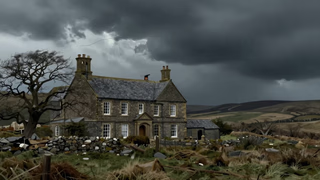
We know it because we have all stood somewhere on that path - not in a gothic manor, not with the Yorkshire moors rolling out beyond us, but in some office, some kitchen, some conversation that tilted quietly toward the edge. And we have felt the words gathering somewhere below the throat, pressing upward, and we have made our calculation. The cost of speaking. The cost of silence. The familiar arithmetic of self-erasure.
To demand equality from someone who has the power to destroy you is not romance; it is an act of extraordinary, almost reckless courage.
What Jane understands, standing in the rain, is that dignity is not something granted when circumstances improve. It is not a reward waiting at the end of a quieter, safer moment. It is only ever available here, in the exposed place, where the speaking of it costs something real. Brontë knew this. She published under a man’s name so that a woman’s voice might finally be heard - and then made that voice say something no one could unhear.
Someone, right now, is swallowing words that would set them free. The silence has grown so familiar it no longer feels like a choice.