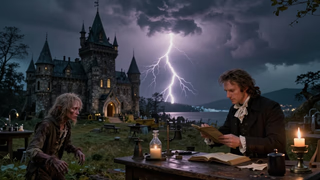
A hand claws at a window latch on the Yorkshire moors, and the fingers that grip it belong to a ghost, or a memory, or something worse: a love that refuses to stay buried. The scene appears early in 『Wuthering Heights』, when the bewildered narrator Lockwood, trapped by a snowstorm in a house that seems to breathe hostility, reaches through broken glass and feels the ice-cold grasp of a child’s hand. “Let me in,” the specter begs. “Let me in.” It is one of the most unsettling passages in English literature, not because of the supernatural element, but because of what it whispers about us. We have all, at some desperate hour, been the voice outside the window. And we have all, in cowardice or self-preservation, been the one who pulled our hand away.
Emily Brontë was twenty-nine when she published this novel under the pseudonym Ellis Bell, a man’s name chosen not out of whimsy but necessity. The literary world of 1847 England had little patience for women who wrote quietly, let alone women who wrote like this, with a ferocity that seemed to arrive from somewhere outside polite society altogether. Emily had spent most of her short life in the parsonage at Haworth, a village pressed against the edge of the moors, where the wind never quite stopped and the graveyard lay just beyond the garden wall. She was the middle surviving sister, quieter than Charlotte, more elusive than Anne, and by most accounts deeply uncomfortable in the company of strangers. The moors were her society. The sky over Haworth, constantly shifting between bruised purple and pale silver, was her conversation partner.
What drove her to write a novel of such savage emotional power? The honest answer is that nobody knows. Emily left almost nothing in the way of personal confession. No diary entries explaining her vision. No letters outlining her ambitions. What we have is the book itself, and a handful of poems that burn with the same strange, dark light. Some scholars point to the Brontë children’s elaborate imaginary worlds, Gondal and Angria, as the seedbed. Others note that Emily witnessed her brother Branwell’s slow destruction through addiction, watched genius curdle into ruin. Still others suggest that the moors themselves were the true author, that Emily simply took dictation from the wind.
Where the Wind Comes From
The creation of Wuthering Heights was an act of solitary courage, though Emily would likely have rejected both words. She wrote in a household already devoted to writing. Charlotte and Anne were composing their own novels at the same kitchen table. The three sisters would walk in circles around the dining room at night, reading passages aloud, debating, revising. But Emily’s work stood apart from her sisters’ in tone and temperature. Where Charlotte’s Jane Eyre moved toward resolution, toward a hard-won domestic peace, Emily’s novel spiraled inward, then exploded. It offered no comfort. It did not repent.
The critics noticed, and many of them recoiled. Reviews called the book “wild,” “confused,” “disagreeable.” One critic wrote that the only consolation was that the novel would never become popular. The complaint was always the same: the characters were too brutal, the passions too raw, the moral compass absent. Heathcliff, the orphan plucked from the streets of Liverpool and raised at Wuthering Heights, was no brooding romantic hero. He was cruel. He hanged Isabella’s spaniel on the night she ran away with him, and it was cut down alive. He systematically destroyed the families of everyone who had ever wronged him, and some who had not. Catherine Earnshaw, the woman he loved with a force that bent the world around them, was selfish, manipulative, and wholly aware of it. “I am Heathcliff,” she declares, and the line has been quoted so many times it has lost its strangeness. But read it again slowly. She is not saying she loves him. She is saying there is no boundary between them. That the self she knows and the self he is are the same wild territory.
This was what disturbed Victorian readers, and it is what still disturbs us now. Not the cruelty, exactly. Not the revenge. But the suggestion that love, real love, the kind that roots itself in the bones, might not make us better. It might make us monstrous.
Think of that moment when you realized a feeling you carried had grown beyond your ability to manage it. Not a fleeting crush, not a passing infatuation, but something that rearranged the furniture of your inner life without asking permission. You did not choose it. You could not negotiate with it. And the shape it took was not always tender. Sometimes it looked like jealousy so fierce it nauseated you. Sometimes it felt like anger at the person you loved most, simply for existing in a way that made you need them. Brontë understood this. She understood that passion and destruction are not opposites but neighbors, separated by the thinnest of walls.
The House on the Hill, and the One in the Valley
 Photo by
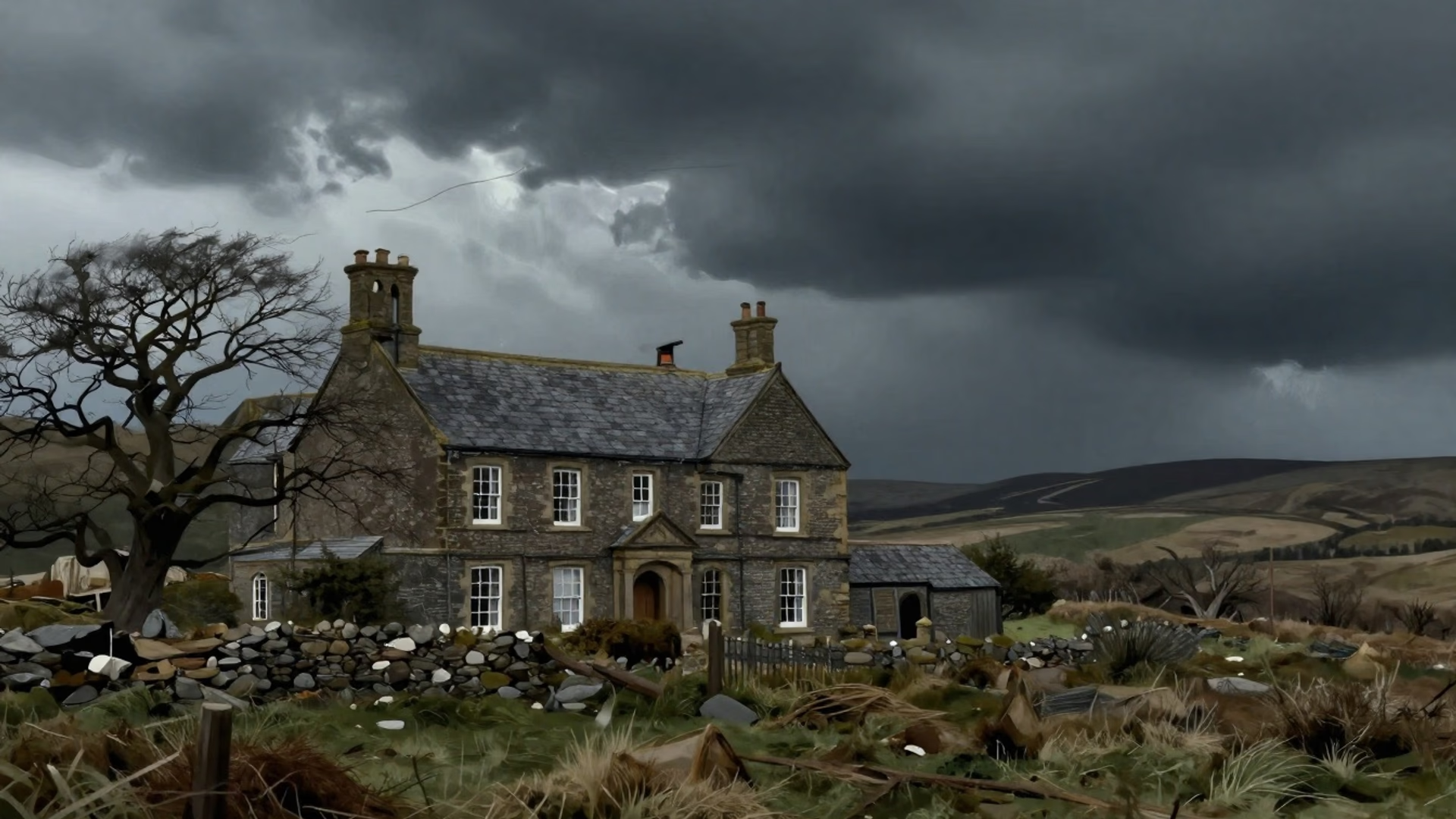
 The novel’s geography is its moral architecture. Wuthering Heights sits exposed on the hilltop, battered by every storm, its very name an old Yorkshire word for the turbulence of weather. Thrushcross Grange lies sheltered in the valley below, refined, warm, cushioned by money and manners. The tension between these two houses is the tension between wildness and civilization, between what we feel and what we are permitted to show. Catherine marries Edgar Linton of the Grange because he is handsome, wealthy, and gentle. She knows, as she tells her servant Nelly, that marrying Heathcliff would degrade her. And in the same breath, she knows that Edgar’s love is like “the foliage in the woods” while her bond with Heathcliff resembles “the eternal rocks beneath.” She chooses the foliage. Most of us would.
We build our lives in the valley. We take the jobs that make sense, form the relationships that others can understand, construct selves that fit neatly into social expectations. And somewhere on the hill above, the wind keeps howling. We hear it at three in the morning when sleep won’t come, or in the sudden rage that flares over something trivial, or in the grief that arrives years after a loss, as if it had been walking toward us all that time.
Heathcliff’s revenge, which consumes the second half of the novel, is a portrait of what happens when someone lets the hill swallow them entirely. He acquires Wuthering Heights and Thrushcross Grange. He degrades Hindley’s son Hareton, turns him into a servant to mirror his own childhood humiliation. He traps young Cathy, Catherine’s daughter, in a loveless marriage. Every act is calculated, methodical, and utterly hollow. Revenge, Brontë shows us, is grief wearing a mask. Heathcliff does not want property or power. He wants Catherine. And Catherine is dead.
The novel might have ended there, in permanent darkness. But something extraordinary happens in the final chapters. Hareton, the young man Heathcliff has tried to ruin, begins to teach himself to read with young Cathy’s help. Love returns, not as a tempest but as patience. Not as obliteration of the self but as the slow, clumsy work of two people learning to see each other. It is quieter than the love between Catherine and Heathcliff, and that is precisely the point. The second generation heals what the first one broke, not by ignoring the storm, but by learning to live after it passes.
A Door Left Open on the Moors
 Photo by
 Emily Brontë died of tuberculosis on December 19, 1848, just a year after Wuthering Heights was published. She was thirty. She refused to see a doctor until the morning of her death, when it was far too late. Even in dying, she would not be managed. The novel she left behind is not a love story, or not only a love story. It is a map of the places inside us where reason has no authority. It asks whether the forces that make us most intensely alive are the same forces that destroy us, and it refuses to answer neatly.
 Photo by
 We carry our own moors. The passions we have tried to civilize. The old injuries that still throb when the weather changes. The people we loved so fiercely that the love became indistinguishable from pain. Brontë does not tell us to tame these things, nor does she celebrate them. She simply says: look. This is what we are. The wildness and the wreckage. The hand at the window, begging to be let in.
You might find yourself, one evening, in a house that feels too quiet. The wind might pick up outside, rattling something loose. You might think of a name you haven’t spoken in years, and feel the old pull, half longing, half dread. You do not need to act on it. You do not need to open the window. But you might pick up this strange, dark novel and discover that someone understood, over a century and a half ago, exactly what that pull feels like. Not to cure it, but to name it. To stand beside you on the moor and say, yes. I know. The storm is real.
And that hand at the window, the one Lockwood recoiled from in terror? Read the scene again after you have finished the book. What once felt like horror begins to feel like something else. A plea. A recognition. A cold, desperate grasp reaching through broken glass, not to haunt you, but to remind you that some bonds do not dissolve, that some presences linger not because they wish to frighten, but because they cannot bear to be forgotten. The fingers are still there, still reaching. The question is not whether you hear the voice. It is what you do when you feel the grip tighten.