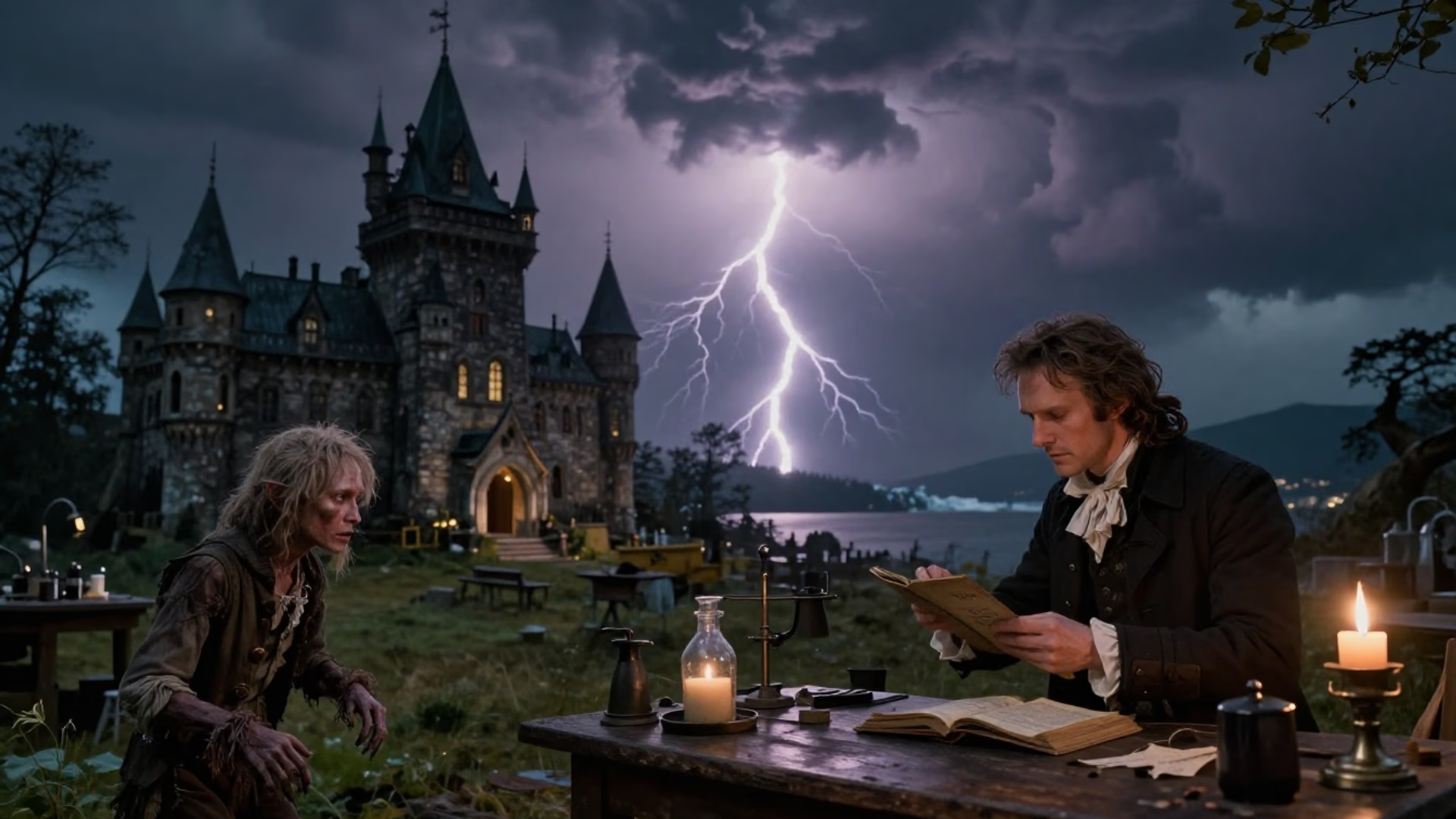
A creature opens its dull yellow eye for the first time, and the man who made it runs. He does not reach for it, does not speak a word of welcome. He simply flees the room, disgusted by the thing he spent years aching to build. That single moment, written over two hundred years ago in 『Frankenstein』, contains an entire philosophy of failure. Not the failure to create life, but the failure to stay once life has been created.
Mary Shelley was eighteen years old when she wrote this. Eighteen. The fact still startles, not because youth lacks depth, but because the depth she reached is the kind most people spend whole lifetimes circling without ever touching. During the cold, volcanic summer of 1816, trapped indoors at a villa near Lake Geneva with Lord Byron, Percy Shelley, and John Polidori, she accepted a casual dare to write a ghost story. What emerged was not a ghost story at all. It was a reckoning with what it means to bring something into the world and then refuse to hold it.
She knew something about abandonment. Her mother, Mary Wollstonecraft, died days after giving birth to her. Her father grew distant. By the time she sat down to write, she had already lost a premature baby of her own, a daughter who lived less than two weeks. The grief did not simply inform Frankenstein. It became its bloodstream. Every page pulses with the terror of being responsible for a life you cannot protect, or worse, a life you will not protect.
The Lightning That Would Not Wait
Victor Frankenstein’s obsession begins innocently enough, the way most dangerous ambitions do. A boy watches a tree split by lightning and becomes fascinated with the hidden forces of nature. He goes to university. He reads the old alchemists, then the modern chemists. Slowly, the question shifts from “how does life work” to “can I make it myself.” The transition feels almost gentle on the page, and that gentleness is part of Shelley’s genius. She understood that the slide from curiosity into hubris rarely announces itself. It whispers.
Victor works alone. He cuts himself off from family, from friends, from Elizabeth, who waits for him with a patience the novel never rewards. He digs through charnel houses, collects bones and tissue, labors in a workshop he will later describe with revulsion. For two years he lives inside a single fixation: the act of creation itself. Not what comes after. Never what comes after.
This is the pattern we recognize even now, stripped of its Gothic dressing. Think of that late-night certainty that you can build the thing, launch the project, begin the venture, fix the relationship on your own terms. The intoxication of making sits so close to the heart that we forget the creature will need something from us once it exists. A business needs tending. A child needs presence. An idea released into the world needs the person behind it to stand there and say, yes, this came from me, and I will not look away.
Victor looks away. The moment his creation breathes, he abandons it. And the creature, nameless and enormous and startlingly eloquent, wanders into a world that recoils at the sight of him. He teaches himself to read by listening through the wall of a cottage. He learns tenderness by watching a family he can never join. He asks for nothing monstrous, only companionship, only the smallest recognition that he has a right to exist. When even that is denied, his sorrow turns to fury, and the novel spirals into its long, Arctic grief.
Shelley never lets us settle into easy blame. Victor is not a villain; he is a coward, which is worse in some ways because cowardice is so common. The creature is not innocent either. His murders are real, his rage genuine and destructive. But between the two of them, the one with the greater sin is the one who had the choice and chose to turn his back. Creation without responsibility is not creation at all. It is detonation.
The Creature’s Mirror
 Photo by
 The most devastating passages in Frankenstein are not the killings. They are the moments when the creature tries to be good. He secretly gathers firewood for the De Lacey family. He saves a drowning girl and is shot for his trouble. He approaches the blind old man in the cottage, the only person who might judge him by his voice rather than his face, and for a few trembling seconds something like acceptance seems possible. Then the others return, and the screaming begins.
We do not need stitched-together skin to know what it is to enter a room and feel the atmosphere curdle around us. The experience of being perceived as wrong before you have spoken, of carrying a difference that others read as threat, is so widespread it hardly needs illustration. And yet Shelley illustrated it in 1818 with a force that still cuts. The creature’s loneliness is not a metaphor we have to decode. It is a mirror held up with uncomfortable steadiness.
What the novel quietly insists is that monstrosity is made, not born. Victor assembled the creature’s body, yes, but the world assembled its rage. Every door slammed, every stone thrown, every moment of horrified rejection added another layer to the thing society then pointed to as proof of its own fear. The loop is vicious and familiar. We see it in how communities treat those they have already decided not to understand. We see it in the way neglect breeds the very behaviors that justify further neglect.
Shelley, writing in an era when women’s intellectual ambitions were often dismissed or punished, understood this architecture of exclusion from the inside. She built her monster not to frighten us but to make us ask a question that has no comfortable answer: if we create the conditions for someone’s suffering and then condemn them for suffering, who is the real architect of the horror?
The novel does not answer cleanly. It is too honest for that. Victor dies exhausted and unrepentant, still blaming his creation rather than himself. The creature, weeping over Victor’s body, promises to end his own life on a funeral pyre in the Arctic wastes. Whether he follows through, we never learn. The story simply stops, like a wound left open.
The Fire You Carry Forward
 Photo by
 Something in us wants to tidy this up. We want the lesson packaged, the moral extracted, the warning label printed and affixed. But Frankenstein resists packaging precisely because its questions are still live. Every generation finds new resonance in it, from nuclear anxiety to genetic engineering to the algorithms we train on our own data and then release without knowing what they will become. The novel is not about one technology or one era. It is about the impulse that lives at the center of human ambition: the desire to make something powerful and the temptation to walk away from its consequences.
 Photo by
 You carry this impulse too. Maybe not in a laboratory, maybe not with stolen bones. But every meaningful act of creation, a project you pour yourself into, a relationship you shape, a child you raise, a community you help build, carries within it the same question Victor refused to face. What do you owe the thing you have made? How long must you stay? What happens if you leave?
The answers will be different each time. Sometimes letting go is not abandonment but wisdom. Sometimes the thing you created must find its own path. The difference, the one Shelley marks in fire and ice across her pages, is whether you leave out of care or out of revulsion. Whether you turn away because the work is done or because you cannot bear to look at what your hands have shaped.
Consider the creature one last time. Not the bolts-and-green-skin version that Hollywood gave us, but Shelley’s original: articulate, grieving, desperate to be seen. He opens his dull yellow eye in a dark room, and the first thing he knows in this world is the sound of his maker’s retreating footsteps. That silence where a voice should have been, that absence where care was owed, became the seed of everything that followed. The next time you bring something new into being, stay in the room. Speak first. Let the yellow eyes find yours, and do not run.