A boy stands in a churchyard at dusk, the flat marshes stretching toward a cold horizon, and he is reading the letters on a gravestone to learn his dead father’s name. He has never seen his father’s face. He will never hear his father’s voice. Everything he knows about himself he has assembled from scraps, from the rough affection of a blacksmith, from the sharp knuckles of a sister who resents the burden of raising him. And right there, in that opening scene, before any convict rises from behind a tombstone, before any decaying wedding cake or rusted iron gate, 『Great Expectations』 by Charles Dickens asks its real question. Not with words, but with the image of a small figure squinting at stone in fading light: who told you what you’re worth?
We carry that question everywhere, don’t we? Into classrooms, into job interviews, into the first seconds of meeting someone new. Somewhere, long before we had language for it, someone or something planted a number inside us, a sense of where we belonged on some invisible ladder. And we have been climbing, or refusing to climb, or pretending we don’t care about the ladder ever since. Pip, the orphan at the center of Dickens’ novel, is given a sudden fortune by an unknown benefactor and told he has “great expectations.” He leaves the forge where he was raised, abandons the people who loved him without conditions, and walks into London’s drawing rooms believing that money will make him into the person he was always meant to be. It is one of the oldest mistakes in the human playbook, and one of the most painful, because it works just long enough to feel true.
The Smoke and the Gilt
Dickens wrote Great Expectations in weekly installments for his literary journal, All the Year Round, beginning in 1860. He was fifty-one, famous, exhausted, and unhappy in his marriage. The glittering success of his career had not spared him private anguish. His own childhood wound, the blacking factory where he was sent to work at twelve while his father sat in debtor’s prison, never fully closed. It festered in his imagination, surfacing again and again in characters who feel the sting of class shame. But by the time he sat down to write Pip’s story, something had shifted. He was no longer simply angry at the system that humiliates the poor. He was asking a harder question: what happens to the person who escapes poverty only to discover that the escape itself has deformed them?
Pip’s journey through Victorian England is a study in misplaced devotion. He worships Estella, a beautiful young woman raised by the bitter Miss Havisham to break men’s hearts. He pours money into appearances, furnishing rooms he cannot afford, keeping a servant he does not need. He is ashamed of Joe Gargery, the blacksmith who raised him, whose rough hands and simple speech now embarrass him in polished company. And here is the twist that makes the novel so unsettling: we understand Pip completely. We do not just pity him. We recognize him. Because most of us have, at some point, looked at someone who loved us plainly and wished they were a little more impressive.
Dickens builds the novel’s architecture around a series of revelations. Pip assumes his benefactor is Miss Havisham, the wealthy recluse, and that his fortune is a sign that he is destined for Estella. When he discovers that his true benefactor is Abel Magwitch, the escaped convict he helped as a terrified child on the marshes, the foundation of his identity cracks open. The money he wore like a badge of belonging came from the lowest rung of society, from a man the law considered barely human. Pip’s horror at this discovery is the novel’s most brutal mirror. He is not horrified by the crime. He is horrified by the association. His revulsion tells him, and tells us, exactly how deep the poison of class thinking has traveled into his blood.
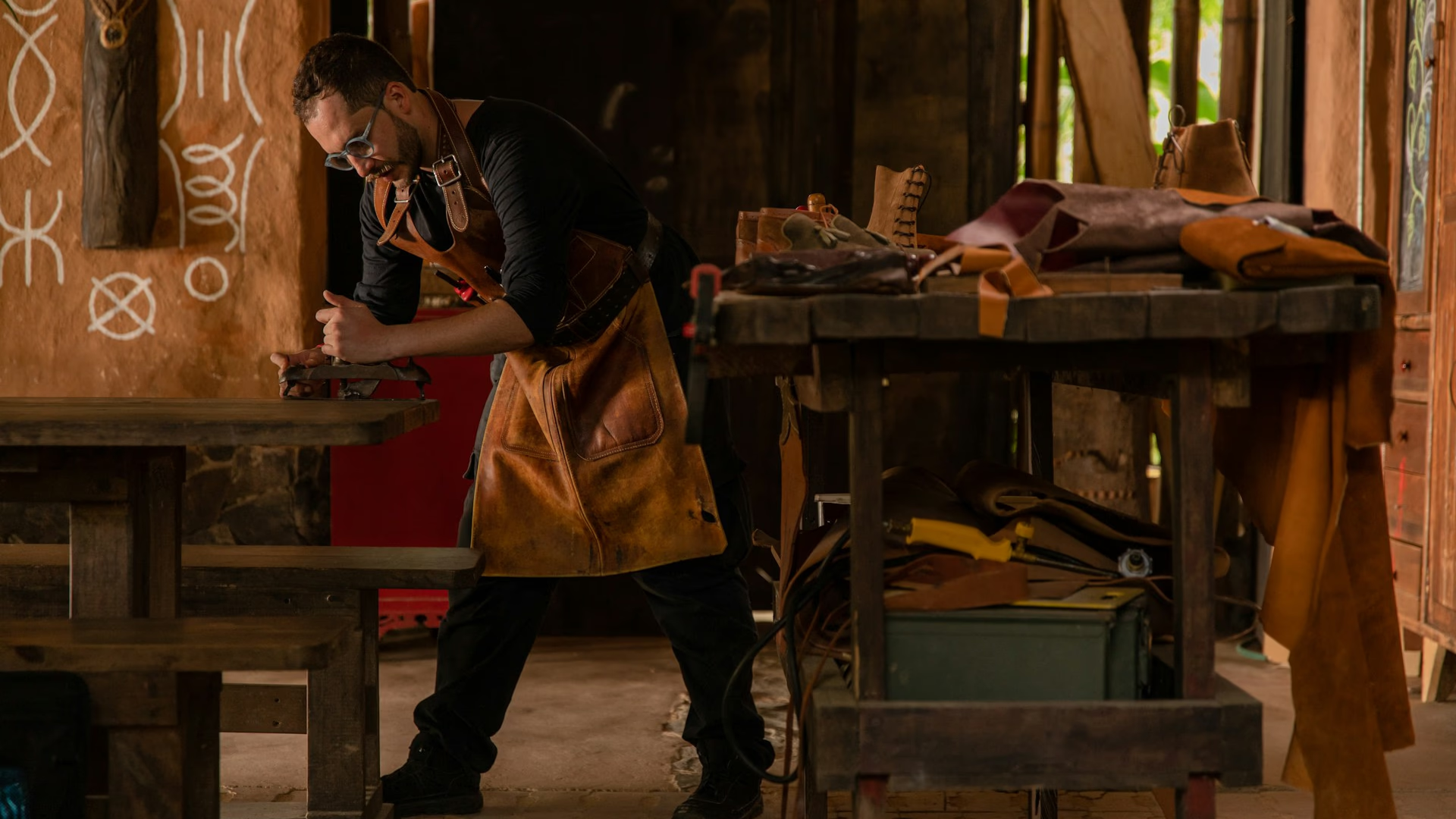
What saves Pip is not a dramatic reversal or a sudden heroic act. It is something slower and less glamorous. It is the long, humbling process of seeing what was always in front of him. Joe, who visited Pip in London and was treated with cold politeness, who paid Pip’s debts without being asked, who never once leveraged his goodness into a claim. Joe, who simply loved the boy and kept the forge warm.
The Hands That Held Us
 Photo by
 Think of that person in your own life. Not the one who dazzled you, not the mentor who opened doors or the friend who made you feel sophisticated. Think of the one you may have overlooked. The parent who drove you to practice and sat in the car reading a newspaper. The teacher whose class wasn’t glamorous but who noticed you were struggling and said something small and precise at exactly the right moment. The friend who never posted about your friendship online but showed up when the phone call came at two in the morning.
We live in a world that constantly ranks and sorts. Algorithms decide what we see, and what we see shapes what we value. The pull toward status, toward visible markers of success, is not a Victorian problem Dickens identified and we outgrew. It is a permanent feature of social life, and it takes on new costumes in every generation. The drawing rooms have become feeds. The gentleman’s wardrobe has become a personal brand. But the ache underneath is the same: the fear that we are not enough as we are, that we need some external seal of approval to justify our presence in the room.
The people who shape us most rarely look like benefactors; they look like ordinary life, and that is precisely why we fail to see them until they are gone.Pip nearly misses Joe entirely. He nearly loses the truest thing in his life because it came wrapped in a blacksmith’s apron instead of a gentleman’s coat. And that near-miss is what gives the novel its particular ache. Dickens is not writing a simple morality tale about the evils of wealth. He is tracing, with painful accuracy, the way ambition can become a lens that distorts everything we look at, making gold out of dross and dross out of gold.
There is something in Pip’s journey that mirrors a pattern many of us live through without naming. In our twenties, we chase. We accumulate credentials, connections, experiences that we believe will build the self we want to become. Somewhere in our thirties or forties, if we are lucky, a crack appears. Not a catastrophe necessarily, but a quiet fracture: a friendship that ends and makes us wonder what we neglected, a success that tastes thinner than we expected, a visit home where we notice our parents have gotten older and we haven’t called enough. The crack lets in a different kind of light, the kind that illuminates not what we’ve gained but what we’ve been carrying all along.
What the Forge Knows
 Photo by
 Dickens originally wrote a somber ending for Great Expectations, one in which Pip and Estella meet briefly and part for good, two people permanently marked by the illusions they chased. His friend Edward Bulwer-Lytton persuaded him to revise it, to leave a thread of hope. Literary scholars have debated for over a century which ending is truer. But the argument may miss the point. The novel’s real resolution happens not in the final pages but in the chapter where Pip returns to the forge, fevered and broken, and wakes to find Joe sitting beside him. “Which dear old Pip, old chap,” Joe says, “you and me was ever friends.” No lecture. No accounting of debts. Just presence. Just the steadiness of someone who never needed Pip to be anything other than what he was.
 Photo by
 That steadiness is not dramatic. It will never trend. It does not photograph well. But it is the thing that, at the end of a life, people reach for. Not the promotion, not the invitation to the important dinner, not the number on the bank statement. The hand that was there. The voice that did not judge. The kitchen table where you were welcome without performance.
We spend so much energy constructing the selves we present to the world, layering on accomplishments and affiliations like so many coats of lacquer. Great Expectations does not condemn this impulse. It simply follows it to its conclusion and lets us sit with what remains when the lacquer chips away. What remains is not nothing. It is, in fact, everything that mattered from the start. The forge was never the thing Pip needed to escape. It was the thing he needed to learn how to return to.
And maybe that is what growing up actually means: not the accumulation of wisdom or wealth, but the slow, sometimes painful recognition that the warmth we spent years searching for was already burning in the room we left behind.