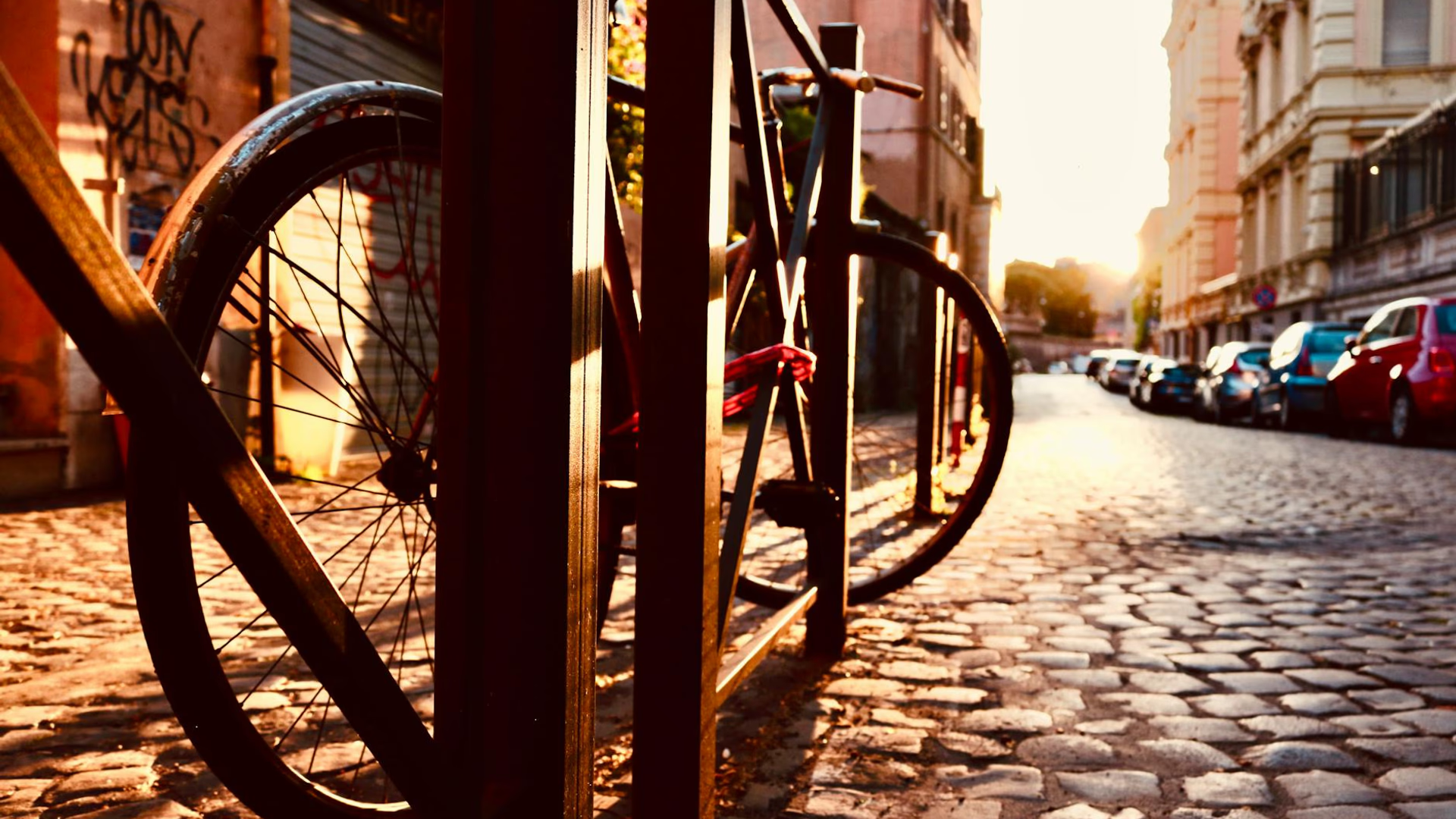
A father wakes before dawn, pulls on his good clothes, and tells himself today will be different. He has a job now. He has a bicycle. His wife pawned their bedsheets to get it back from the pawnshop, and those bare mattresses at home are the price of this second chance. He walks out the door with his young son beside him, and for a few bright hours the city feels almost kind.
Then someone takes the bicycle.
That is the whole story of 『Bicycle Thieves』, the 1948 film by Vittorio De Sica, and it is enough to break you. Shot on the actual streets of Rome with non-professional actors, the film follows Antonio Ricci and his small son Bruno through a single desperate day of searching. No studio sets, no orchestral swells, no villains twirling their metaphorical mustaches. Just a man, a boy, a stolen bicycle, and a city that does not care.
The scene that settles deepest is not the theft itself. It is what comes after. Antonio walks through neighborhood after neighborhood, his stride getting shorter, his voice getting louder and then quieter. Bruno trots beside him, sometimes falling behind, sometimes running ahead. The Roman streets are full of people, traffic, noise, commerce. Everyone is busy surviving. No one has time for a man looking for a bicycle. The camera holds on faces in crowds, and what you see is not cruelty but indifference, which is worse.
Watch Antonio’s hands. Early in the film, they are purposeful. He holds the bicycle with pride, touches his son’s head with casual affection. As the hours pass and every lead dissolves, his hands become restless, clenching and opening, reaching for nothing. By the afternoon, he grabs Bruno roughly, snaps at him, then looks stricken by what he’s done. His hands have become instruments of panic.
The Distance Between a Man and His Reflection
What lies beneath this story of a stolen bicycle is a study in erosion. Not the dramatic collapse we expect from tragedy, but the slow, grinding loss of the things that hold a person upright.
Antonio is not a complicated man. He wants to work. He wants to feed his family. He wants his son to see him as someone worth admiring. The bicycle is the hinge between all of these wants and the void of unemployment that postwar Rome offers in abundance. When it disappears, what actually fractures is not his livelihood alone but his sense of himself as a provider, a protector, a father who can look his boy in the eye.
De Sica layers this so carefully that you almost miss it. The first hour plays like a procedural. Antonio goes to the police. The police shrug. He goes to the market where stolen parts are resold. He confronts a suspicious old man. He chases a lead into a church service for the homeless. Each dead end is also a small humiliation, and each humiliation costs something internal. You can see Antonio’s posture changing, his shoulders curving inward, his eyes growing wild.
Bruno watches all of it.
This is what elevates the film from social document to something that reaches into your ribs. The boy is always there. He doesn’t understand everything that’s happening, but he understands enough. He sees his father beg. He sees his father lose his temper with strangers. He sees his father accused of things and unable to defend himself. At one point, Antonio slaps Bruno across the face in frustration, then immediately takes him to a restaurant and spends money they don’t have on mozzarella in carrozza, trying to buy back the boy’s trust and his own self-respect in a single meal.
That restaurant scene is almost unbearable. Father and son sit across from each other, Bruno eating carefully, Antonio barely touching his food. At a nearby table, a wealthy family’s child eats without thought, without gratitude, without the weight of knowing what food costs. Bruno glances over. He knows. Children always know more than we think, and the knowing arrives not through explanation but through watching.
Dignity is not something we lose all at once; it leaves the way warmth leaves a body, from the extremities inward, so slowly we don’t notice until we’re shaking.The film’s climax is devastating because it is so small. Antonio, at the end of his resources, spots an unattended bicycle outside a building. He hesitates. He circles it. And then he does the thing he has spent the entire day hating someone else for doing. He steals it. He is immediately caught, dragged through the street, slapped, threatened. Bruno is right there, watching his father reduced to the very thing they’ve been chasing.
The bicycle’s owner, seeing the crying child, lets Antonio go. No charges. No punishment except the one Antonio will carry home in his bones. Father and son walk away through the crowd, and Bruno reaches up and takes his father’s hand.
What Falls Through the Cracks We Stand On
 Photo by
 We like to think that character is fixed, that we know who we are and what we would never do. But De Sica’s film suggests something less comfortable. Character is not a monument. It is a rope bridge, and what determines whether we cross safely has as much to do with the width of the gorge as with our footing.
Think of the last time you were desperate. Not inconvenienced, not stressed, but genuinely desperate, the kind of moment when the gap between what you need and what you have becomes so wide that the rules you live by start to feel like luxuries. Maybe it was financial. Maybe it was medical. Maybe it was the particular desperation of watching someone you love suffer and being unable to do anything about it. In those moments, the person you thought you were can become a stranger.
This is not a failure of morality. It is the physics of need. A person can hold a heavy weight for a long time, but not forever. The arms give out. The principle gives way. And what’s left is not a villain but a human being who reached the end of what they could carry.
Antonio’s theft of the bicycle is not a revelation of his true nature. It is a revelation of what poverty does to nature. The film refuses to judge him, and it refuses to let us judge him either, because it has spent ninety minutes showing us exactly how a decent man arrives at an indecent act. Every viewer who watches Antonio circle that bicycle knows, with a sinking feeling, that they might do the same thing. Not because they are bad. Because they are human, and humans under enough pressure will bend.
What makes this universal is not poverty itself. Many of us will never face Antonio’s specific crisis. But all of us live closer to the edge than we like to admit. One job loss, one medical bill, one piece of bad luck, and the distance between who we are and who we swore we’d never become shrinks to nothing. The bicycle is whatever thin thing stands between us and the fall.
 Photo by
 The Hand That Reaches Up
 Photo by
 So return to that final image. A man and a boy, walking through a Roman crowd, anonymous, defeated. Bruno’s small hand finding his father’s. The camera pulls back, and they disappear into the mass of people, two figures among thousands, each of whom is carrying something we cannot see.
What stays is not the theft. Not the humiliation. Not even the poverty. What stays is the hand. Bruno saw everything. He saw his father beg, rage, and steal. He saw the man he most admires become the man that man most despises. And still the boy reaches up.
We want that gesture to be about forgiveness, and maybe it is. But it might be something more stubborn than forgiveness. It might be loyalty. It might be need, the child’s own desperate need for his father to still be his father, regardless of what just happened. It might be the simplest thing of all: love that has not yet learned to be conditional.
At the start of that day, a father walked out holding his son’s hand, certain he was the one providing protection. By the end, it is the child’s hand that holds the man together. The grip is the same. The direction of need has reversed entirely.
A father wakes before dawn, pulls on his good clothes, and tells himself today will be different. We all do this. Every morning, we assemble the version of ourselves we want the world to see, and we step outside hoping the day will let us keep it. Sometimes the day cooperates. Sometimes it takes the bicycle. And sometimes, if we are lucky enough to have someone walking beside us, a small hand reaches up and holds on, not because we deserve it, but because that is what love does when everything else has been stripped away.