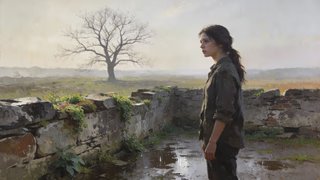
A woman kneels in a patch of dirt behind her house, pulling weeds from between flagstones on a Saturday morning when she should be doing something else. Her hands are already stained. She doesn’t wear gloves because she likes the grit under her nails, the cool resistance of roots letting go. She didn’t plan to garden today. She came outside to check if the recycling bin had been emptied and then she saw the mess of clover pushing through the cracks, and something in her body said stay. She doesn’t know it yet, but this small, unplanned act of clearing ground is the most important thing she will do all week. Not because of the clover. Because of what kneeling in the dirt will quietly begin to loosen inside her chest.
This is the kind of scene that lives at the heart of 『The Secret Garden』, the 1911 novel by Frances Hodgson Burnett that has never really stopped whispering to readers across generations. In the book, a sour, neglected girl named Mary Lennox discovers a walled garden that has been locked for ten years, ever since the death of the woman who loved it. The ivy has grown over the door. The key is buried in the earth. Everything inside appears dead. And yet, when Mary pushes aside the matted growth and steps inside, she finds green shoots already pressing up through the soil. Life has been waiting. Not for permission, exactly. For attention.
Burnett wrote the novel after spending years tending her own gardens in Kent, England, and you can feel the dirt under her fingernails in every paragraph. She knew that the story was not really about a garden. It was about what happens to living things, including children, including grown adults, when they are locked away and forgotten. And it was about what happens when someone finally turns the key.
The Door We Walk Past Every Day
Look closer at the locked garden, and it begins to split open into layers of meaning, the way soil reveals its strata when you dig.
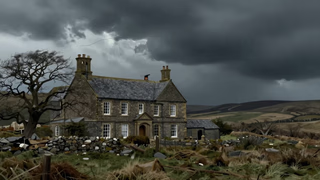
On the surface, the story is about physical neglect. Mary’s uncle, Archibald Craven, locked the garden after his wife’s death because he could not bear to look at anything she had touched. Grief made him a man of closed doors. He shut the garden, shut himself away in distant countries, and shut his own son, Colin, in a darkened bedroom where the boy grew up believing he was dying. The house at Misselthwaite Manor is full of locked rooms and drawn curtains and servants who speak in whispers. It is a place organized entirely around avoidance.
We recognize this architecture. Not the Yorkshire manor, obviously, but the interior blueprint. Most of us have locked a door somewhere inside ourselves. A friendship we stopped tending after a misunderstanding that felt too complicated to untangle. A creative practice we abandoned when someone’s offhand comment made us feel foolish. A part of our personality we sealed off in adolescence because it didn’t seem to fit. We didn’t destroy these things. We just stopped going in. We let the ivy grow over.
What Burnett understood, and what gives the novel its strange, persistent power, is that locking the door doesn’t kill what’s inside. It just makes it wild. The garden, when Mary enters it, is a tangle. But the roses are still alive beneath the dead wood. The bulbs have continued their underground work, season after season, without anyone watching. The garden didn’t need an audience to keep growing. It needed one to grow well.
We lock doors to protect ourselves from pain, and then we forget that we have also locked away the very things that could heal us.The deepest layer of the story is about the relationship between secrecy and sacredness. The children don’t tell the adults about the garden. They guard it fiercely. And this secrecy is not deception; it is a form of devotion. They need a space that belongs only to them, where transformation can happen without being observed or managed or corrected by the anxious eyes of grown-ups. Colin, the invalid boy who has never stood on his own legs, takes his first steps in the garden. He does it defiantly. He trembles, he shouts, he is ridiculous and magnificent. He can do this only because the garden is hidden.
We need hidden spaces too. Not secrets born of shame, but sheltered ground where new growth doesn’t have to justify itself immediately. Think of that period after a loss when you are not yet ready to tell people you feel better, because the feeling is so fragile that naming it might break it. Think of the early days of falling in love, when you hold the other person’s name in your mouth like something you’re afraid to swallow. Some things require walls, not to imprison, but to incubate.
Burnett layers this with the character of Dickon, the local boy who speaks to animals and seems to carry springtime in his pockets. Dickon never forces anything to grow. He simply creates conditions. He loosens the earth. He lets the air in. He is patient in a way that looks, from the outside, like doing nothing at all. And yet everything he touches flourishes. He is the novel’s quiet argument that the most powerful kind of care is not intervention but presence.
Green Shoots in Unlikely Soil
 Photo by
 The Secret Garden has endured for over a century not because it tells children that nature is pretty, but because it tells all of us something we keep needing to hear: that healing is not a dramatic event. It is seasonal. It is cumulative. It looks, for a long time, like nothing is happening.
We live in a culture that prefers the lightning bolt. The breakthrough moment in therapy. The before-and-after photograph. The morning you wake up and everything has changed. And sometimes life does work that way. But far more often, recovery from grief or illness or loneliness follows the pattern of the garden. Underground first. Invisible for months. A green shoot so small you might step on it without noticing. Then one morning, color.
Mary Lennox does not transform because of a single revelation. She transforms because she goes to the garden every day. She pulls weeds. She clears space around the new shoots so they can breathe. She gets rained on and doesn’t go inside. The repetition matters. The dailiness of it rewires something in her that no lecture or punishment ever could. Her body learns generosity before her mind catches up. She becomes kind not through moral instruction but through the physical practice of caring for something outside herself.
This is a truth that sits quietly at the center of the novel, never announced, barely even articulated by the characters themselves. Tending something is how we mend. Not thinking about mending. Not reading about it. The hands-in-the-dirt, show-up-again-tomorrow work of keeping something alive. The garden heals the children because the garden requires them. It gives them a reason to get out of bed that has nothing to do with their own suffering.
And the garden, in turn, gives back more than they put in. This is the part that feels almost magical, and Burnett leans into that magic deliberately, letting Colin chant about “the Magic” flowing through him as he sits among the roses. But the real magic is simpler and stranger than any spell. It is the fact that when we care for the world, the world begins to care for us. Not as a transaction, but as a rhythm. Call and response. Breath in, breath out. Tend and be tended.
What the Ivy Has Been Hiding
 Photo by
 Somewhere in the weeks ahead, you will walk past something neglected. A plant on your windowsill that you stopped watering. A notebook you haven’t opened since last winter. A conversation you keep meaning to have. You will notice it the way Mary noticed the door-knob under the ivy, a small clearing that suggested something underneath.
 Photo by
 When that moment comes, you might remember this: the garden didn’t need to be perfect to be worth entering. It didn’t need to be finished to be beautiful. It just needed someone to push the door open, kneel down, and begin.
So here is a small thing you might try. The next time you pass that neglected corner of your life, whatever it is, don’t try to fix it all at once. Don’t make a plan. Don’t set goals. Just clear one small patch of ground. Pull one weed. Write one sentence in the notebook. Send one honest text. Do the tiniest possible version of showing up, and then walk away without judging what you’ve done.
Go back the next day. Clear a little more.
You may find, as Mary did, that something green has been waiting for you all along, growing quietly in the dark, needing nothing from you but the light you let in when you finally opened the door.