Fairy tales were never meant to teach children that monsters exist. Children already know that. The real gift of a fairy tale, as G.K. Chesterton once observed, is the news that monsters can be defeated. But what happens when the monster wears a captain’s uniform, sits at the head of the dinner table, and holds absolute power over everyone in the house? What happens when the fairy tale and the horror story share the same roof?
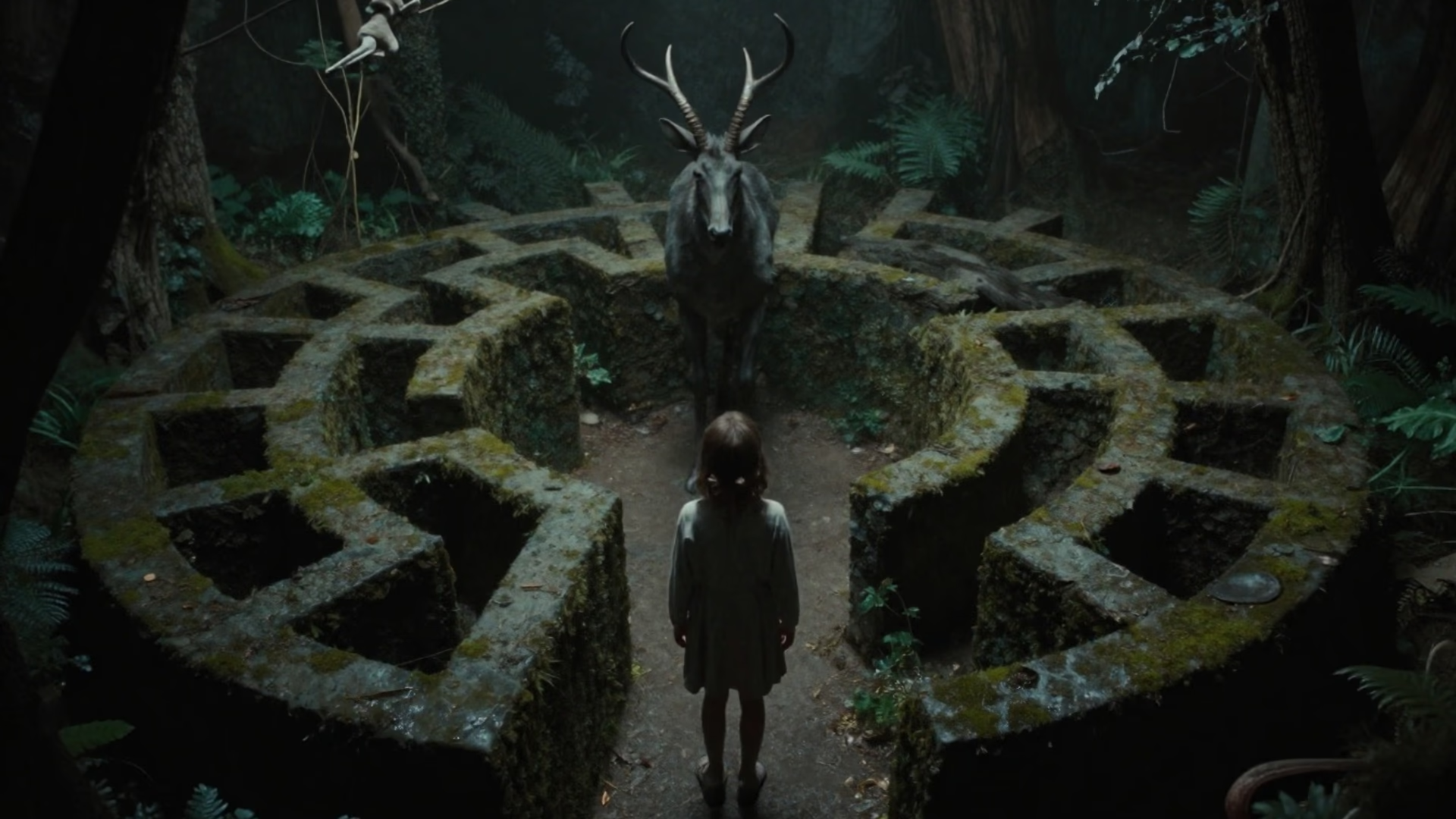
This is the nerve that Guillermo del Toro touches in 『Pan’s Labyrinth』, his 2006 film set in the aftermath of the Spanish Civil War. The story follows Ofelia, a young girl who arrives at a rural military outpost with her pregnant mother, now married to Captain Vidal, a man whose cruelty is as precise as the pocket watch he obsessively maintains. Ofelia discovers an ancient stone labyrinth near the mill, and within it, a faun who tells her she is the lost princess of an underground kingdom. To return, she must complete three tasks before the full moon. The film moves between two worlds: the suffocating, blood-soaked reality of Franco’s Spain and the eerie, luminous corridors of Ofelia’s mythic quest. One world operates by the logic of military discipline and violence. The other operates by the logic of dreams.
The contrast is not subtle, and del Toro never intended it to be. But its power lies not in the opposition itself. It lies in how porous the boundary between these two worlds really is.
Where the Walls Grow Thin
Look closely at the film’s two realms and you notice something unsettling: they mirror each other. Captain Vidal’s dining room, with its long table and rigid formality, finds its dark twin in the lair of the Pale Man, a creature who sits motionless before a banquet of untouched food, his eyeless face slack with ancient hunger. Both rooms demand obedience. Both punish those who reach for what they are not supposed to take. Vidal hoards food and rations it to control the local population. The Pale Man’s table groans with fruit and meat, but a single grape stolen will awaken a violence so swift it swallows children whole.
Del Toro is showing us something we tend to forget: that fantasy is not an escape from reality but a translation of it. Ofelia’s underground trials are not distractions from the war above. They are the war above, rendered in a grammar she can understand. The toad bloating itself inside the dying fig tree is not so different from the fascist regime feeding on Spain’s resources. The faun’s shifting loyalties echo the way authority figures in her real life demand trust they have not earned.
And yet, the fantasy world offers something the real world withholds. It offers Ofelia agency. In Vidal’s house, she is a nuisance, a stepdaughter to be tolerated until she learns to be silent. In the labyrinth, she is a princess with a destiny, someone whose choices matter. The underground kingdom does not ask her to be quiet. It asks her to be brave.
This tension, between a world that diminishes you and a story that enlarges you, is not unique to Ofelia. Think of the times you’ve retreated into a book during a period of grief, or replayed a song on a loop during a week when nothing at work made sense. We don’t do this because we are weak. We do it because the imagination is a workshop, a place where we rehearse the selves we are not yet permitted to be. A child playing pretend is not avoiding life. She is practicing for it.
The stories we tell ourselves in the dark are not lies; they are blueprints for the people we are trying to become.But del Toro does not let us rest comfortably in that idea. The fantasy world in Pan’s Labyrinth is not safe. It has its own dangers, its own rules that punish disobedience. The Pale Man’s chamber is as terrifying as anything in Vidal’s quarters. Ofelia’s courage is tested just as severely underground as it is above. The film refuses the easy binary: reality is cruel, fantasy is kind. Instead, both realms demand sacrifice. Both require Ofelia to decide what kind of person she will be.
This is what gives the film its moral weight. Imagination is not a vacation. It is a commitment. When Ofelia chooses, in the film’s final moments, to protect her infant brother rather than spill his blood to open the portal, she is not choosing fantasy over reality or reality over fantasy. She is choosing compassion over obedience in both worlds simultaneously. The faun tells her that the portal requires the blood of an innocent. Vidal, in his own way, has been saying the same thing all along, that power is built on the suffering of the powerless. Ofelia refuses both versions of that logic.
The Old Story, Told Again
 Photo by
 This pattern, the child who descends into a mythic underworld while the adult world burns, is ancient. Persephone eaten by the earth. Alice falling through the rabbit hole during a dull afternoon that conceals the rigid hierarchies of Victorian England. Narnia opening behind the wardrobe while the Blitz rains fire on London. Every generation finds a new doorway, but the architecture is always the same: a threshold between what is and what could be, guarded by creatures who speak in riddles.
Why does this story persist? Perhaps because every generation has its own version of Captain Vidal. Every era produces authorities who demand silence, who mistake cruelty for strength, who punish curiosity because it threatens control. And in every era, someone, usually the person with the least power, finds a crack in the wall and slips through.
The Spanish Civil War ended in 1939, but its aftershocks vibrated through decades of dictatorship. Del Toro set his film in 1944, five years into Franco’s rule, when the resistance fighters hiding in the mountains were being systematically hunted. The rebels in Pan’s Labyrinth, led by characters like Mercedes, fight not because they believe they will win but because surrender would mean becoming something they cannot live with. Their resistance is not strategic. It is existential.
We see this same impulse in quieter, less dramatic forms all around us. The teacher who slips a banned book into a student’s hands. The employee who documents wrongdoing even when no one will listen. The person who keeps a journal during a time of personal chaos, not to solve anything but to insist that their inner life matters, that the official story is not the only story. These are small labyrinths, personal ones, and the creatures guarding them may not have cloven hooves or eyes in their palms, but they are real enough.
What del Toro understood, and what makes Pan’s Labyrinth endure nearly two decades after its release, is that the choice to imagine is itself an act of defiance. Not escapism. Defiance. To say “I see a different world” when the one you inhabit insists there is only one way to live, that takes a particular kind of courage. It is the courage of the powerless, and history has shown, again and again, that it outlasts the courage of the powerful.
The Blood and the Bloom
 Photo by
 Return now to the contrast we started with. A military outpost and a mythic labyrinth. A captain who believes only in what he can control and a child who believes in what she cannot see. The film ends with Ofelia’s death, shot by Vidal as she clutches her baby brother. Her blood drips onto the stone altar in the labyrinth. And then, in a scene that del Toro leaves deliberately ambiguous, she opens her eyes in the golden throne room of the underground kingdom. Her father, the king, welcomes her home. Her mother sits beside him, whole and alive.
 Photo by
 Is it real? The film does not answer, and that refusal is its greatest act of respect toward the audience. If the underground kingdom is real, then Ofelia’s faith was justified, her sacrifice meaningful in a way that transcends death. If it is not real, if it is only the final flickering of a dying child’s mind, then something even more remarkable has happened: Ofelia chose her own ending. In a world that gave her no power, she authored the last chapter.
Either way, Vidal loses. He gets the child he wanted, the son, but Mercedes takes the boy from him moments later. She tells Vidal that his son will never even know his name. The man who lived for legacy is erased. The girl who lived for story becomes eternal.
We carry this same duality in our ordinary lives, though the stakes are rarely so stark. Every day we negotiate between the world as it presents itself and the world as we sense it could be. We obey or we resist. We accept the story we are handed or we climb down into the dark and look for another one. Most of the time, these choices are small, nearly invisible. But they accumulate. They shape us.
The labyrinth is not a place you visit once and leave behind. It is a place you carry with you, carved into the architecture of who you are, waiting for the moment when someone tells you there is only one way forward, so that you can answer, quietly and completely: no, there is a door right here.
In the end, the most dangerous thing in Pan’s Labyrinth is not the captain’s pistol or the Pale Man’s jaws, but a girl who refuses to stop imagining.