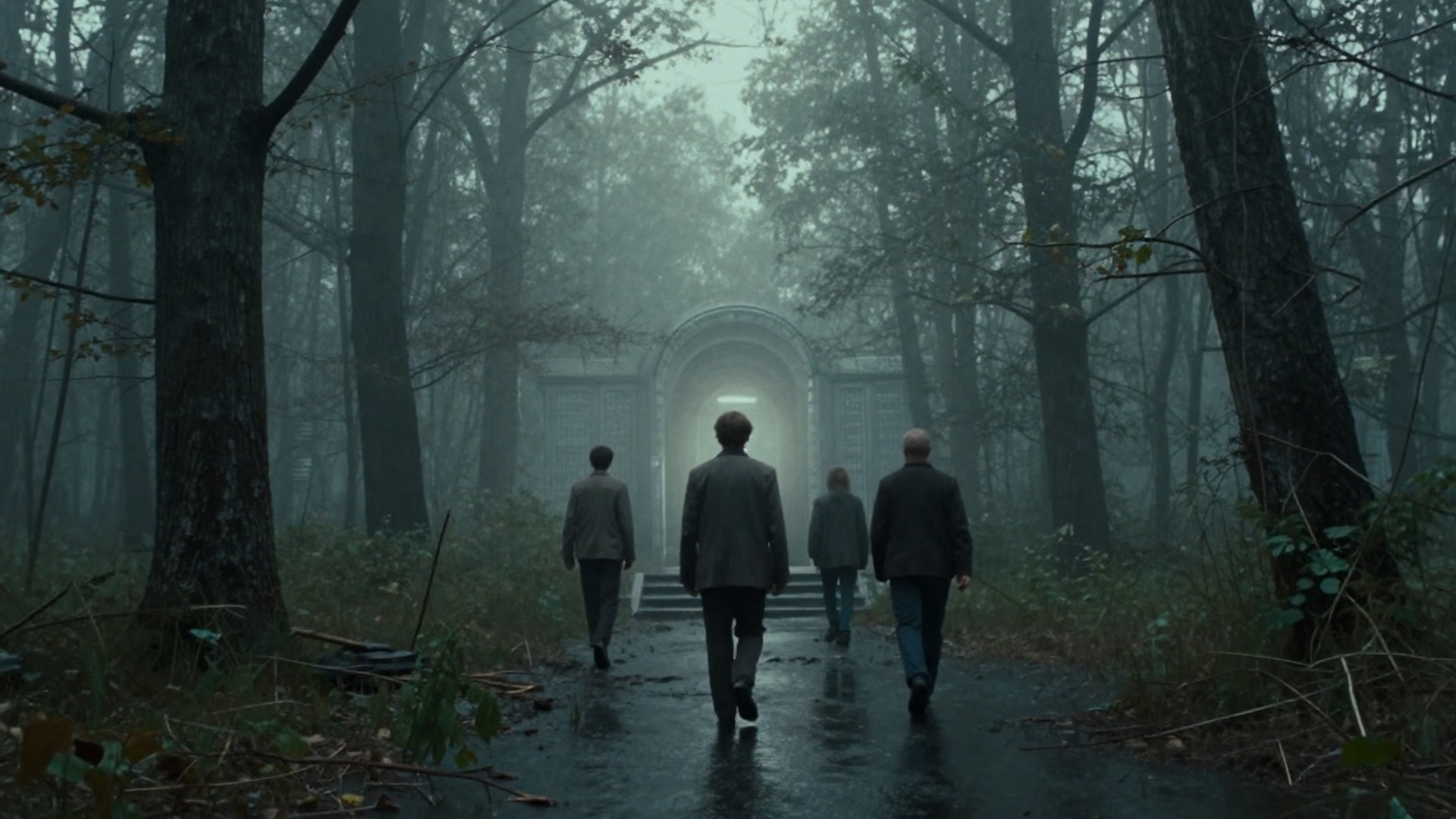
The most terrifying gap in human experience is not the distance between what we have and what we want. It is the distance between what we say we want and what we actually want, the wish we’d speak aloud versus the one buried beneath every performance we’ve ever given. In 1979, Andrei Tarkovsky made a film that lives inside that gap. 『Stalker』 is set in a world where a mysterious region called the Zone has appeared, possibly from a meteorite, possibly from something stranger, and at its center sits a Room that grants the innermost desire of anyone who enters. The Soviet authorities have sealed the Zone off with barbed wire and armed patrols. But certain guides, called stalkers, smuggle people in. The film follows one such journey. And it is the journey, not the destination, where everything that matters unfolds.
The Long Walk Toward Yourself
Tarkovsky built the film from the bones of a novel by Arkady and Boris Strugatsky, but what arrived on screen bears only a passing resemblance to its source material. The Strugatsky brothers wrote science fiction full of alien artifacts and adventurous scavenging. Tarkovsky stripped all of that away and kept only the premise, the room, and the question it poses. He replaced spectacle with silence. The film’s camera lingers for minutes at a time on puddles, on rusted metal, on the backs of men’s heads as they sit still in wet grass. Long tracking shots drift over debris and standing water with the patience of someone watching a wound heal.
The three characters who make the journey have no proper names. They are called the Stalker, the Writer, and the Professor. Each represents a different posture toward meaning. The Writer is cynical, burned out, suspicious of inspiration. The Professor is rational, precise, secretly carrying a bomb in his backpack to destroy the Room so no tyrant can ever use it. The Stalker is the believer. He has been to the Zone many times, not to wish for himself but to guide others. His faith in the Zone’s power is absolute and almost religious, even though the Zone has given him nothing but a disabled daughter and a life of poverty.
The production itself was a kind of zone. Tarkovsky shot the film twice. The first version, nearly complete, was destroyed when the film stock was improperly developed at the lab. An entire year of work, gone. He started over, with a different cinematographer and a radically different visual approach. The second shoot took place near a chemical plant in Estonia, where toxic runoff stained the river and the air carried an acrid sweetness. Several members of the crew, including Tarkovsky himself, would later develop cancers that many attributed to the location. The film was made, in a very literal sense, at great cost. And yet Tarkovsky pressed forward, as though the Zone he was filming and the zone he was filming in had merged into the same thing: a place where the rules of normal life did not apply, where something essential could be found if you were willing to risk enough.
What he created does not behave like other films. It does not build toward a climax. The three men argue, rest, walk, argue again. They throw metal nuts tied to strips of cloth to test the invisible traps the Zone supposedly sets. They crawl through a tunnel called the Meat Grinder. They sit at the threshold of the Room. And then, at the moment of arrival, something breaks. Neither the Writer nor the Professor can bring himself to enter.
What the Room Already Knows
 Photo by
 This is the crack in the film where light pours through. The Room does not grant what you ask for. It grants what you truly desire, at the deepest level of your being. And both men realize, with a horror that is quiet and total, that they do not trust what lives at that depth. The Writer suspects his deepest wish is petty, self-serving, nothing like the noble longing he performs for his audience. The Professor fears his wish might be monstrous. They have traveled all this way, risked their lives, and they cannot cross the final threshold because they are afraid of themselves.
Think of the last time you were offered exactly what you said you wanted. A promotion, a confession of love, an open door. And think of the strange paralysis that sometimes accompanies such moments. The hesitation that has nothing to do with the opportunity and everything to do with the suspicion that you might not actually want what you’ve been chasing. That the goal was a decoy your surface mind constructed so you’d never have to confront the real hunger underneath.
We spend most of our lives building elaborate maps to rooms we will never let ourselves enter.This is not cowardice. Or rather, it is a kind of cowardice so universal that it barely deserves the name. We all carry unexamined wishes. We all avoid certain quiet rooms inside ourselves, rooms where the noise of daily life can’t reach and where we’d be left alone with the raw shape of our wanting. The Zone in Tarkovsky’s film is simply that interior landscape made visible, with all its standing water and strange beauty and concealed dangers.
The Stalker weeps after his clients refuse to enter. He weeps not because they’ve failed some test, but because their refusal confirms what he has always feared: that people do not actually want what the Zone offers. They want the journey. They want the hope. They want to believe that meaning exists somewhere ahead of them, in a room they haven’t reached yet. The moment meaning becomes available, present, graspable, they turn away.
This pattern repeats across every human life, scaled down from the mythic to the mundane. The relationship we pine for but sabotage when it gets too close. The creative work we dream about but never begin, or begin and never finish. The honest conversation we rehearse a thousand times in the shower but never have. We are all stalkers guiding ourselves toward rooms we’ve already decided not to enter.
The Water That Moves Without Wind
 Photo by
 But the film does not end in despair. It ends with something far stranger. The Stalker returns home to his wife and his daughter, called Monkey, who cannot walk and who may have been born with her condition because of her father’s repeated exposure to the Zone. In the final scene, Monkey sits at a kitchen table. The camera rests on her face, still and focused, while she stares at three glasses. One by one, the glasses begin to slide across the table on their own. One falls to the floor. It does not break. A train rumbles past outside, shaking the apartment, and for a moment you can explain the movement as vibration. But the timing is wrong, the direction is wrong, and the girl’s gaze is too steady. Something else is happening.
Tarkovsky never explains. He simply shows you a world where the boundary between the Zone and ordinary life has dissolved. The Zone is not out there, fenced off and forbidden. It is here, in a shabby apartment, in the gaze of a child, in the trembling of a glass on a table. The sacred has leaked into the everyday, or maybe it was always there and we built fences around it because we couldn’t stand the exposure.
This is the vision the film leaves us with, and it reshapes everything that came before. All that agonizing about whether to enter the Room, all the intellectual debates about faith and reason, all the Stalker’s tears, they become backdrop to a simpler truth. The power was never contained in a destination. It was scattered everywhere, in the puddles, in the rust, in the love between a broken man and his family. We don’t need to find the Zone. We need to stop pretending we aren’t already standing in it.
Hope, in Stalker, is not optimism. It is not a belief that things will get better. It is the stubborn, almost irrational insistence that meaning is present, right now, in this moment, even when the evidence argues otherwise. The Stalker is poor, exhausted, married to sorrow. His wife delivers a monologue directly to the camera in which she admits that life with him has brought her nothing but suffering, and then she says she would choose it again, because the suffering came with something she cannot name but refuses to surrender. That unnamed thing is the film’s actual subject. Not the Zone, not the Room. The thing that keeps people moving forward when every rational calculation says stop.
You know this thing. You’ve felt it on mornings when nothing in particular has changed but the light hits the kitchen counter a certain way and you feel, without reason, that being alive is sufficient. You’ve felt it in the presence of someone you love, in a silence that asks nothing. You’ve felt it reading a sentence that cracked open a door you didn’t know was closed.
The glasses on the table keep sliding, and the girl keeps watching, and outside the window the world is loud and careless and ordinary, and none of that changes the fact that something impossible is happening right here, right now, if you are willing to sit still long enough to see it.