Softness is not the opposite of survival. We have been taught otherwise, trained by years of rough weather and rougher expectations to believe that tenderness is a luxury for those who can afford safety. But Barry Jenkins’ 2016 film 『Moonlight』 makes a different argument, one whispered rather than shouted, and all the more devastating for it. The film insists that the gentlest thing about us might also be the most durable.
The Voice That Reaches Through Blue Light
Moonlight speaks to us in three chapters, three ages of a single life, and yet its voice never raises above a murmur. Little, Chiron, Black. A boy, a teenager, a man. Each name a costume, each body a fortification built around the same unresolved ache. The film’s voice is not instructional. It does not say, “Here is how a Black boy grows up in Liberty City, Miami.” It says something closer to, “Do you see him? Are you willing to stay?”
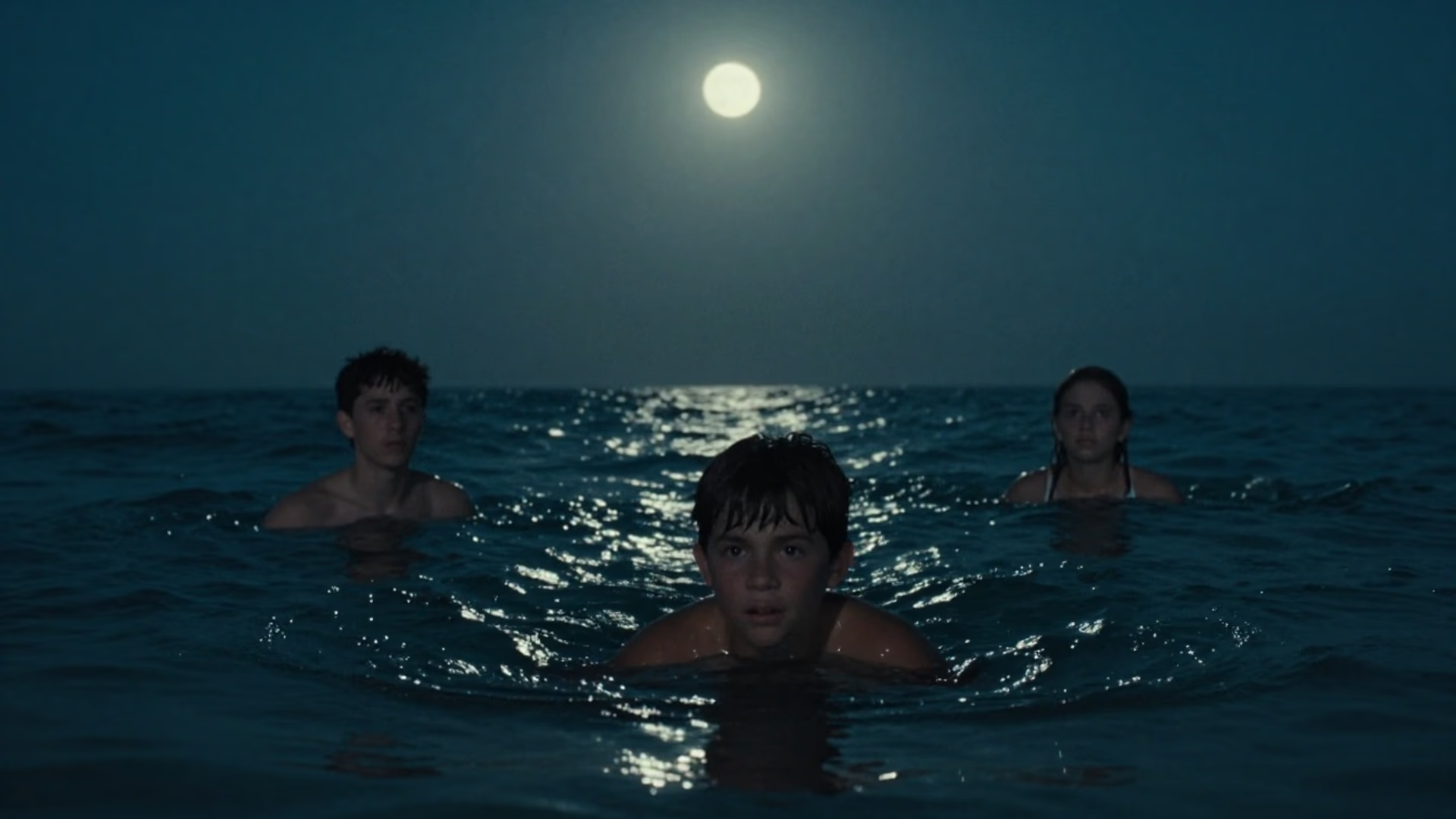
Juan, a drug dealer with heavy hands and a heavier conscience, teaches a small, silent child to float in the ocean. The water holds what no person has yet managed to hold. Jenkins films this scene as if the Atlantic itself were performing an act of parenting, cradling this boy who has learned, already, at seven or eight, that he should take up as little space as possible. The moonlight on the water turns the child’s skin blue, and we realize we are watching something almost unbearable in its gentleness.
The film asks us: When was the last time you let yourself be carried? Not rescued, not fixed, not improved. Just held up by something larger than your own will.
And then there is Kevin, the friend, the lover, the one who touches Chiron on a nighttime beach as if touch were a language Chiron had only ever heard spoken in anger. The waves move behind them. The scene is so quiet you can hear the sand shift. This is not a coming-of-age milestone played for catharsis. It is a boy discovering that his body can mean something other than a target.
Moonlight speaks, and what it says is this: you were soft once. Before the world got to you, before you built the armor, before you learned the performance. You were soft once, and that softness did not make you weak. It made you real.
What We Say Back to the Silence
 Photo by
 How do we answer a film like this? Not with analysis, not with applause, but with recognition. The uncomfortable, stomach-dropping kind. The kind that makes you look away from the screen for a moment because something on it has found the thing inside you that you thought you had hidden well enough.
We answer by thinking of the roles we play. Think of the moment you realized you were performing. Not on a stage, not in a school play, but in your own kitchen, your own car, your own body. The moment you caught yourself speaking in a voice that was not yours, laughing at something that was not funny, agreeing with a version of yourself you had assembled for someone else’s comfort. Most of us cannot name the exact day we started doing this. It happened in layers, like paint applied so gradually we forgot the original color of the wall.
Chiron, by the film’s third chapter, has become Black. Muscled, grilled teeth, a drug dealer like the father figure who once held him in the water. He drives through Atlanta in a car that gleams. He has become, in the most painful sense, someone else’s idea of strength. And we recognize this, because we have all built our own versions of that armor. Maybe ours is politeness. Maybe it is competence, or humor, or silence, or control. Whatever material we chose, we built it for the same reason Chiron did: because someone, somewhere, taught us that who we actually were was not going to be enough.
Our response to the film, if we are honest, is not “I understand this character.” It is “I am this character.” Scaled differently, dressed in different circumstances, but operating from the same fear. We all carry a version of ourselves that we abandoned not because it was wrong, but because it was unsafe.
And that is where the conversation deepens, because Moonlight does not let us sit in comfortable sympathy. It is not interested in making us feel wise or compassionate from a safe distance. It pulls us into the silence between Chiron and Kevin in that final scene, two grown men sitting across from each other in a small kitchen, and it asks, simply: Can you stay in this room? Can you stay with the discomfort of wanting something you trained yourself not to want?
Where the Meanings Touch
 Photo by
 The synthesis between what Moonlight says and what we say back does not happen in a neat resolution. It happens in the mess, in the gap between who we perform as and who we are when the performance falters.
Jenkins understood something about silence that most storytellers miss. Silence in this film is not the absence of speech. It is the presence of everything that cannot be spoken. Chiron barely talks through the entire movie. He communicates through the angle of his shoulders, the way his eyes track danger before they track anything else, the particular stillness of a person who has learned that attention is a precursor to harm. And yet his silence is not empty. It is full to breaking. We know what he means even when he says nothing, because we have all had those moments when language was not large enough for what we were feeling.
This is where the film meets us most directly. Not in its specifics, though those specifics matter enormously, but in its understanding that identity is not a destination. We do not arrive at ourselves the way we arrive at an address. We circle back. We overshoot. We build elaborate detours and then, sometimes, if we are lucky or brave or desperate enough, we find our way to a kitchen table where someone from our past looks at us and says, “Who is you, Chiron?”
That question. Who is you? Not who are you, because Kevin is not asking for a biography. He is asking something more radical. He is asking Chiron to separate himself from every expectation, every survival strategy, every mask, and to speak from the place underneath. And Chiron’s answer, when it comes, is devastating in its simplicity. He has not been touched by anyone, he says, since Kevin touched him on that beach. Years. A lifetime of physical contact avoided or endured but never wanted, never chosen, never soft.
The shared meaning that rises from this exchange is not about romance, though romance is part of it. It is about the cost of self-protection. We build walls, and those walls work. They keep out the harm. But they also keep out the ocean, the nighttime beach, the hand on the jaw, the voice that says your actual name. We survive, and in surviving, we sometimes lose access to the very thing that made survival worth the effort.
Jenkins filmed Moonlight drawing from his own childhood in Miami, and the film won the Academy Award for Best Picture, but those biographical facts matter less than the emotional fact of what it does inside a viewer. It does not instruct. It does not explain. It places you in the blue light and waits to see if you can breathe.
The synthesis is this: Moonlight speaks of tenderness as the most courageous act available to a person who has been taught that tenderness will get them killed. And we answer back with our own small, private recognitions, our own memories of the moment we armored up, our own longing for the kitchen table where someone asks us who we really are. The meanings meet in the understanding that softness is not something we outgrow. It is something we bury, and the burial takes more energy than we ever admit.
What We Carry Out Into the Evening
 Photo by
 What we learn together, the film and us, is not a lesson. It is closer to a permission. Permission to consider that the toughest thing we ever did might not have been enduring hardship but allowing someone to see us without the armor on. That the people who changed everything for us were not always the ones who protected us from the world, but the ones who made us feel, even briefly, that the world did not require protection from.
One act of tenderness, offered at the right moment, can sustain a person for decades. This is not sentimentality. It is the plain, almost brutal arithmetic of human connection. Juan holding a boy in the water. Kevin’s hand on a beach. A meal cooked in a quiet kitchen thirty years later.
Somewhere tonight, someone is sitting across from another person, and the air between them is thick with everything unsaid. The food is getting cold. Neither of them has moved. And in that stillness, something long buried is beginning, very slowly, to float.