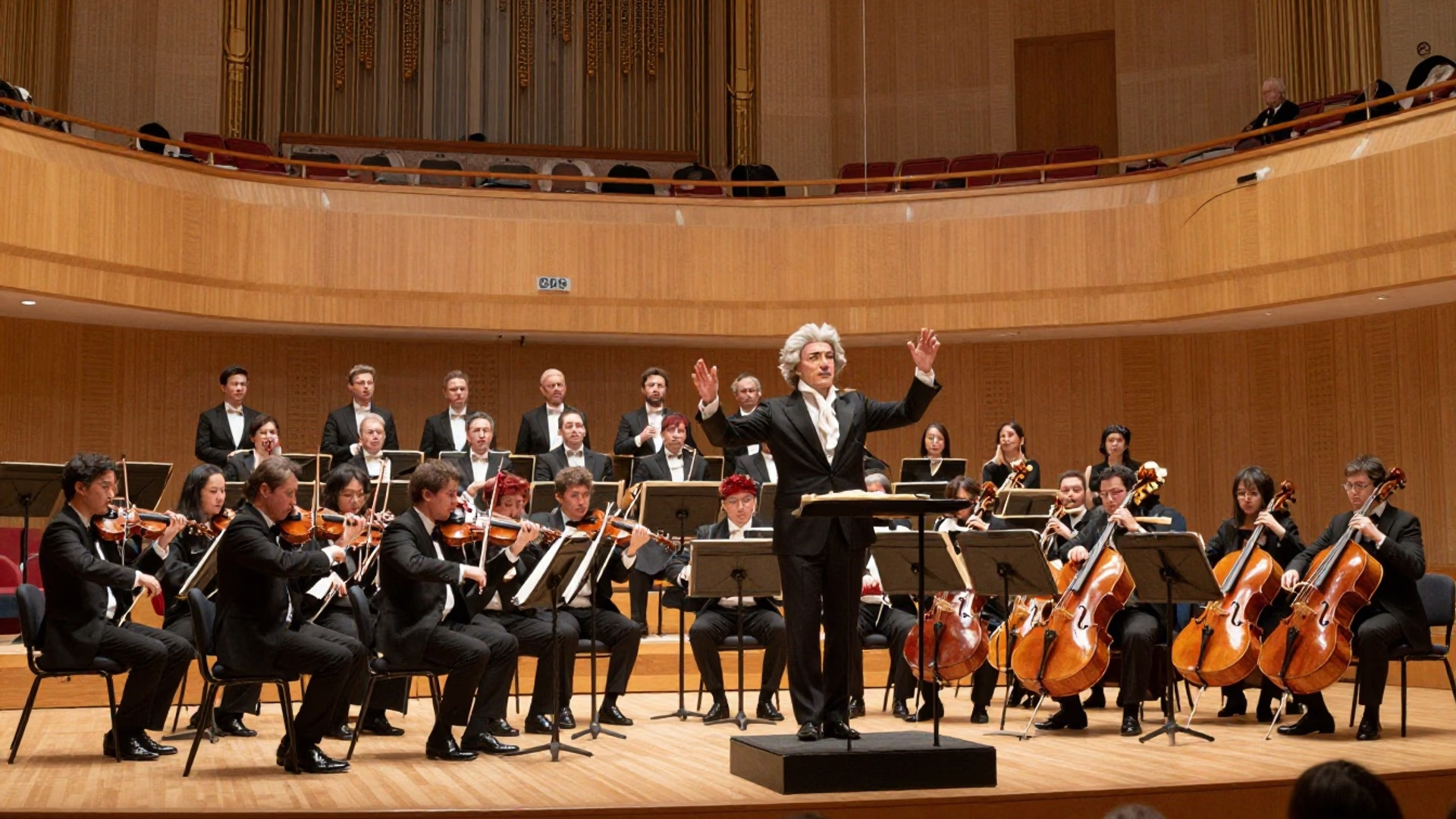
A man stands before an orchestra in Vienna, his back to a packed theater, his arms moving through silence. The year is 1824. The music surges around him, but he cannot hear a single note. When the final chord breaks and the audience erupts, he does not turn. He does not know they are standing. A contralto named Caroline Unger has to walk over and gently rotate him by the shoulders so he can see what his music has done to a room full of strangers. And so the question surfaces, raw and unsettling: what kind of person pours everything into a creation whose full reality they will never experience themselves?
This is the scene that haunts the premiere of 『Symphony No. 9』 by Ludwig van Beethoven, the last completed symphony by a composer who had been losing his hearing for over two decades and was, by this point, entirely deaf. The moment is almost too symbolic to be real, but it was real. And the question it raises is not about music at all. It is about the nature of giving, of making, of loving forward into a future you may never fully inhabit.
The Sound That Silence Built
To understand the Ninth, you have to understand what came before it. Not just the eight symphonies that preceded it, but the decades of increasing isolation, the conversations conducted through notebooks because Beethoven could no longer hear spoken words, the social withdrawal, the bitterness that crept in and then, somehow, did not win. By the early 1820s, Beethoven lived in a kind of sealed chamber. Visitors described the chaos of his apartments, the ink-stained manuscripts everywhere, the cold meals untouched. He was irascible. He was lonely. And he was working on something that would stretch the entire form of the symphony beyond anything anyone had attempted.
The first three movements of the Ninth are vast and turbulent. The opening of the first movement begins with open fifths, hollow and searching, as if the universe itself hasn’t yet decided what key it wants to exist in. The second movement is almost violent in its energy, a scherzo that hammers and drives. The third is achingly slow, a set of variations so tender they feel like a hand resting on your forehead during a fever. These three movements trace a passage through struggle, fury, and exhausted peace that mirrors the arc of any life lived with honesty.
But the fourth movement is where Beethoven did something no symphonic composer had dared. He brought in the human voice. He took Friedrich Schiller’s poem “Ode to Joy,” written decades earlier, and wove it into a finale that begins with a kind of recitative, as if the orchestra is literally searching for the right melody. The cellos and basses rumble through fragments of earlier movements, rejecting each one, before a simple tune emerges. That tune, quiet at first, builds and builds until a baritone soloist breaks in with the words: “O friends, not these sounds! Let us sing something more pleasant, more full of joy.”
What follows is a sustained eruption of communal ecstasy. Soloists, chorus, and orchestra fuse into something that feels less like a performance and more like a declaration. “Alle Menschen werden Brüder” - all people become brothers. Beethoven chose these words deliberately. He had carried Schiller’s poem with him since he was a young man in Bonn, turning it over for years, waiting for the right vessel. The vessel turned out to be his farewell.
The fact that he composed this while deaf has been repeated so often it risks becoming a cliché. But sit with it for a moment. Every note was heard only in his mind. Every orchestral color, every choral entrance, every dynamic swell existed for him as pure imagination, translated through memory and will into marks on paper. He trusted that what he could no longer verify would still be true when it reached the air.
Singing Into the Dark
 Photo by
 We do this more often than we think. Not on Beethoven’s scale, of course, but with the same underlying act of faith. Think of the parent who pours years into raising a child, knowing full well that the person that child becomes will live mostly out of sight, in rooms the parent will never enter, making choices the parent cannot control. The work is done in a kind of deafness to outcomes. You shape what you can, and then you let it go into the world.
Or think of something smaller. Think of the moment you say something honest to someone you love, not knowing if it will land, not knowing if they will hear what you actually mean or only what their own fears filter through. Every vulnerable sentence is a note written by a deaf composer. You put it out there and trust the music.
The deepest acts of creation are always, in some sense, performed in silence, offered to a reception we cannot predict or control.There is a particular kind of courage in this. Not the dramatic kind that makes for good stories at dinner parties, but the quiet, grinding kind that sustains a person through years of uncertain effort. Beethoven did not compose the Ninth in a single inspired burst. He labored over it, revised, scratched out, started again. His conversation books from the period show a man dealing with petty financial disputes, nephew troubles, stomach ailments, all the unglamorous debris of daily life. The transcendence of the Ninth did not come from transcending those difficulties. It came from working through them, alongside them, with ink-stained hands and a body that kept failing its tenant.
This is something we tend to get wrong about triumph. We imagine it as a moment when the clouds part and the struggle falls away. But the Ninth suggests something different. The joy of the fourth movement does not erase the turbulence of the first three. It absorbs them. It says: yes, all of that happened, and still, we sing. The darkness is not overcome by pretending it wasn’t dark. It is overcome by refusing to let darkness be the final word.
The Room You Cannot Hear
 Photo by
 So here is the fresh thing the Ninth offers us, if we let it in. Not just the obvious lesson about perseverance, which is true but incomplete. Something stranger and more liberating.
 Photo by
 We spend enormous energy trying to control how our efforts are received. We want to see the standing ovation. We want to hear the applause. We monitor reactions, track metrics, seek validation in real time. And there is nothing wrong with wanting to know that what we’ve made or given matters. But Beethoven’s situation strips that possibility away entirely, and what remains is the act itself, pure and unwitnessed by its maker.
What if the deepest freedom is not hearing the applause but discovering that you never needed to hear it? Not because recognition doesn’t matter, but because the making already contained its own meaning. The joy was in the composing, in the imagining of those voices joining together, in the private certainty that this was worth bringing into being whether or not he would ever experience its full arrival.
This reframes so much of what we agonize over. The email sent into silence. The kindness offered without acknowledgment. The years spent building something whose significance won’t be visible for a long time. These are not failures of communication. They are acts of faith, each one a small symphony premiered in a theater we cannot fully enter.
And now return to that theater in Vienna, May 7, 1824. The man is standing with his back to the audience. The music has ended. For him, there is only silence and the nervous sweat of exertion. Then a hand touches his arm, turns him gently, and he sees the faces. Mouths open. Hands beating together. Tears on cheeks. He cannot hear any of it, but he can see it. And maybe seeing is enough. Maybe it was always going to be enough, because the real symphony was never just the one in the concert hall. It was the one that had been playing inside him all along, complete and joyful and unsilenceable, a song the deaf man heard more clearly than anyone else in the room.