We are most blind, it turns out, when we are most certain. The person we have completely figured out by the end of a single evening, the one we have filed away with quiet confidence, is often the one we understood least. This is not a comfortable thing to sit with. It asks us to consider that our sharpest judgments, the ones that feel most instinctive, most righteous, might be the very ones leading us astray. It asks whether intelligence and perceptiveness can actually become obstacles to understanding. And it is the question at the heart of Jane Austen’s 『Pride and Prejudice』, a novel published in 1813 that has never, for a single generation since, stopped being relevant.
We tend to think of first impressions as raw data, unfiltered signals from reality. Someone speaks too curtly at a dinner, and we file them away. Someone laughs too loudly, and we know their type. But what if the filter is us? What if the very quickness of our assessment is what distorts it? Elizabeth Bennet is one of the most intelligent characters in English literature, and her intelligence is precisely what makes her so spectacularly wrong.
The Mirror in the Ballroom
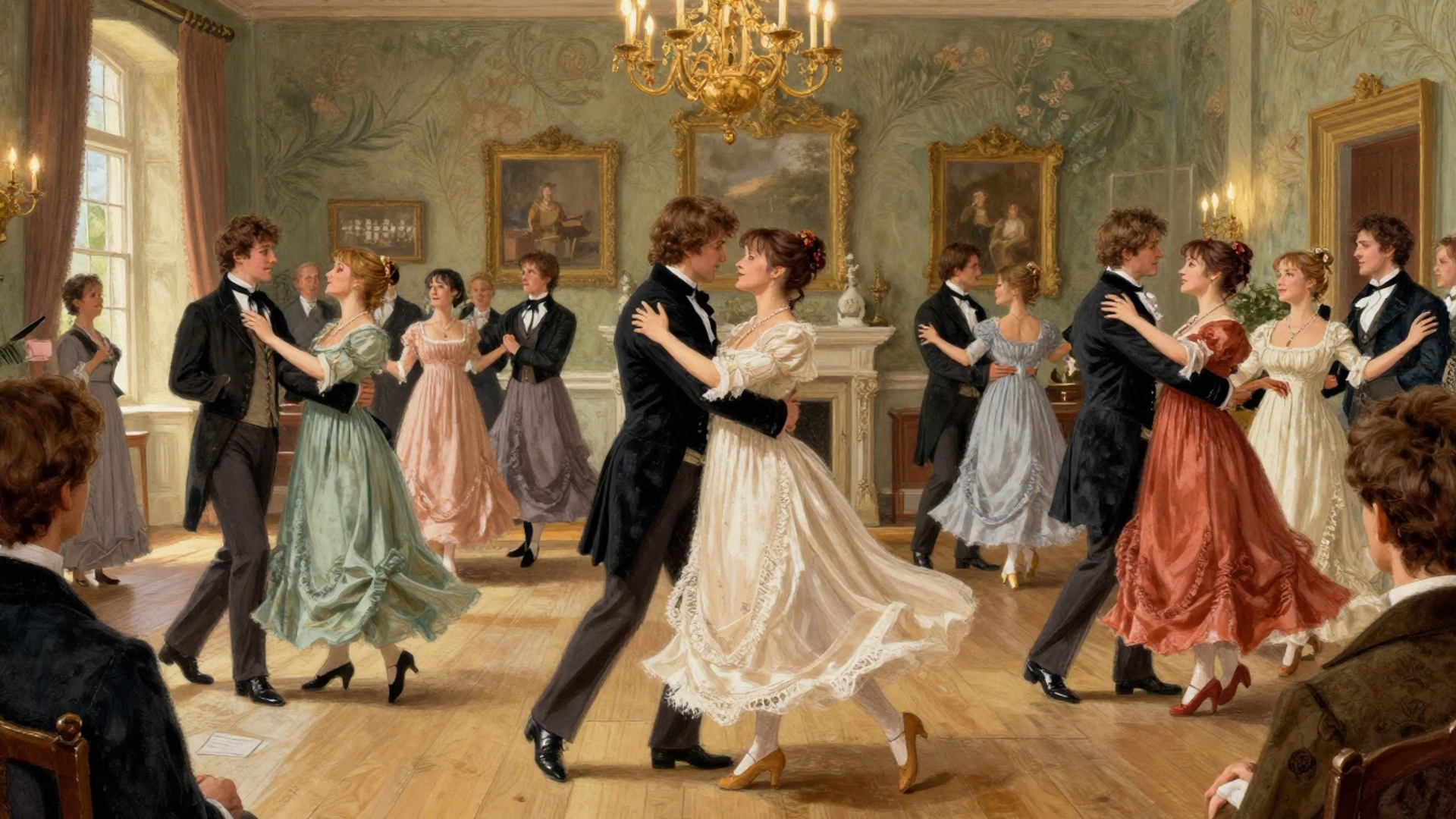
The story Austen tells is deceptively simple. Elizabeth Bennet, the second of five daughters in a family of modest means in rural England, meets Fitzwilliam Darcy at a country ball. He is wealthy, reserved, and visibly uncomfortable among strangers. She overhears him declining to dance with her, dismissing her as “not handsome enough to tempt me.” From that single moment, a verdict forms. Darcy is proud. Darcy is cold. Darcy is not worth knowing.
What makes this verdict so sticky is that Elizabeth is not foolish. She is witty, observant, and genuinely kind. She reads people well, or believes she does, and her reading of Darcy is confirmed, seemingly, by everyone around her. The charming Mr. Wickham tells her a story of Darcy’s cruelty. Her own family’s experience reinforces the image. Evidence accumulates in one direction, and Elizabeth never pauses to wonder whether she started looking for that evidence only after her pride was bruised.
Austen wrote the novel during a period when marriage was not merely romantic but economic. For women like Elizabeth, marrying well was the difference between security and dependence. The pressure to assess quickly, to sort men into categories of suitable and unsuitable, was enormous. Against this backdrop, Austen did something quietly radical. She suggested that the sorting itself might be the problem. That the categories we create to protect ourselves become the walls that keep out the very connections we need.
Darcy, for his part, carries his own distortion. Born into wealth and social standing, he has learned to see the world through a lens of rank. He looks at Elizabeth’s family and sees their lack of polish, their embarrassing mother, their younger sisters’ wild behavior. He fights his attraction to Elizabeth because she does not fit the mold of what someone in his position should want. His pride is not arrogance exactly, but a deep, inherited assumption that worth and class are intertwined.
The genius of the novel is that both characters are partially right about each other. Darcy is proud. Elizabeth’s family is embarrassing. But being partially right is one of the most dangerous states a person can occupy, because it feels like being completely right. Partial truth hardens into total certainty, and certainty closes the door to revision.
The turning point comes through a letter. After Elizabeth rejects Darcy’s first, disastrously worded proposal, he writes to her. Not to argue, but to explain. He lays out the facts about Wickham. He acknowledges his own failings while quietly correcting her misunderstandings. And Elizabeth, reading that letter, experiences something rare and painful: she watches her own narrative collapse. “Till this moment,” she says, “I never knew myself.”
When the Story We Tell Ourselves Breaks Open
 Photo by
 That line is the hinge of the entire novel, and it points to something we all carry but rarely examine. Each of us walks through life narrating. We tell ourselves who we are, who others are, what a situation means. These stories feel like perception, like reality itself. But they are constructions, built from fragments of experience and shaped by needs we may not even recognize.
Think of a time when you were absolutely sure about someone. Maybe a colleague who seemed cold and dismissive in meetings. Maybe a neighbor who never said hello. Maybe someone at a gathering who struck you as pretentious or shallow. Now think about whether you ever learned something that cracked that story open. A piece of context you hadn’t known. A vulnerability they had been hiding. The colleague going through a divorce. The neighbor dealing with crippling anxiety. The person at the party who was terrified of not being taken seriously.
The most dangerous stories we tell are the ones we don’t realize are stories at all, the ones that feel like simple facts.Elizabeth’s error is not that she misjudged Darcy. Misjudgment is human and inevitable. Her error is that she locked her judgment in place and then, unconsciously, arranged all incoming information to support it. Psychologists now call this confirmation bias, but Austen understood it two centuries before the term existed. She understood it not as a clinical phenomenon but as a deeply personal one, rooted in pride, in the need to feel that our perception is trustworthy.
This is where the novel touches something tender in all of us. We want to be good judges of character. It matters to us. Being perceptive feels like a kind of moral achievement. So when someone suggests we might have it wrong, the resistance is not just intellectual. It is emotional. It feels like an attack on who we are.
The beautiful thing about Elizabeth is that she lets the story break. She reads Darcy’s letter, and instead of defending her position, she sits with the discomfort. She reexamines every interaction, every conversation, every assumption. It is not a sudden revelation but a slow, honest reckoning. And what emerges is not just a corrected view of Darcy but a corrected view of herself.
Seeing Again, for the First Time
 Photo by
 What would it look like to carry Elizabeth’s willingness into our own lives? Not her initial confidence, which is easy to replicate, but her later humility, which is far harder.
 Photo by
 We live in a time that rewards quick judgment. Social media compresses people into a few words, a single post, a brief clip. We form impressions at a speed Austen could never have imagined, and those impressions calcify just as fast. The mechanisms of pride and prejudice have not changed since 1813; only their velocity has increased.
But the novel offers something more than a warning. It offers a picture of what becomes possible when two people are willing to revise. Darcy does not simply stay the man Elizabeth discovers him to be. He changes. He softens. He examines his own behavior and finds it wanting. He acts differently, not to perform for her but because her challenge revealed something true about his limitations. And Elizabeth grows too, becoming not less sharp but more generous in her sharpness, learning to distinguish between wit that illuminates and wit that wounds.
Their love story, in the end, is not about two people who were always meant for each other. It is about two people who became capable of each other. That distinction matters. It suggests that the deepest connections are not discovered but built, through the difficult, unglamorous work of admitting we were wrong.
This is what stays with us long after the Bennets and their drawing rooms have faded from the page. Not a lesson about romance or social class, but a quiet, persistent invitation. Pay attention to your certainties. Hold them up to the light. Ask what you might be protecting by holding them so tightly.
The people closest to understanding each other are sometimes the ones standing the farthest apart, needing only the courage to look again.