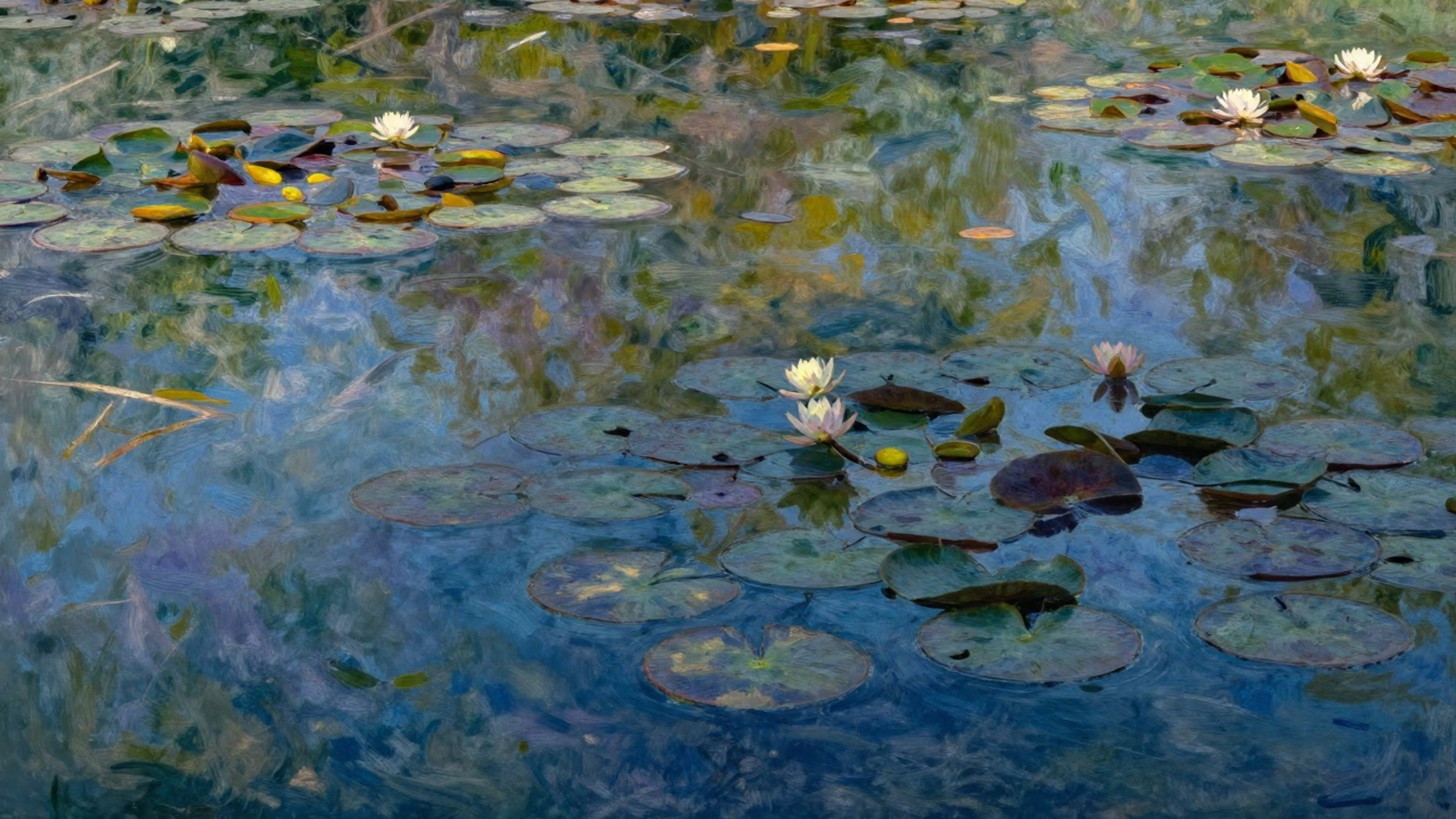
There is a paradox hiding in plain sight on the surface of a painted pond. Look closely at 『Water Lilies』 by Claude Monet, and you will find that the closer you look, the less you see. Step back, relax your gaze, let the edges dissolve, and a whole world opens up. Sky folds into water. Petals melt into reflections. The boundary between what is real and what is mirrored simply stops mattering.
This is the contrast that has stayed with me since I first stood in front of one of these canvases: the tension between clarity and blur, between seeing sharply and seeing deeply. We spend so much of our lives sharpening things. We want high resolution. We want precise answers. We want the edges of our plans and relationships and identities to be crisp and well-defined. And yet some of the most truthful moments we experience are the ones where the lines go soft, where we stop trying to focus and simply let the world wash over us.
Monet painted this particular work in 1906, during a long season of his life devoted almost entirely to the water garden at his home in Giverny. He returned to the same pond, the same lilies, the same shifting light, over and over again, producing more than 250 paintings in the series. He was not chasing novelty. He was chasing something that kept escaping: the fleeting impression of light touching water, the way a single scene could become a hundred different paintings depending on the hour, the weather, the quality of his own attention.
And here is where the paradox deepens. As the years passed, Monet’s eyesight deteriorated. Cataracts blurred his vision, stealing the sharp contours he had once relied on. The world literally became less defined. Many would call this a loss. Monet kept painting. The work did not diminish. If anything, it grew more expansive, more immersive, more alive. The paintings from his later years pull you not into a scene but into a sensation. They don’t describe the pond. They become the pond.
So which is the truer way of seeing: the sharp eye or the softened one?
Where the Water Meets the Sky
We tend to believe that precision equals understanding. A doctor’s diagnosis, an accountant’s spreadsheet, a scientist’s measurement. There is comfort in exactness, and rightly so. But precision can also become a kind of trap. When we insist on defining every edge, we sometimes lose the relationship between things. We see the lily pad but miss the water. We see the water but miss the sky reflected in it. We see the sky but forget that we are standing in a garden, breathing, alive.
Monet’s Water Lilies resist this habit of separation. Stand in front of one of the large canvases, the ones that stretch wider than your arms can reach, and your peripheral vision gets swallowed. There is no horizon line. There is no solid ground. The painting offers no fixed point of reference, nothing to anchor your analytical mind. You are left with color, with light, with the suggestion of depth. You are left, in other words, with feeling.
This is not a failure of representation. It is a choice. Monet was not painting what a camera could capture. He was painting what it felt like to be present at the edge of that water on a particular afternoon, when the clouds shifted and the lilies floated and the whole surface trembled with something too brief to name.
I think about this when I catch myself clutching too tightly at certainty. There are seasons of life when we need blueprints and timelines and five-year plans. But there are other seasons when the most honest thing we can do is admit that the edges are blurry, that we don’t know exactly where one chapter ends and another begins, and that this not-knowing might be its own form of clarity.
Consider the way we experience grief. It does not arrive with clean borders. It bleeds into Tuesday mornings and the smell of coffee and a song playing in a pharmacy. Or think about falling in love, that slow dissolution of the boundary between your life and someone else’s, the way you stop being able to say precisely where your thoughts end and theirs begin. These experiences resist the sharp line. They live in the blur.
Perhaps what we call confusion is sometimes just the world being more honest with us than we are ready to accept.Monet seemed to understand this. His cataracts did not make him a lesser painter. They stripped away a certain kind of control and, in doing so, freed something else. The late Water Lilies are not diminished versions of earlier, sharper work. They are a different country entirely, one where the rules of edges and outlines have been suspended in favor of something closer to breath.
The Same Pond, Always Changing
 Photo by
 This tension between sharpness and softness, between holding on and letting go, is not unique to Monet or to Impressionism. It runs through centuries of human thought like an underground river.
The ancient Greek philosopher Heraclitus said you cannot step into the same river twice. The water moves. You move. The moment of contact is already gone before you can describe it. Japanese aesthetics gave this idea a name: mono no aware, the bittersweet awareness of passing things. A cherry blossom is beautiful not despite its brief life but because of it. And in Korean, there is the word 여백, the beauty of empty space, the understanding that what is left unsaid or unpainted can carry more meaning than what is filled in.
Monet, working in his French garden at the turn of the twentieth century, arrived at the same insight through paint and water and fading sight. He painted the same pond hundreds of times because the pond was never the same. Light changed it. Season changed it. His own aging eyes changed it. Each canvas was a record not of the pond but of one unrepeatable moment of encounter between a man and the world in front of him.
We live this truth every day without always recognizing it. The commute you take to work is technically the same route each morning, but some days the light hits the buildings differently and you notice a window you have passed a thousand times. Your child’s face at breakfast is both the face you know by heart and a face that has changed overnight in ways too subtle to catalog. The friend you meet for dinner after months apart is familiar and slightly foreign, and that gap between who you remembered and who sits before you now is where real intimacy begins.
Slowing down enough to notice this is hard. The world rewards speed, efficiency, the ability to process and move on. But Monet sat by his pond for decades. He did not move on. He moved deeper in. And what he found there, in the repetition and the patience and the gradual surrender of sharp sight, was not less but more. A single pond became an ocean of experience.
 Photo by
 Returning to the Surface
 Photo by
 So I come back to the contrast I started with, but it looks different now. Clarity versus blur. Sharpness versus softness. Control versus surrender. These are not oppositions to resolve. They are partners in a long, slow dance.
There are days when we need the sharp eye, when precision matters, when drawing firm boundaries keeps us safe and sane. And there are days when the most courageous thing we can do is let the edges dissolve. To sit with uncertainty. To watch the light change on the water and not rush to name what we see.
Monet’s Water Lilies hang in museums around the world now, enormous and quiet, asking nothing of the people who stand before them. They do not instruct. They do not argue. They simply offer a surface that reflects whatever you bring to it, much like the pond itself.
Maybe that is the truest mirror: not one that shows you a sharp image of your face, but one that shows you the sky and the water and the flowers all tangled together, boundaries gone, everything shimmering. And in that shimmering, you recognize something you have always known but keep forgetting.
The world is not less real when it blurs. It might be more so. The question is whether we are willing to stay long enough to see it.