A Green Light in the Darkness
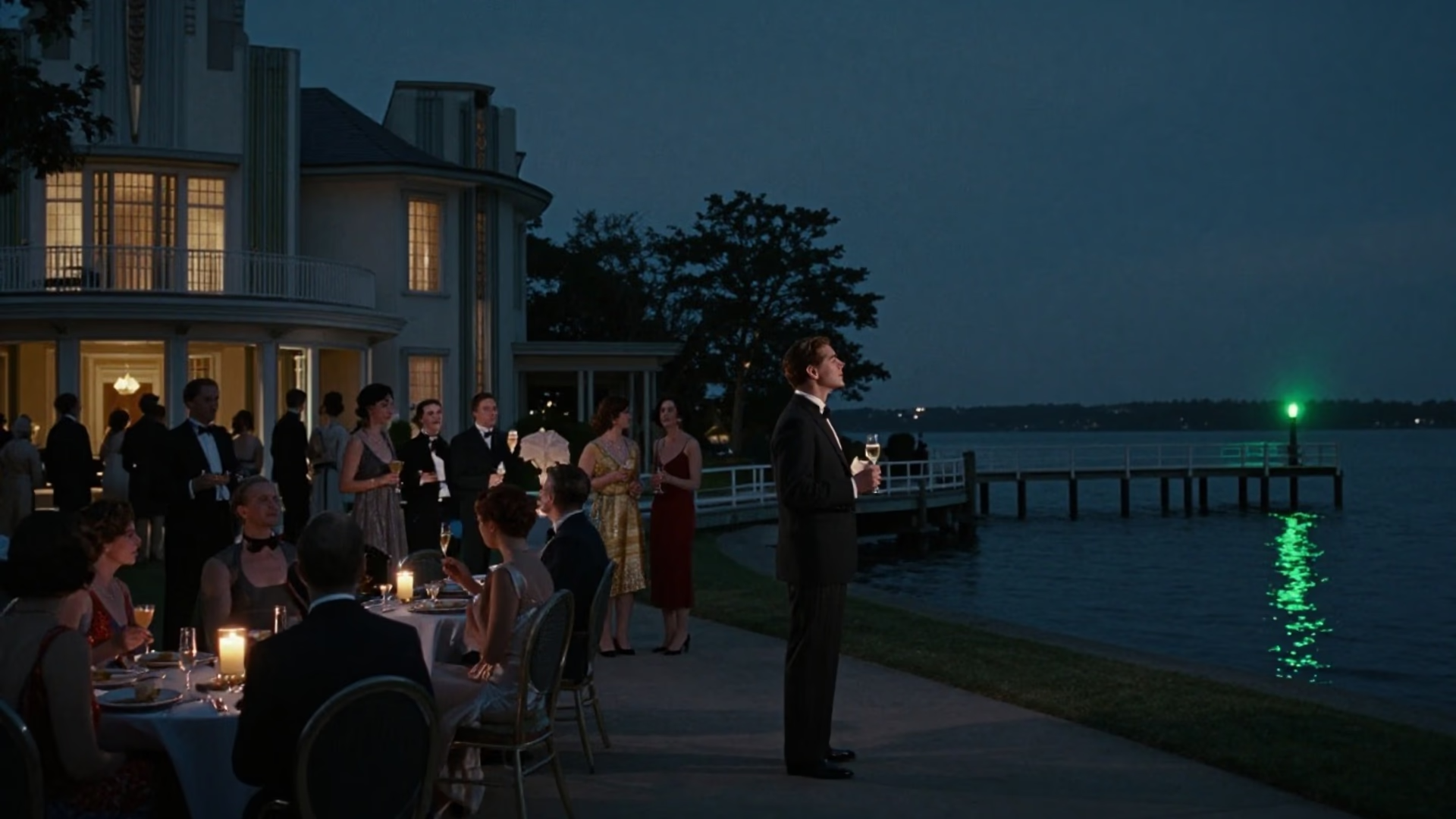
There is a moment near the end of a long pier, just past midnight, when the water turns black as ink and the only thing visible is a single light on the opposite shore. It pulses there, small and patient, neither beckoning nor retreating. Just existing. And in that darkness, with the wooden planks creaking beneath your feet and the smell of salt and money hanging in the humid air, you might understand what it means to want something so completely that the wanting becomes who you are.
This is where we find Jay Gatsby, standing alone on his manicured lawn, arm outstretched toward the green light at the end of Daisy Buchanan’s dock. F. Scott Fitzgerald gives us this image in 『The Great Gatsby』, and nearly a century later, it has not loosened its grip on our collective imagination. The scene is deceptively simple: a man, a light, a body of water between them. Yet Fitzgerald understood that the most profound human experiences often hide inside such elemental frames.
The light is green, the color of money, of envy, of spring things not yet arrived. Gatsby has spent years accumulating wealth, throwing parties for strangers, building a palace of illusions, all for this single vanishing point across the bay. The water separating him from that light might as well be an ocean. It might as well be time itself.
I think about this scene whenever I catch myself staring at something I cannot have, something that seems to glow with a promise I cannot quite articulate. The promotion that would finally prove my worth. The relationship that ended badly and still haunts certain songs. The version of myself I imagined at twenty that has not quite materialized at forty. We all have our green lights, don’t we? Those fixed points that organize our longing, that give shape to the shapeless ache of being human and finite and always, always reaching.
What the Distance Teaches
 Photo by
 The remarkable thing about Gatsby’s obsession is not that he wants Daisy. People fall in love every day, and sometimes that love persists beyond reason or circumstance. What makes his story tragic, what makes it speak to something deeper than romance, is his belief that he can erase the years between them. He wants not just Daisy as she is, but Daisy as she was, the moment before she made choices that did not include him. He wants to rewind the clock, to unmake history, to prove that willpower and wealth can defeat time itself.
“Can’t repeat the past?” he says to Nick Carraway, incredulous. “Why of course you can!”
This is the great delusion at the heart of the novel, and perhaps at the heart of modern ambition. We build our futures on the scaffolding of our pasts, convinced that if we just work hard enough, accumulate enough, perform enough, we can return to some perfect moment and live there forever. The green light promises this return. It whispers that the distance between who we are and who we wish we had been can be closed with sufficient effort.
But Fitzgerald knew better. He lived the contradiction himself, a status-anxious boy from St. Paul who crashed into wealth and celebrity only to find both hollow. The Jazz Age parties, the champagne, the beautiful people, these were the materials of his life and his fiction. Yet even as he documented the glamour, he saw the rot beneath it. His Gatsby is a self-made man in the most literal sense: a reinvention so complete that the original person, James Gatz from North Dakota, simply ceases to exist. And what replaces him is not a person at all, but a monument to longing.
We become monuments to our longings when we mistake the reaching for the arriving, when the pursuit itself becomes our entire architecture.This is the lesson hidden in the space between Gatsby and his light. The distance is not an obstacle to be overcome. The distance is the thing itself. Take it away, and what remains? Gatsby finally gets his reunion with Daisy, finally brings her to his mansion, finally shows her the shirts and the gardens and the orchestrated life he has built in her name. And something dies in that moment. The shirts are just shirts. The light, seen up close, is just a light. The dream requires the water between.
I have felt this collapse, this strange disappointment that arrives precisely when you get what you wanted. The job you fought for that turns out to be just a job. The city you moved to that turns out to be just a city. The person you convinced to love you who turns out to be just a person, complicated and ordinary and nothing like the story you told yourself. We are creatures who need our distances, our spaces of imagination, our green lights pulsing in the dark.
The Dreams We Share
 Photo by
 What makes The Great Gatsby endure is not its portrait of 1920s excess, though the parties and the cars and the mansions retain their seductive shimmer. It endures because Fitzgerald captured something universal about the way we construct meaning from absence. The novel is less about Gatsby than about the structure of desire itself, the way we project our deepest needs onto objects and people who cannot possibly fulfill them.
We do this constantly. We scroll through curated images of other people’s lives and feel that old familiar ache, the sense that happiness exists somewhere just out of reach. We pursue careers that promise significance and discover that significance is not something careers can give. We chase youth, or beauty, or influence, or recognition, and when we catch them, we find ourselves still standing on that pier, still staring at a light across the water, still reaching.
This is not a counsel of despair. Fitzgerald was not telling us to stop wanting things, to abandon our ambitions, to accept mediocrity as our natural state. The reaching matters. Gatsby’s tragedy is not that he dreamed, but that he dreamed too literally, that he confused the symbol for the substance. He thought Daisy was the destination when she was only ever the direction.
Perhaps this is what the green light truly represents: not any particular goal, but the human capacity for hope itself. Nick Carraway sees this clearly in the novel’s famous final passage, linking Gatsby’s private longing to the original wonder of Dutch sailors seeing the fresh green breast of the new world. We are all, in our way, those sailors. We are all Gatsby, standing in the darkness, believing that the light means something, that the reaching will eventually arrive somewhere.
What Remains When the Light Goes Out
 Photo by
 I return to this novel in different seasons of my life and find different things waiting there. In my twenties, I saw a romance and a warning about materialism. In my thirties, I saw a portrait of self-deception and the lies we tell to survive. Now, approaching the middle passage, I see something gentler: a meditation on what it means to hold onto hope when hope has no rational basis.
Gatsby dies without our ever learning whether he still believed. This could be read as delusion, and perhaps it is. But it could also be read as a kind of faith, a stubborn refusal to let the world reduce his longing to mere disappointment. He kept reaching, even when the reaching made no sense, even when everyone around him could see the futility of it. There is something admirable in that, something that speaks to the part of us that refuses to settle, that insists on believing that the light across the water means something true.
So here is the question I cannot answer, the one Fitzgerald leaves us with: Is it better to reach for what we cannot have and fail, or to succeed at wanting less? Is the green light a gift or a curse? Does it illuminate our lives or blind us to what stands right in front of us?
I do not know. But I know that tonight, somewhere, someone is standing at the edge of their own private pier, looking across their own dark water, at their own small and patient light. And they are reaching. And the reaching is everything.