The Question We Carry
What if the most terrifying moment in any life is not the ending, but the beginning?
We speak so often of death, of loss, of the slow fading of things. But there is another kind of threshold that haunts us, one we cross again and again throughout our lives. The moment of emergence. The instant when we step out of the protective waters of who we were and stand, trembling and exposed, as who we are becoming.
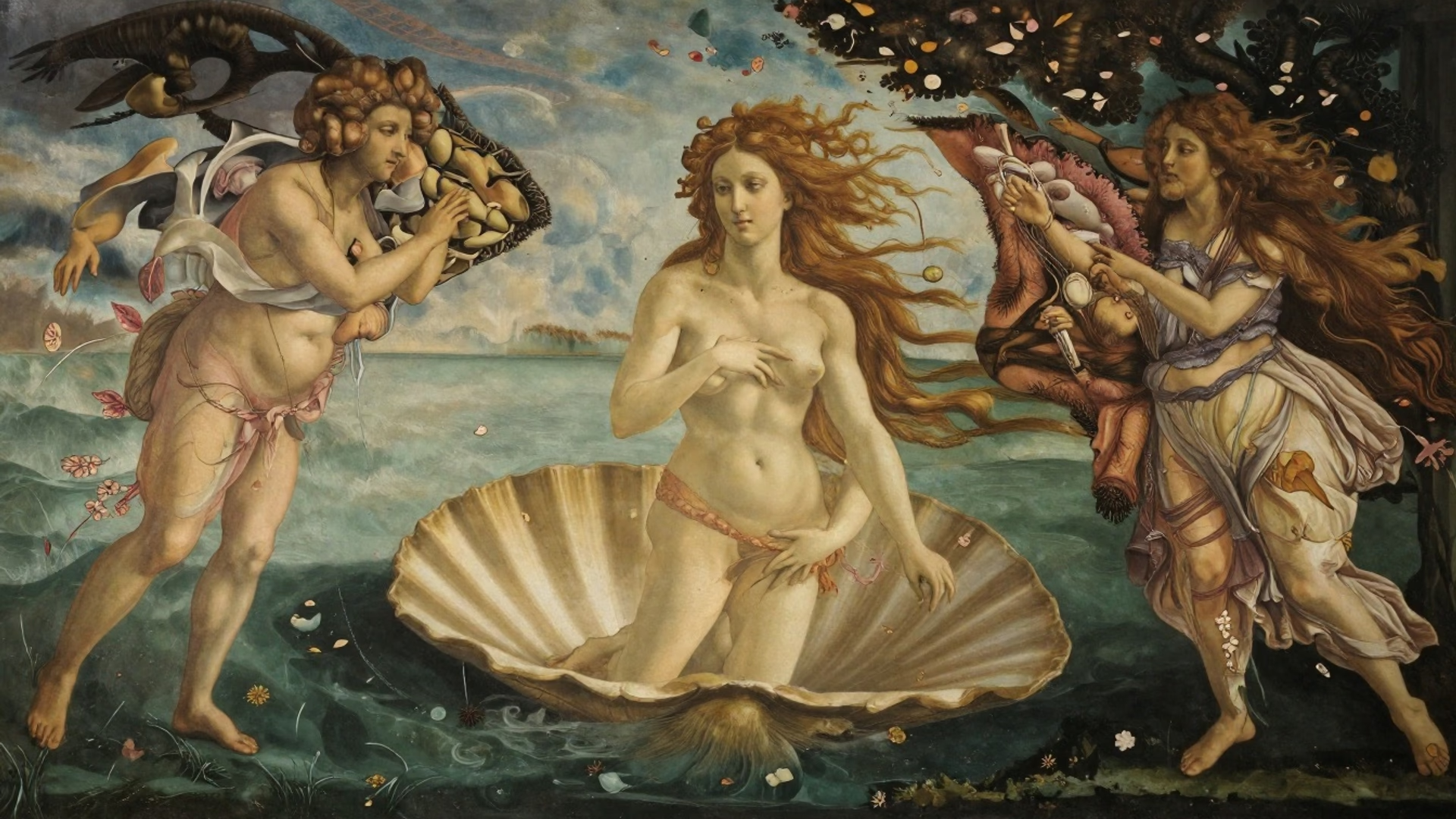
Look at her there, standing on that great scallop shell, one hand raised to cover her breast, the other gathering her hair against the wind. Sandro Botticelli’s 『The Birth of Venus』, painted around 1485 in Florence, captures something that no mirror ever could. Not just the goddess of beauty arriving on the shores of Cyprus, but the universal moment of becoming. She is divine, yes. But she is also afraid. She is radiant, but she is also reaching for something to cover herself. She has just been born from sea foam and catastrophe, from violence and transformation, and now she must meet the world.
Why does this image, over five centuries old, still stop us in our tracks? Perhaps because we recognize ourselves in that posture. We have all stood on some shore, wind howling around us, feeling both magnificent and utterly unprepared for what comes next.
What the Foam Remembers
 Photo by
 The story behind the painting is as layered as the pigments Botticelli mixed on his palette.
In Greek mythology, Venus, or Aphrodite, was not born in any ordinary way. She emerged from the sea foam that formed when Cronus severed his father Uranus and cast the divine remains into the ocean. From violence came beauty. From destruction came love itself. The Greeks understood something we often forget: that new life rarely arrives through gentle means. It tears its way into existence.
Botticelli most probably painted this massive canvas for a member of the Medici family, the great patrons of Renaissance Florence. It was a revolutionary act. For nearly a thousand years, the human body had been hidden away in Western art, draped in shame and piety. The nude was sinful, the flesh a prison for the soul. Then Botticelli looked back to ancient Greece and saw something different. He saw that the body could be sacred. That beauty itself might be a form of prayer.
He worked with egg tempera on canvas, building up thin transparent layers of color until Venus seemed to glow from within. Her skin carries a luminosity that photography cannot quite capture. You must stand before the original in the Uffizi Gallery in Florence to understand. She does not reflect light. She generates it.
The figures surrounding Venus tell their own story. To her left, Zephyr, the west wind, blows her toward shore, tangled with a nymph who may be Chloris or Aura. They are intertwined, their bodies forming a single force of propulsion. To her right waits a Hora, one of the goddesses of seasons, holding out a floral cloak. She is ready to receive Venus, to clothe her, to ease her transition from the elemental world into civilization.
But Venus herself occupies the center, alone. This is the space between. The wind pushes her forward. The shore awaits. But for this suspended moment, she belongs to neither. She is pure potential, balanced on the edge of a shell, carried by forces beyond her control toward a destination she has never seen.
Botticelli’s intent, scholars tell us, was to resurrect the ideals of classical beauty. To show that the Renaissance was not just a rebirth of learning but a rebirth of wonder. The goddess represents the soul arriving in the material world, maintaining her divine beauty even as she enters the realm of time and decay. It is philosophy rendered in paint.
But I think the painting speaks to something older than philosophy. Something we feel in our bones.
Shores We Have Known
 Photo by
 Think of the births you have experienced. Not only the literal ones, though those count too. The moment you walked into a new school for the first time, the hallway stretching endlessly before you, every face a stranger. The first day at a job where you knew no one and nothing, where even finding the bathroom felt like a test. The morning after a divorce was finalized, when you woke up and realized you had to become someone you had never been.
We are born so many times in a single life, and each birth carries its own terror, its own wind, its own waiting shore.I remember a morning years ago, standing outside a building where I was about to give a presentation that would determine the next phase of my career. My hands were shaking. The wind off the street cut through my coat. And I thought, absurdly, of Venus. Of that posture, that reaching for something to cover oneself. I wanted to turn back. To remain in the waters I knew. But the wind was already pushing me forward, and someone was waiting at the door with a metaphorical cloak, ready to help me through.
We underestimate how much courage ordinary life requires. We reserve words like “brave” for soldiers and firefighters, forgetting that every human being faces moments of radical exposure. The teenager who comes out to their parents. The widow who attends her first social event alone. The artist who shows their work for the first time. The patient who receives a diagnosis and must now become a different person, one who lives with this new knowledge.
Venus covers herself not because she is ashamed, but because she is sensitive to what she is. She knows her own power and her own fragility. She is not hiding. She is preparing. There is a difference.
A Different Shore
 Photo by
 So what does Botticelli’s goddess offer us, standing there in the Uffizi, surrounded by tourists and their cameras?
Perhaps this: that emergence is not something we do once and complete. It is a posture we learn to hold. Life will strip away our old selves again and again. We will lose jobs, relationships, identities we thought were permanent. We will wake up in bodies that have changed overnight, in countries that have transformed while we slept, in families restructured by death or distance. And each time, we will find ourselves standing naked on some shore, wind whipping around us, waiting for someone to bring us a cloak.
The gift of this painting is not its beauty, though its beauty is staggering. The gift is its honesty about the nature of becoming. Venus does not stride confidently onto the beach. She arrives carried by forces outside herself. She is delivered, not self-made. And yet she is fully present, fully divine, fully herself. She does not pretend she is not vulnerable. She does not fake confidence. She simply arrives, and in arriving, she transforms the shore itself into holy ground.
There is wisdom here for all of us who fear new beginnings. You do not have to be ready. You do not have to be clothed. You do not have to have figured out who you will be on the other side. You only have to arrive. To let the wind carry you. To trust that someone or something waits on the shore with what you will need.
The foam remembers everything that came before. But Venus faces forward, toward the land, toward the world, toward whatever comes next.
Perhaps the question is not whether we are brave enough to be born again. Perhaps it is whether we are willing to stand, even for a moment, in that space between the water and the shore, neither who we were nor who we will become, but simply and terrifyingly alive.