Time does not melt. We all know this, and yet something in us recognizes the image of a melting clock as deeply, uncomfortably true.
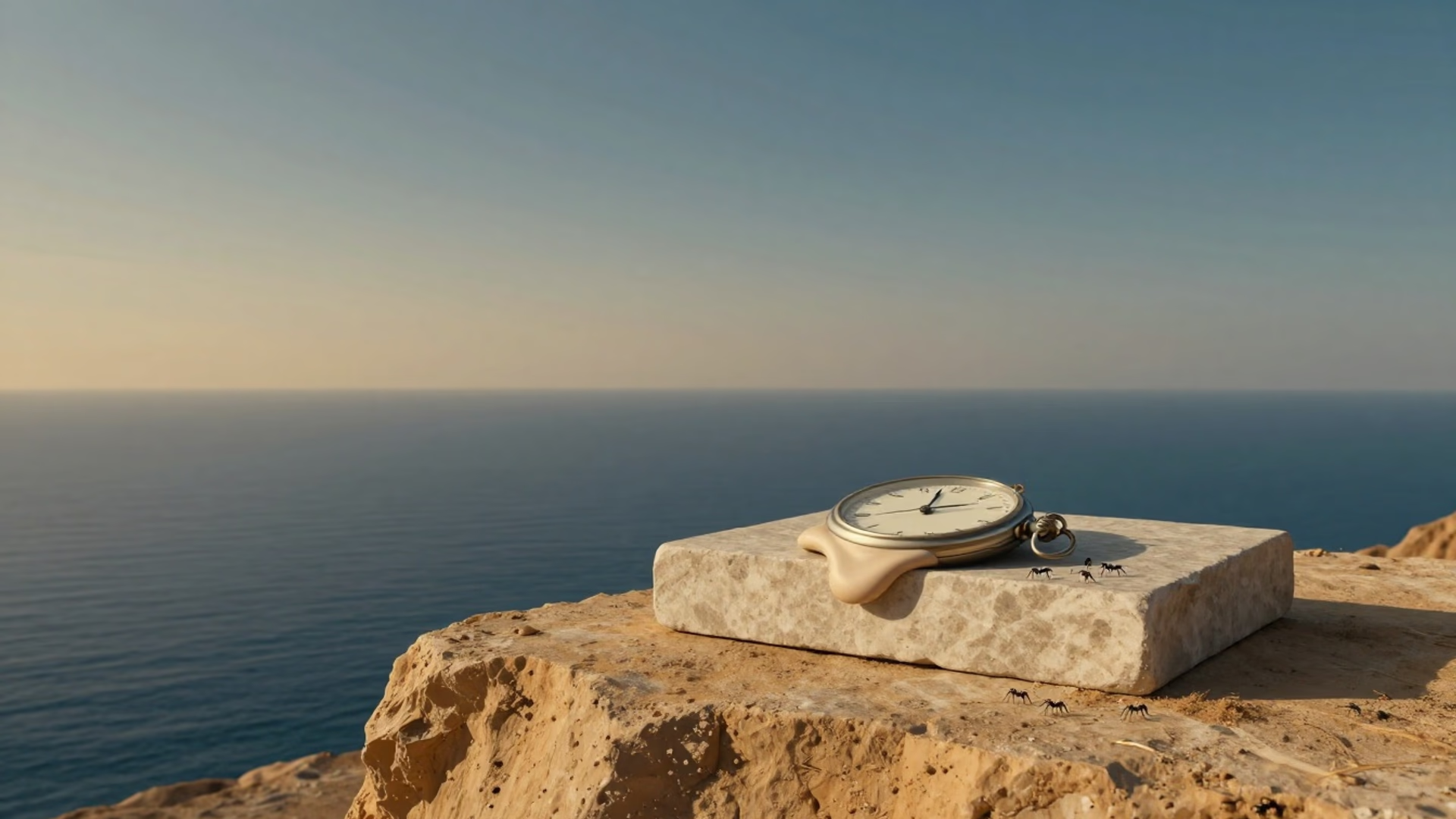
Look at the landscape in Salvador Dalí’s 『The Persistence of Memory』, painted in 1931, and you will find a world drained of all hurry. The cliffs of Port Lligat glow amber in a light that belongs to no particular hour. The sea is still. The sky bleeds from pale gold into a bruised blue, the kind of sky you see when you wake at an hour you cannot name and the room feels like it belongs to someone else. In the foreground, three watches drape themselves over surfaces like exhausted animals. One hangs from the branch of a dead tree, its face sliding downward. Another folds over the edge of a brown rectangular form, oozing toward the ground. A third clings to a fleshy, shapeless figure lying on the sand, a creature that might be sleeping or might be dissolving. Ants swarm the back of a fourth watch, the only one still closed, still hard-cased, as if something alive wants in, or wants to consume what is left of precision.
The air here feels thick. You can almost smell warm stone and the faint sweetness of decay, the way overripe fruit smells in the sun. Nothing moves, and yet everything is in the process of becoming something else. The clocks lose their shape. The land loses its logic. The creature on the ground loses its identity. Even the shadows seem uncertain about which direction to fall.
Dalí reportedly said the idea came to him while staring at a piece of melting Camembert cheese. That origin story feels exactly right. Not a grand philosophical revelation, but a moment of idleness, a warm kitchen, soft cheese on a plate, and suddenly the mind slips sideways into a truth that daytime thinking would never permit. The painting was born not from effort but from the kind of wandering attention that most of us have been trained to distrust.
The Hidden Architecture of Softness
Beneath the strangeness of the image, something precise is happening. The painting is not chaos. It is structured with a quiet, almost mathematical care, the cliffs receding in orderly perspective, the horizontal plane of the shore meeting the vertical edge of the table. The composition follows rules. It is only the clocks, those instruments of measurement and certainty, that refuse to obey.
This tension is where the painting lives. The world holds its shape, but the tools we use to understand it do not. Think about that for a moment. We carry calendars and schedules and five-year plans, and we move through our days as though time is a solid surface beneath our feet. Then something happens. Grief strikes, or love, or illness, or a Tuesday afternoon when the light hits a wall a certain way and you suddenly feel as though you are six years old and sixty years old simultaneously. The clock on the wall keeps ticking, but the time inside you goes soft.
Dalí was steeped in the work of Sigmund Freud, fascinated by the idea that beneath our waking rationality lies a seething, image-drunk unconscious that speaks in symbols and distortions. The melting watches are not illustrations of Freud’s theories so much as they are experiences of them. Looking at the painting, you do not think about the unconscious. You feel it. The ground shifts. The familiar becomes alien.
We spend most of our lives pretending that time is a ruler, straight and rigid, when every honest memory we carry tells us it is more like water, pooling in some places, rushing through others, evaporating before we can cup it in our hands.Consider how memory actually works. An afternoon from twenty years ago can feel closer than last Thursday. A conversation that lasted five minutes can occupy more space in your mind than an entire year of commuting. The moments that matter most to us rarely correspond to the time they consumed. A first kiss, a phone call bearing bad news, the instant you understood something you had been circling for years, these events warp the timeline, pulling it out of shape the way gravity bends light around a star.
The Persistence of Memory does not argue this point. It simply shows it. The watches drape and fold and sag, and we look at them and think: yes. That is what it feels like.
And the creature on the ground, that strange soft form with the closed eye and the long lashes, sleeping or dead or dreaming, is it us? Its shape echoes a profile Dalí used in other works, a kind of self-portrait melted down to its most vulnerable form. It does not stand upright. It does not face the viewer. It has surrendered to the landscape, become part of it. One of the soft watches rests on its back like a blanket, or a parasite. Time does not merely surround this figure. It clings to it, becomes indistinguishable from its body.
Where the Shore Meets the Unnameable
 Photo by
 We all know moments when the logic of waking life quietly collapses. Not dramatic breakdowns, but small slippages. You walk into a room and forget why. You hear a song and the present tense dissolves. You dream about someone you haven’t thought of in a decade, and the dream is so vivid that the next morning their absence feels like a fresh wound. These are the moments when the clocks go soft, when the rigid categories of past, present, and future blur into something more honest and more frightening.
What Dalí’s painting captures is not madness but a kind of radical honesty about how consciousness actually operates. We like to believe we live in linear time, that yesterday leads to today and today to tomorrow in an orderly procession. But sit quietly for five minutes without a task to perform, and watch what your mind does. It leaps. It circles. It drags old images into the present and projects anxieties onto a future that does not yet exist. The mind does not respect the clock. It never has.
This is not a flaw. It may be the most human thing about us. Our ability to fold time, to carry the dead alongside the living, to feel the pull of a moment that hasn’t happened yet, this is what makes us storytellers, artists, lovers, mourners. A creature locked in pure present tense would be efficient but empty. We are inefficient and full.
The painting, for all its strangeness, offers something like permission. Permission to distrust the schedule. Permission to honor the way a Tuesday afternoon can suddenly open into something vast. Permission to admit that the version of time we carry inside us, lumpy and uneven and shot through with emotion, is no less real than the version on our wrists.
 Photo by
 A Small Reckoning
 Photo by
 Dalí painted The Persistence of Memory when he was twenty-seven. It is a small canvas, roughly the size of a sheet of notebook paper. People are often startled by this when they see it in person at the Museum of Modern Art in New York. They expect something enormous. Instead, they find something intimate, nearly private, like overhearing someone describe a dream in a low voice.
Smallness suits it. The most disorienting experiences of time are not the grand ones but the quiet, private ones. Not the milestones, the weddings and graduations, but the in-between moments. The way a hospital waiting room makes an hour feel like a geological age. The way a perfect evening with someone you love compresses into what feels like a single bright minute. The way you can be standing at a kitchen sink and suddenly feel the weight of all the years you have stood at kitchen sinks, and all the years you will.
We do not need surrealism to know that time is strange. We need surrealism to be reminded that we already knew.
Somewhere right now, someone is glancing at a clock on a wall, and the hour it shows has nothing to do with the time they are actually living in.