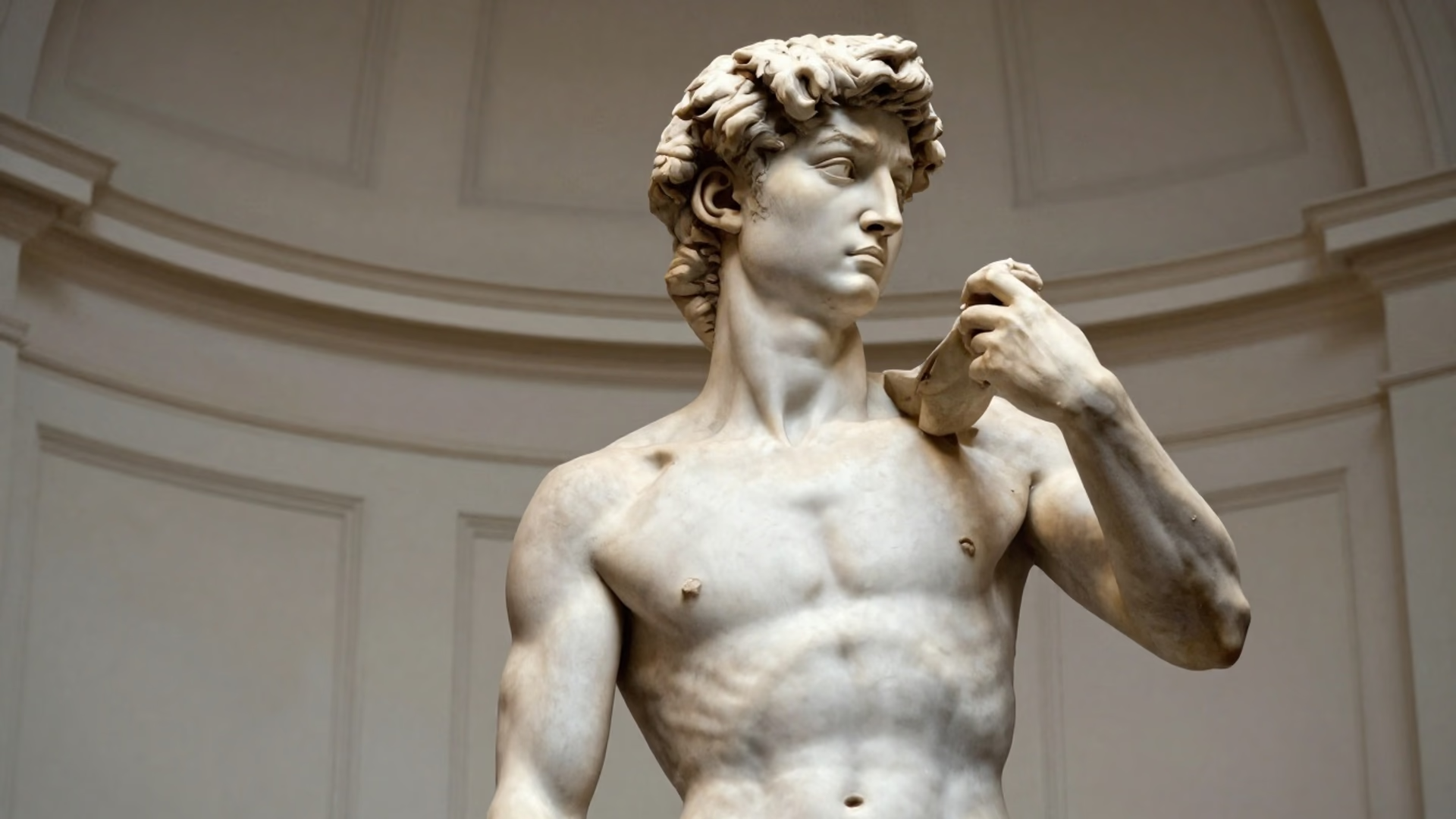
The marble is cold to the touch, even in a Florentine summer. Visitors who have stood close enough describe the strange chill radiating off seventeen feet of Carrara stone, a coolness that seems almost biological, as if the figure were holding its breath. And in a sense, he is.
Look at 『David』 long enough and a contradiction begins to surface, one that has unsettled viewers for over five centuries. Michelangelo carved a body of impossible composure, every muscle rendered with a precision that borders on medical, the veins on the back of the hand raised just so, the torso twisting with the casual grace of someone who has all the time in the world. Yet the eyes tell a completely different story. They are wide, locked on something we cannot see, and the brow is furrowed with a tension that no amount of physical perfection can conceal. The body says calm. The face says terror. This is not a portrait of triumph. It is a portrait of the second before triumph becomes possible, or impossible, and no one yet knows which.
We live inside that contradiction more often than we admit.
Between the Steadied Hand and the Racing Heart
Consider the two readings of David that have competed for centuries. The first sees the sculpture as a celebration of the human form at its apex, a Renaissance hymn to what the body can be when idealized by genius. This is the David of postcards and refrigerator magnets, the icon of beauty, symmetry, and classical proportion. Generations of art students have sketched his contours to learn the rules of anatomy. He stands as proof that the human body, rendered faithfully enough, becomes its own kind of argument for meaning in the universe.
The second reading looks past the surface and finds something far less comfortable. This David is afraid. His right hand, the one that will release the stone from the sling, is oversized, almost grotesquely so, and it grips with a force that betrays the rest of his relaxed posture. The tendons in his neck are pulled taut. His weight shifts onto his back foot, not in relaxation but in preparation, the coiling of energy that precedes a violent, irreversible act. Michelangelo chose to depict not the aftermath of victory, as Donatello and Verrocchio had done before him, but the unbearable moment of decision. The giant is still standing. The outcome is still uncertain.
Both readings are true. That is what makes the sculpture devastating.
We know this duality in our own skin. Think of the morning before a conversation you have rehearsed a hundred times, the one where you must say the thing that changes everything. Your hands are steady when you pour your coffee. You button your shirt with ordinary precision. Anyone watching would see composure. But inside, the blood is loud in your ears, and every cell is oriented toward a single approaching moment. You are marble on the outside and fire within.
Or think of the athlete in the tunnel before the match, bouncing lightly on the balls of their feet, face blank, breathing controlled. The body has been trained into stillness. The mind has not. The mind is a wild animal pacing in a cage, and the cage is discipline, and discipline is the only thing standing between poise and panic.
The bravest thing a person can look like is calm, because calm in the face of enormity is always a lie the body tells on behalf of the will.Michelangelo understood this with an almost frightening clarity. He was twenty-six years old when he completed the sculpture, working on a block of marble that two other sculptors had already abandoned as unworkable. The stone was too narrow, too shallow, riddled with imperfections. It had sat in the cathedral workshop for decades, a monument to failure. And the young sculptor looked at it and saw not limitation but a figure waiting to be freed. There is something of David in that act itself, the willingness to face a material that others had declared impossible and say: I see something in here that you missed.
What Giants Look Like When You’re Close Enough to Count Their Teeth
 Photo by
 The biblical story is familiar to the point of cliché. A shepherd boy faces a warrior giant. Brains beat brawn. The underdog wins. We tell it to children so they will believe the world rewards cleverness and courage. But stand in front of the actual sculpture and the comfortable moral dissolves. This David is not clever. He is not smiling with the confidence of someone who has figured out the trick. He is terrified and resolved in equal measure, and the sculpture insists that these two states are not opposites but companions.
This tension resonates across every era because every era produces its own giants. In fifteenth-century Florence, the giant was political tyranny, and the city placed David in front of the Palazzo della Signoria as a warning to despots. The sculpture was civic armor, a declaration that the republic would defend itself against any Goliath, foreign or domestic. Centuries later, the giant shifted shapes. It became industrialization, then fascism, then the nameless dread of nuclear annihilation, then the creeping algorithmic erosion of individual agency. The giants change. The posture of the person facing them does not.
What persists is the recognition that courage is not the absence of fear but fear’s most disciplined performance. Every generation rediscovers this, and every generation is briefly shocked by the discovery, as if it were new. A young woman stepping into a courtroom to testify against power. A scientist publishing findings that dismantle a comfortable consensus. A parent sitting beside a hospital bed, face composed, voice even, while everything inside screams. They are all standing in David’s posture, weight on the back foot, eyes fixed on something enormous, hand gripping the only weapon they have.
And the weapon is often absurdly small. A sling and a stone against a giant in bronze armor. A single voice against an institution. A brushstroke against oblivion. The disproportion is the point. Michelangelo did not give David a sword or shield. He gave him a strip of leather and a rock, and he made the boy beautiful, not to diminish the danger but to heighten it. Beauty facing destruction is the oldest dramatic engine we have, and it still works because we still feel it in our throats when we see it.
The sculpture has survived earthquakes, political upheaval, an attack with a hammer in 1991 that chipped the toes of the left foot. It has been cleaned, moved, enclosed in a purpose-built tribune at the Galleria dell’Accademia, and surrounded by crowds that sometimes number in the thousands on a single afternoon. Through all of it, the expression has not changed. The eyes are still wide. The hand still grips. The stone has not yet left the sling.
 Photo by
 The Moment That Never Ends
 Photo by
 Perhaps this is why the sculpture feels so alive after five hundred years. It captures a moment that, by its nature, refuses to resolve. Michelangelo froze David in the eternal present tense of decision, and decision is the one human experience that never becomes historical. It is always happening to someone, right now, in a hospital waiting room or a courtroom corridor or a kitchen at two in the morning. The before is where we actually live most of our lives, in the breath before the act, and it is far more honest than the after.
We build monuments to victors. We write histories of outcomes. But the truest portrait of human experience is not the moment of triumph or defeat. It is the moment just before, when both possibilities are real and the body is trying to hold itself together long enough to choose. David does not show us what it looks like to win. He shows us what it looks like to decide that you will try.
Walk through any city, and you will see people wearing that same face, the composed exterior over the racing interior. The student opening the envelope. The entrepreneur signing the lease. The lover reaching for the phone. They do not look heroic. They look ordinary. And that is the most radical thing Michelangelo ever proposed: that the heroic and the ordinary are the same posture, the same oversized hand clenching around the same fragile weapon, the same wide eyes fixed on the same approaching enormity.
Somewhere tonight, in a room you will never see, someone is standing with their weight on their back foot, breathing slowly on purpose, holding steady against something vast. The marble is cold. The hand grips. The stone has not yet left the sling.